Weimaraner
Breed Guide
Fast, athletic, intensely people-oriented, and built for work, the Weimaraner is a true German hunting breed. Its speed, stamina, environmental confidence, and drive to move can all matter when a dog slips away.
5 min read · Practical pet-owner education with recovery-focused guidance
Overview
The Weimaraner is a German hunting breed of medium to large size with a long-established reputation for speed, stamina, courage, and intelligence. Long valued as an all-purpose gun dog, it is also widely known as Germany’s sleek and swift “Gray Ghost,” a nickname that reflects both its athletic beauty and its need for plenty of exercise and human connection.
That combination is important. The Weimaraner is not just a pretty silver dog with a lot of energy. It is a purpose-built field animal designed to move decisively, cover ground efficiently, notice scent and visual cues quickly, and stay mentally engaged with the environment. Even when kept purely as a companion, the old hunting template remains visible.
In daily life, Weimaraners often feel intensely human-oriented. Many are affectionate, clingy, expressive, and highly bonded to their people. But the breed’s attachment should not be mistaken for passivity. A Weimaraner can be deeply attached and still move fast, roam far, and become difficult to interrupt once arousal and motion take over.
For TailTracker, this makes the breed especially relevant. A loose Weimaraner may not behave like a cautious yard dog or a nearby hide-and-freeze companion. It may transition very quickly into purposeful forward movement, especially if open terrain, prey cues, trails, or momentum-rich environments are available.
Physical Characteristics
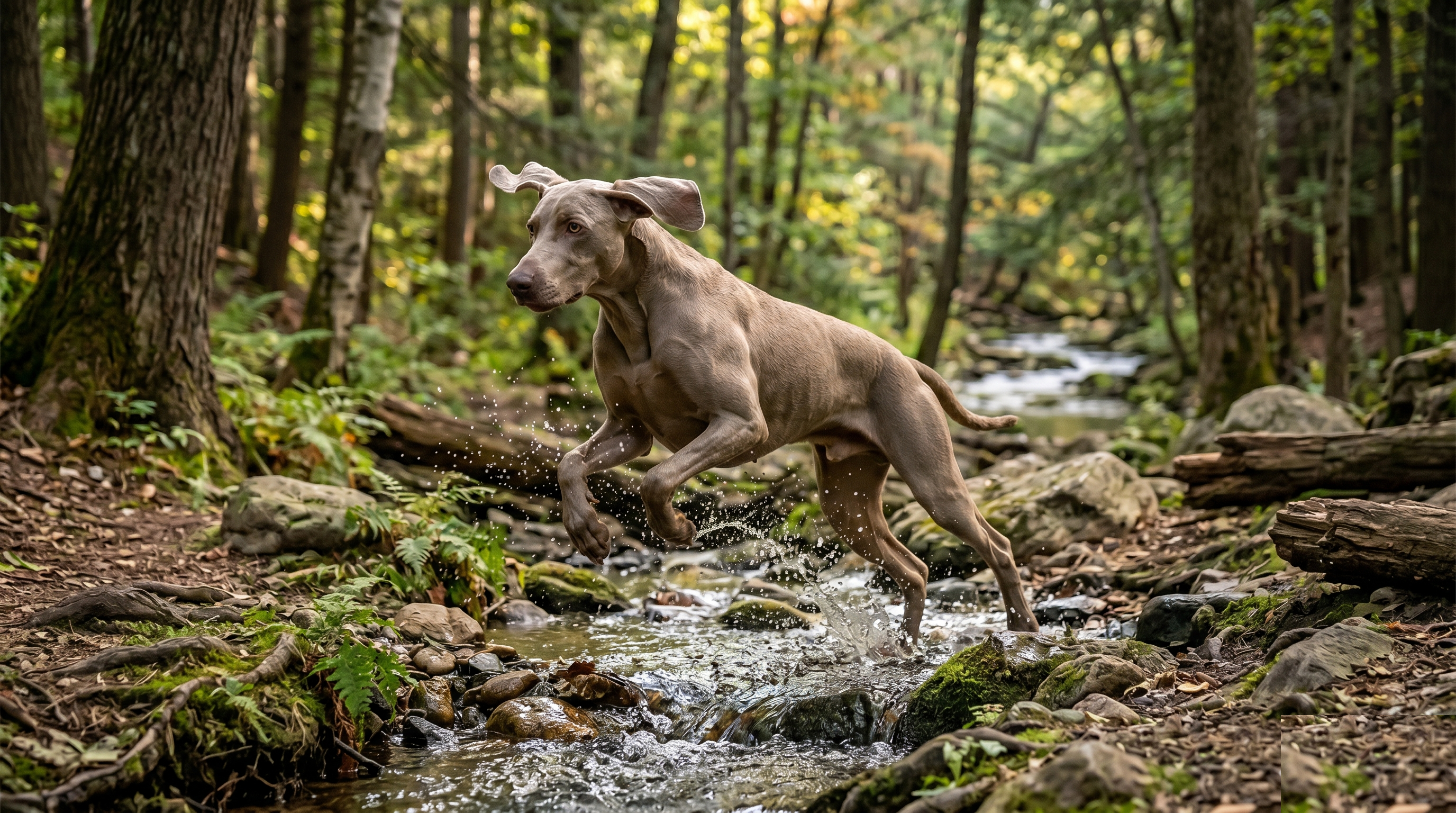
The Weimaraner is long-limbed, smooth-coated, deep-chested, and visibly built for athletic performance. It carries itself with a kind of tensile readiness that experienced handlers recognize immediately: this is a dog made to launch, extend, and continue moving.
The breed’s coat is most famously silver-gray, though the exact shades range from mouse-gray to silver-gray and related intermediate tones. Both short-haired and long-haired coats exist, though the short-haired form is what most people picture first.
Amber eyes, pendant ears, and a sleek outline give the Weimaraner its distinctive visual identity, but the recovery-relevant details are more practical: powerful rear drive, excellent ground coverage, high environmental confidence, and a body capable of carrying speed for longer than many owners expect.
This matters when lost. A fast dog with a physically efficient stride, low coat drag, and strong field conditioning can turn a short head start into a materially larger search zone within minutes.
Personality & Temperament
Weimaraners are commonly described as friendly, obedient, and highly attached to their humans, but those words only tell part of the story. The breed is also intense, driven, alert, and often restless when underworked. They are loyal, smart, active, and in need of substantial exercise, but that same high-engagement temperament can become operationally challenging once a dog is loose.
Many Weimaraners are highly social with their own people and can be emotionally transparent at home. They may follow owners room to room, react quickly to routine change, and show a near-constant desire for involvement. This deep social attachment is real, but it coexists with strong movement drive and substantial environmental responsiveness.
In practical terms, the breed often does not merely notice the world—it engages it. Birds, squirrels, trails, running figures, openings, shoreline lines, scent drift, and motion cues can all become action prompts. Once that engagement begins, the dog’s decision-making can shift from handler-focused to field-focused very quickly.
That is one reason the Weimaraner can be deceptively difficult in recovery. Owners may assume that because the dog loves them, it will naturally come back. Sometimes that is true. But a high-arousal Weimaraner in open space may continue forward despite strong attachment, especially if the dog is young, fit, excited, and still mentally in pursuit mode.
Living With This Breed
Living with a Weimaraner means living with a dog that typically needs far more than a casual walk and a fenced yard. This breed often thrives on structured exercise, training, scent work, retrieval, running, advanced obedience, hunting-related outlets, or other forms of serious engagement. Without that outlet, boredom can become destructiveness, vocal frustration, frantic energy, or opportunistic escape behavior.
These dogs are often intensely people-oriented indoors but highly movement-oriented outdoors. That split can catch owners off guard. A dog that seems deeply velcro-like in the house may still become a very different animal when a gate opens, prey flashes, or a new path presents itself.
The breed also tends to do poorly with neglect, under-stimulation, or long idle isolation. Many Weimaraners do not merely prefer involvement; they expect it. When that expectation is unmet, their behavior can become louder, more impulsive, and less stable. That makes proactive management especially important.
For lost-dog prevention, secure fencing, door discipline, line management, recall practice, and careful handling during transitions matter more than owners of quieter breeds often realize. This is a dog that can exploit a five-second mistake.
History
The Weimaraner originated in Germany, in the region associated with the city of Weimar, and has documented breed history reaching back at least to the nineteenth century. The breed was recognized as distinct in 1891, and an official breed association was established shortly afterward.
Historically, the Weimaraner was developed as a versatile hunting dog capable of tracking, pointing, flushing, and retrieving. That versatility is not a decorative footnote. It means the breed was selected not for one narrow behavioral trait but for a package of field competencies: range, intelligence, cooperation, courage, and sustained working motivation.
The breed came close to extinction in the early twentieth century and had to be reconstituted from surviving examples, which makes its preserved working identity even more notable. In Germany, breed tradition has long emphasized that the Weimaraner is fundamentally a hunting dog, not merely a casual companion.
That historical stance helps explain why so many modern Weimaraners still feel “all-purpose” in the field. Even when not used for hunting, they often retain the full behavioral toolkit that made them valuable there in the first place.
Grooming & Health
Grooming needs for the short-haired Weimaraner are usually moderate compared with heavier-coated working breeds. The coat is sleek and relatively easy to maintain, though regular brushing still helps remove dead hair and keep the skin and coat in good condition. Long-haired individuals require somewhat more attention.
The more significant daily-care issue is usually not coat maintenance but whole-dog management: exercise, conditioning, joint stress, mental stimulation, and safe handling of a dog that often wants to be moving. A physically underworked Weimaraner may become behaviorally harder to live with, and a physically overconfident one may become harder to contain.
Several health concerns are associated with the breed, including neurologic and ophthalmic issues, as well as certain other inherited or predisposed conditions. A 2024 UK study placed the median lifespan at 12.8 years, close to the broader purebred average.
Owners and breeders should think proactively about veterinary care, structural health, and safe conditioning. This is a breed whose working frame and drive can mask fatigue or create overuse risks if common sense is replaced by “he still wants more.”
TailTracker Recovery Insight
The Weimaraner is one of the clearest examples of a breed whose lost-dog profile is shaped by forward movement. TailTracker models this breed as high in environmental confidence, high in terrain efficiency, high in speed potential, and moderate-to-high in owner orientation. That combination creates a dog that may remain emotionally bonded while still moving away rapidly and decisively.
Compared with a German Shepherd, the Weimaraner is usually less boundary-anchored and less watchfully territorial. Compared with a Beagle, it may be less purely scent-locked but more visually and kinetically pulled by movement and open range. Compared with a retriever, it is often leaner, faster, and more likely to stretch the search footprint quickly when under arousal.
A loose Weimaraner may follow trails, field edges, shoreline lines, deer paths, bike routes, runners, birds, or any other environmental channel that rewards continued motion. In the first phase after escape, the breed often does best when searchers think in terms of likely travel corridors rather than assuming the dog has stopped and hidden close by.
The good news is that many Weimaraners remain highly relationship-sensitive. The bad news is that relationship alone may not override momentum. Recovery often depends on intercepting the movement pattern before it becomes a long-distance pattern.
If This Breed Goes Missing
Think speed, reach, and travel channels first. A Weimaraner may not spend much time dithering near the point of escape if there is open terrain, prey activity, or a route that encourages continued movement. Many will travel farther, faster, and more efficiently than owners expect.
- Search outward along the dog’s likely movement lanes: trails, field edges, shoreline paths, roads with wide shoulders, drainage lines, bike routes, and other continuous corridors.
- Check high-stimulation terrain early. Birds, woods, open fields, wildlife edges, and places with active scent or motion can keep a Weimaraner moving forward instead of circling back.
- Use the dog’s primary handler and avoid chaotic group pursuit. A pressured Weimaraner may continue extending range instead of slowing down to reconnect.
- Think interception, not just recall. With this breed, physically getting ahead of the movement logic can matter more than repeatedly calling from behind.
- If sighted, do not assume a direct rush is wise. Some Weimaraners will come in readily to trusted people, but others will widen if the approach feels abrupt or blocks the dog’s options.
Recovery is often strongest when searchers act quickly, map the outward pattern, and make strategic use of sightings, routes, and human geography before the dog’s radius becomes much larger.
Fun Facts
The Weimaraner’s “Gray Ghost” nickname reflects not just the coat color but the breed’s sleek, fast, almost gliding appearance in motion.
Although many people think of the breed as a modern elegant companion, the Weimaraner was preserved as a serious, versatile gun dog with a broad working skill set rather than a narrow single-purpose role.
In Germany, breed culture historically emphasized working function so strongly that the breed was explicitly framed as a hunter’s dog first, not simply a general-purpose household pet.
Famous Examples
Man Ray’s Weimaraners, photographed by William Wegman, helped make the breed visually iconic in modern popular culture. Those portraits turned the Weimaraner’s unusual elegance and expression into a widely recognized artistic signature.
Historical German hunting Weimaraners are just as important as celebrity examples. The breed’s true fame rests on generations of versatile field dogs selected for courage, stamina, and all-purpose usefulness rather than ornament alone.
Modern working and sport Weimaraners continue to show why the breed’s operational identity matters. Even in non-hunting homes, their physical and behavioral design still reflects that history.
Frequently Asked Questions
Are Weimaraners likely to run far when loose?
They can. Their athletic structure, field drive, and comfort in motion mean some individuals can extend their search radius quickly, especially in open terrain or along trails.
Do Weimaraners come back because they are people-oriented?
Sometimes, but not reliably enough to assume safety. Many remain highly bonded while still continuing forward under excitement, prey interest, or environmental pull.
What is the biggest recovery mistake with a loose Weimaraner?
Underestimating speed and delaying route-based search. Waiting too long or searching only close to the escape point can let the dog’s working stride turn a local problem into a much larger one.
Build a smarter recovery plan before your dog ever slips away.
TailTracker helps you organize your dog’s profile, routines, behavior clues, and recovery priorities so you can act faster in the moments that matter most.
Built to help reunite lost pets with the people who love them.