German Shorthaired Pointer
Breed Guide
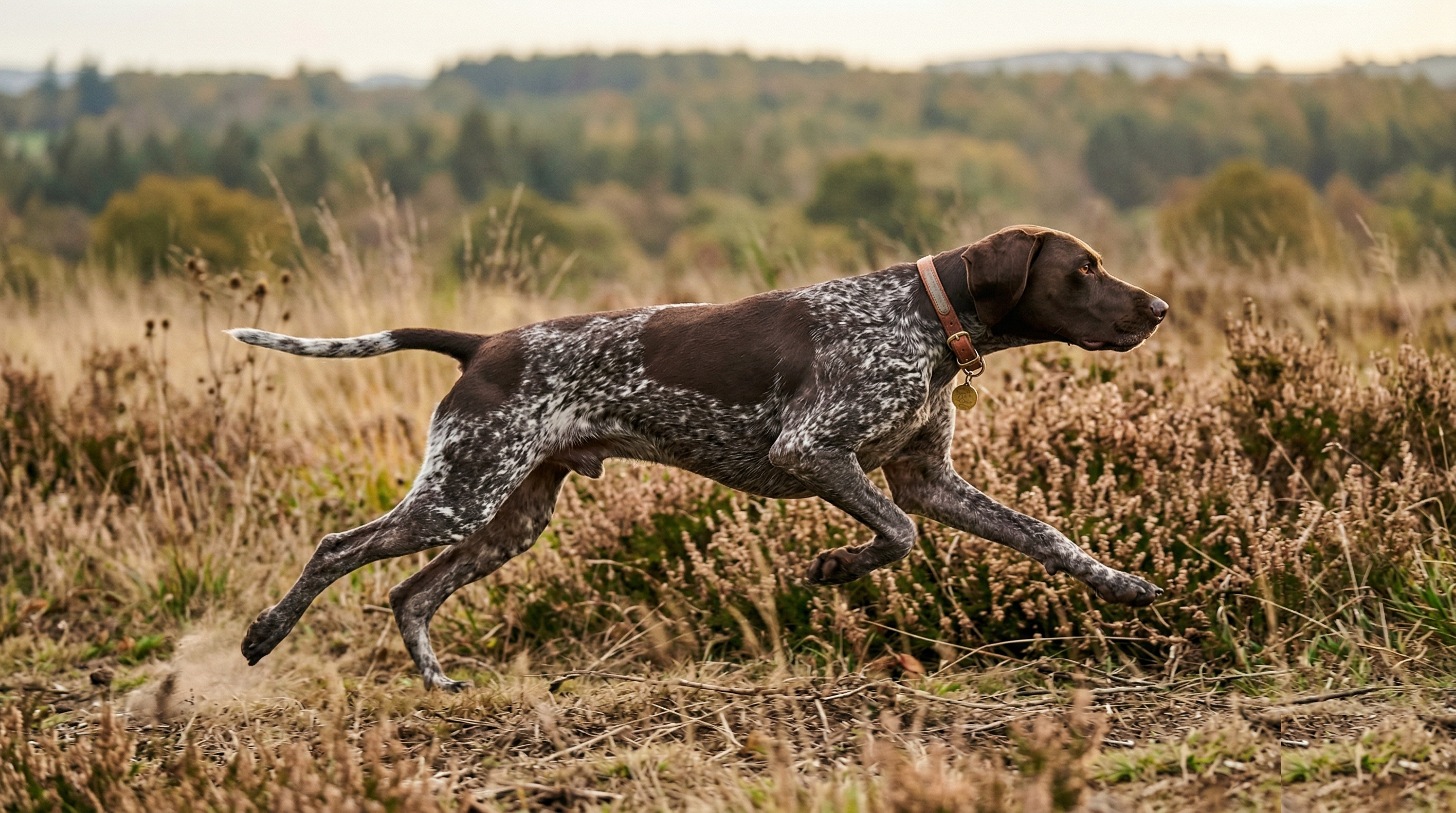
Athletic, driven, and intensely functional, the German Shorthaired Pointer is a versatile sporting dog built to cover ground. Its lost-dog profile is shaped by speed, scent, momentum, and working instincts that can keep it moving long after many companion breeds would stop.
6 min read · Practical pet-owner education with recovery-focused guidance
Overview
The German Shorthaired Pointer, often called the GSP, is one of the great all-purpose sporting breeds. Developed in Germany in the nineteenth century, it was bred to be a dog that could do nearly everything a hunter might need: locate game, point, retrieve on land, retrieve in water, follow scent, and work across different terrain and weather conditions.
That versatility still defines the breed today. Even when kept purely as a companion, the German Shorthaired Pointer often retains the physical stamina, curiosity, and task orientation of a serious working dog. This is a breed that tends to experience the world in motion.
For TailTracker, that matters enormously. A lost GSP is often not behaving like a casual pet who wandered a few blocks and stopped. This breed is more likely to continue traveling with purpose, especially if scent, wildlife movement, field edges, trails, or open ground are involved.
Personality & Temperament
German Shorthaired Pointers are typically energetic, intelligent, eager, and highly people-connected. They often form strong bonds with their families and can be affectionate and cooperative in the home, but beneath that companionable side sits a powerful working engine.
Many GSPs are happiest when they have a job, a routine, or a clear physical outlet. They are often responsive, trainable, and enthusiastic, but they can also become overstimulated, impulsive, or restlessly inventive if under-exercised. Their confidence is usually athletic rather than defensive. They tend to investigate rather than withdraw.
In recovery terms, that means a loose GSP may move forward decisively rather than hiding immediately. It may keep ranging, follow fresh scent, and continue through fields, brush lines, utility corridors, shorelines, or trail systems long enough to widen the search area quickly.
Living With This Breed
Living successfully with a German Shorthaired Pointer usually means understanding that exercise is not optional enrichment for this breed. It is part of the breed’s emotional and behavioral stability. A GSP generally needs much more than a quick leash walk and basic indoor companionship.
These dogs often thrive with running, hiking, training, scent work, field activities, retrieving games, and structured outdoor time. Their short coat is practical and relatively low-maintenance, but their minds and bodies are not low-maintenance at all.
Owners who do well with the breed usually embrace movement, training, and outlet-based living. Owners who underestimate the breed’s drive may find themselves dealing with escape attempts, overexcitability, or chronic frustration behaviors. Those same realities help explain why a GSP loose in the wrong moment can turn into a distance case very quickly.
History
The German Shorthaired Pointer originated in Germany and descends from continental pointing dogs of Braque type. Breed history traces its deeper ancestry back through older European pointing dogs, with later development shaped by the needs of hunters who wanted one dog that could perform multiple field tasks well.
By the late nineteenth century, Germany had moved toward formalizing standards for native hunting breeds, and the Deutsch Kurzhaar emerged as one of the established national types. The first stud book for the breed was published in 1897, and the breed was later recognized by major kennel bodies internationally.
In the United States, the American Kennel Club recognized the breed in 1930. In modern times, the GSP has become known not only as a hunting dog but also as a high-performance competitor in agility, obedience, dock diving, and working detection roles.
Famous German Shorthaired Pointers
German Shorthaired Pointers are more visible in sporting and working circles than in toy-breed celebrity culture, but the breed has produced several notable public moments.
One of the most prominent came in 2016, when a three-year-old German Shorthaired Pointer named CJ won Best in Show at the Westminster Kennel Club Dog Show, giving the breed a widely recognized moment on one of the biggest stages in American dogs.
The breed is also notable for its real-world utility beyond conformation. German Shorthaired Pointers have been used in dog sports, in structured field work, and in some law-enforcement nosework settings, reflecting the breed’s enduring reputation for drive and versatility.
More broadly, the most “famous” GSPs are often the ones known within hunting, field, and active-dog communities: dogs remembered for range, steadiness, retrieval ability, trainability, and the athletic charisma that makes the breed so distinctive.
TailTracker Recovery Insight
The German Shorthaired Pointer is a momentum breed. In practical recovery terms, that means the dog’s first loose movement matters a great deal. This breed can convert an accidental escape into a rapidly expanding search pattern because it is physically capable, environmentally confident, and strongly motivated by scent and forward motion.
Unlike some small companion breeds that are often recovered very close to the point of escape, a loose GSP may continue traveling through connected terrain: field margins, farm roads, conservation trails, drainage corridors, woodland edges, marsh access routes, shorelines, or suburban greenbelts. These dogs often move in purposeful lines rather than random circles.
TailTracker therefore models the breed as a dog that may start with owner attachment but quickly transition into self-directed ranging behavior if stimulation is high. Recovery often depends on directional intelligence, early sighting mapping, and terrain-based prediction rather than relying only on calling, waiting, or neighborhood door knocks.
If This Breed Goes Missing
With a German Shorthaired Pointer, time and direction matter more than many owners expect. This is often not a “check under the porch and wait” breed. If the dog leaves with speed and confidence, the search must expand intelligently and early.
- Start with the exact direction of travel, not just the point of escape. Early movement line is often more valuable than a tight circular search.
- Check open terrain fast: trails, woods edges, athletic fields, farm roads, marsh paths, utility cuts, shoreline access, and other corridors a driven sporting dog might naturally follow.
- Map sightings immediately. For this breed, multiple sightings can reveal a directional pattern rather than isolated random appearances.
- Use calm handling if the dog is visual. A stimulated GSP may arc wide, continue moving, or avoid direct interception if it feels chased.
- Do not assume it will remain close simply because it is owner-bonded. Working momentum can temporarily overpower homeward decision-making.
The most common mistake with a loose GSP is waiting too long to think like a field dog. If the dog launched with energy, the search should quickly account for terrain, scent opportunities, and connected travel routes rather than staying overly anchored to the home block.
Health & Practical Care
German Shorthaired Pointers are generally regarded as robust, athletic dogs, and a recent UK study placed median longevity for the breed at 13.4 years, slightly above the all-dogs average in that study. Even so, the breed is associated with several health concerns owners should understand.
Reported breed-associated issues include certain neurological conditions as well as disorders such as cataracts, cruciate injury, progressive retinal atrophy, hereditary lupoid dermatosis, Von Willebrand’s disease, and some other inherited or predisposed conditions. As with many athletic breeds, practical wear-and-tear matters too: cuts, strains, paw injuries, overexertion, and environmental exposure are part of real-life management.
The breed’s short coat is easy to maintain, but active-lifestyle care is not. Secure containment, recall work, field-safe exercise, and thoughtful outlet planning are central to responsible ownership. Those same measures also reduce the chance that a loose event becomes a long-range recovery case.
Frequently Asked Questions
Are German Shorthaired Pointers likely to run far when loose?
They can be. Compared with many companion breeds, GSPs have a much higher capacity to keep moving with purpose, especially if scent, wildlife, or open terrain is involved.
Will a GSP come when called if it gets loose?
Sometimes, but not reliably enough to build your recovery plan around it. High arousal, field drive, and environmental stimulation can override recall even in otherwise well-trained dogs.
What is the biggest recovery mistake with a loose German Shorthaired Pointer?
Staying too local for too long. If the dog left with speed and direction, owners often lose valuable time before shifting to corridor-based search logic and directional sighting analysis.
Be ready before an emergency.
TailTracker helps owners prepare before a pet goes missing, so they can act faster with a clearer plan if the unthinkable happens.
Most lost-pet tools broadcast alerts.
TailTracker coordinates the recovery.