Border Collie
Breed Guide
Brilliant, intense, and highly movement-sensitive, the Border Collie is a true working herder whose lost-dog behavior is often shaped by familiar routes, constant scanning, handler orientation, and a powerful response to motion.
8 min read · Practical pet-owner education with recovery-focused guidance
Overview
The Border Collie is a medium-sized British herding dog developed along the Anglo-Scottish border from the traditional working collies of the British Isles. It remains most closely associated with sheep work, stock handling, sheepdog trials, and modern performance sports, and it is widely regarded as one of the most trainable and cognitively intense dog breeds in the world.
Breed descriptions often focus on intelligence, but intelligence alone does not explain the Border Collie. The defining qualities are attention to motion, rapid pattern recognition, responsiveness to directional cues, and an ability to remain mentally engaged over sustained periods of work. In practical terms, this is a dog built not merely to move, but to read movement.
For TailTracker, that makes the Border Collie especially important. A lost Border Collie often does not behave like a random roaming dog. Many move in ways that reflect familiar routes, the layout of the area, handler expectation, or attraction to moving people, animals, bicycles, vehicles, fields, and other open working spaces. That can make them highly recoverable if searched correctly—and frustratingly difficult if searched like an ordinary pet.
Personality & Temperament
Border Collies are typically intense, observant, responsive, and mentally active. They are often deeply bonded to their people and highly sensitive to routine, tone, and movement. Many are affectionate and eager to work with familiar handlers, but they are not usually best understood as casual low-demand family dogs.
A great Border Collie often appears to be watching everything at once. That attentional style is not an accident of personality—it is part of the breed’s functional design. Traditional stock work rewards eye contact, pressure control, directional awareness, distance response, and the ability to manage movement calmly and precisely. The famous Border Collie “eye” reflects this deep visual and behavioral focus.
In home life, that same wiring may show up as intense ball fixation, sensitivity to bicycles or joggers, herding behavior around children or other pets, difficulty settling without enough stimulation, or rapid response to openings and changes in the environment. When loose, those traits can turn into a very specific recovery challenge: the dog may continue following motion, paths, or job-like patterns long after an owner expects it to stop.
Living With This Breed
Living well with a Border Collie usually means giving the dog meaningful structure, not merely exercise. These dogs often require regular mental work, clear routines, training, and controlled outlets for their energy and attention. For many, a backyard alone is not enough. In fact, under-stimulated Border Collies can become obsessive, vocal, destructive, or escape-prone precisely because their minds keep searching for a task.
This breed often shines in agility, flyball, disc, tracking, obedience, and sheepdog trial work, but those are not just hobbies—they are examples of what the breed was designed to enjoy and process. That same working profile also means many Border Collies are unusually quick to exploit a gate left open, bolt after motion, or continue along a familiar walking loop, fence line, trail, or field edge without hesitation.
Successful ownership usually includes reliable fencing, strong recall work, enrichment, decompression time, and careful management of overstimulation. With Border Collies, prevention and recovery planning are tightly linked.
History
The Border Collie descends from the landrace collies long used throughout the British Isles, with its modern identity linked most strongly to the Anglo-Scottish border region. The name “Border Collie” was first used in 1915 by James Reid of the International Sheep Dog Society to distinguish these working dogs from Kennel Club collies that had moved in a more show-oriented direction.
One dog in particular stands at the center of breed history: Old Hemp, born in Northumberland in 1893. He became famous for a calm, powerful working style to which sheep responded readily, and many modern Border Collie lines trace back to him. Later, Wiston Cap became another major influence, especially through sheepdog trial culture and widespread stud use.
This history matters for TailTracker because the Border Collie was not shaped primarily for companion life. It was selected for distance responsiveness, environmental command, quiet pressure, and extraordinary working intelligence. Those traits do not disappear when the dog leaves the pasture and moves into a suburban home.
Famous Border Collies Through History
Border Collies have built a remarkable public legacy through livestock work, research, media, and performance, often because their intelligence is so visible.
Old Hemp is the foundational historical figure of the breed, remembered as the dog whose working style strongly influenced modern Border Collie behavior and bloodlines. Wiston Cap later became another major icon, so influential that the International Sheep Dog Society badge portrays him in the classic herding pose.
In canine cognition research, Border Collies became famous through dogs such as Rico, Betsy, and especially Chaser, who became widely known for recognizing more than 1,000 object names and for showing category and exclusion-learning abilities that drew global attention.
In broader culture, notable Border Collies include Jean, an early collie-family screen star often discussed in the Border Collie’s wider working-collie heritage; Shep of railway-station loyalty fame; and more recently Messi, the Border Collie actor associated with Anatomy of a Fall and the 2023 Palm Dog award.
TailTracker Recovery Insight
The Border Collie is one of the clearest examples of a breed whose lost behavior may look “intentional” even when the dog is technically missing. TailTracker models this breed as highly route-aware, highly movement-sensitive, and unusually likely to continue traveling if the environment presents a pattern worth following.
In practice, that means a loose Border Collie may orient to trails, fence lines, pasture margins, school fields, bike paths, herdable animals, jogging routes, or any familiar corridor associated with movement and work. Some will circle back toward home. Others continue outward while still appearing calm, focused, and task-like rather than distressed.
This is not the same pattern as a prey-driven terrier sprint or a fearful toy-breed concealment event. A Border Collie often rewards strategic search thinking: follow the dog’s logic, not just the radius. Search plans should ask where the dog would go to keep moving, keep watching, or keep doing something that resembles a job.
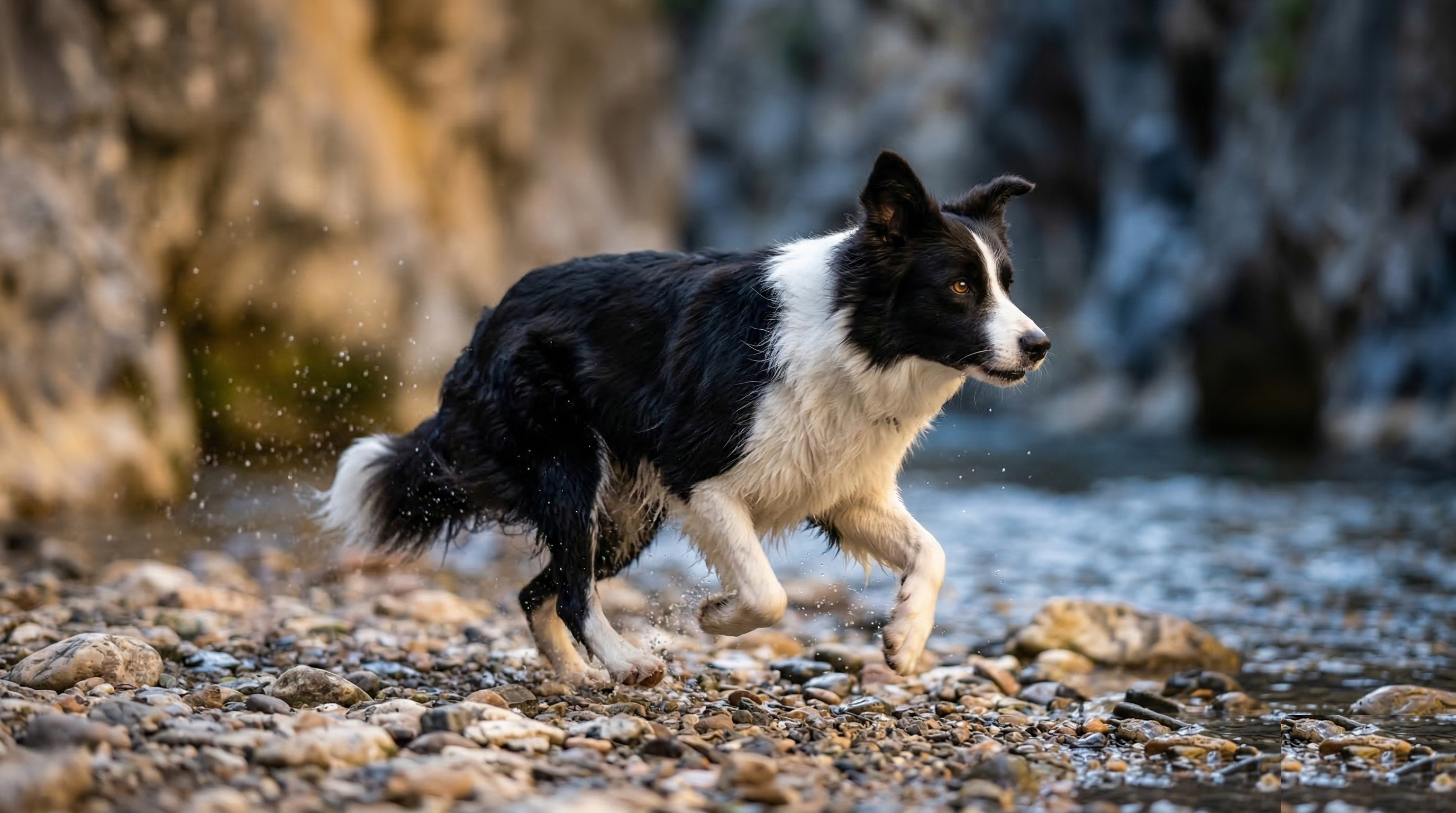
If This Breed Goes Missing
A missing Border Collie should usually be treated as a route-and-purpose search problem. If the dog escaped while stimulated, moving, or in a familiar outdoor context, it may continue along pathways, field edges, fences, trails, or human activity zones instead of hiding immediately.
Start with familiar routes, fields, trails, fence lines, and motion-rich areas. Create a TailTracker emergency profile to organize sightings, search zones, and first-response steps.
Start Recovery Profile- Search likely directional routes first: regular walking paths, roads, trails, field margins, fence lines, and routes tied to routine exercise or work.
- Check motion-rich environments such as school fields, parks, livestock areas, running paths, barns, riding rings, agility fields, and open recreation areas.
- Use familiar, structured recall cues rather than escalating emotional shouting. Many Border Collies respond better to routine and handler clarity than panic.
- Ask where the dog would go to keep watching or controlling movement. This breed often chooses vantage points, edges, and open lines of sight.
- Expand search coverage strategically if the dog left in an activated state. Border Collies can travel farther than owners expect while still looking composed and purposeful.
The biggest recovery mistake is assuming the dog will automatically circle back quickly because it is “smart.” Intelligence does not guarantee stationary behavior. In many Border Collies, intelligence supports continued motion, continued problem-solving, and continued engagement with the environment.
Health & Practical Care
Border Collies are often relatively long-lived dogs, with recent UK longevity research placing the breed slightly above the overall average for dogs. Individual health still depends on genetics, preventive care, weight management, injury history, and lifestyle.
Commonly discussed Border Collie screening and health topics include collie eye anomaly, trapped neutrophil syndrome, neuronal ceroid lipofuscinosis in certain lines, glaucoma or goniodysgenesis screening, congenital or adult-onset deafness, Border Collie Collapse, and lower-frequency but relevant MDR1 drug-sensitivity variants. Owners should use breed-club health guidance and a veterinarian rather than treating any breed page as medical advice.
For everyday ownership, the most important practical issue is often not appearance but load management. Border Collies can overwork themselves physically and mentally. Good care means balancing training, structured exercise, recovery, orthopedic awareness, and mental decompression. For this breed especially, “more activity” is not always the same as “better regulation.”
Sources & Methodology
TailTracker breed pages combine breed-standard references, breed-club health information, working-dog history, and recovery-behavior modeling. Behavioral recovery insights are derived from breed purpose, temperament, movement tendencies, and field-recovery logic; they are not a guarantee of how any individual dog will behave.
- American Kennel Club Border Collie breed information and breed-standard context
- Royal Kennel Club Border Collie pastoral breed standard
- Border Collie Society of America breed health overview
- Working sheepdog history, sheepdog trial context, and canine cognition literature
- TailTracker recovery-behavior modeling based on breed purpose, movement tendencies, and lost-pet field logic
Frequently Asked Questions
Are Border Collies likely to wander far?
They can, especially when stimulated by motion, routine routes, or work-like environments. Their travel often follows paths and patterns rather than random drifting.
Will a Border Collie usually come when called if loose?
Sometimes, especially with strong training and low arousal, but a highly activated Border Collie may stay committed to movement, scanning, or route behavior despite hearing the owner.
What is the biggest recovery mistake with a missing Border Collie?
Assuming intelligence means the dog stayed nearby or automatically came home. Many Border Collies need a directional, route-based search focused on movement corridors and familiar work-like destinations.
Protect your pet before an emergency starts.
TailTracker helps owners prepare smarter, respond faster, and coordinate recovery with behavior-aware guidance when every minute matters.
Most lost-pet tools broadcast alerts. TailTracker coordinates the recovery.