Australian Shepherd
Breed Guide
Intelligent, athletic, and intensely task-oriented, the Australian Shepherd is a herding breed whose lost-dog behavior is often shaped by motion, purpose, environmental scanning, and strong attachment to routine and people.
5 min read · Practical pet-owner education with recovery-focused guidance
Overview
The Australian Shepherd, often called the Aussie, is a herding breed developed in the United States despite its misleading name. Breed history ties it to western ranch work, sheep handling, and pastoral dogs associated with flocks brought through trade routes that included Australia and New Zealand.
Modern Australian Shepherds are admired for intelligence, responsiveness, athleticism, and versatility. They are now common as companion dogs, but the breed was shaped by practical stock work, and many still retain strong movement sensitivity, environmental awareness, and instinctive herding behavior.
For TailTracker, the Australian Shepherd is one of the most important breeds to model well. This is not a passive dog that simply drifts without structure. When loose, many Aussies move with intention, scan terrain quickly, and may continue traveling if they interpret motion, trails, livestock, vehicles, or people as cues worth following.
Personality & Temperament
Australian Shepherds are typically described as intelligent, active, loyal, protective, playful, and adaptive. In practice, many combine deep owner attachment with a persistent need for mental engagement and movement.
They often notice everything. Motion in the environment, unfamiliar patterns, livestock, bicycles, runners, door openings, and shifting household energy can all matter to them more than they might matter to lower-drive breeds. That attentiveness is one reason they excel in herding, agility, rally, obedience, disc, and other working or sport activities.
Many Aussies are affectionate and biddable at home, but they are rarely dull. If under-exercised or under-stimulated, they can become restless or destructive. TailTracker translates that into a lost-dog risk pattern: this breed often keeps moving longer than owners expect, especially if it leaves in an activated, aroused, or task-seeking state.
Living With This Breed
Living well with an Australian Shepherd means recognizing that intelligence alone is not enough. This breed usually needs structured outlets: exercise, pattern, training, and meaningful engagement. Aussies often do best when they are given regular tasks, predictable routines, and safe ways to use their minds and bodies.
Many remain strongly responsive to movement and may try to herd children, other pets, or fast-moving household activity. That does not make them difficult dogs by default, but it does mean their instincts are often still present even in purely companion homes.
These traits matter for escape prevention. A bored or over-aroused Aussie may clear space fast, read an open gate as opportunity, or continue moving because the environment itself becomes rewarding. Secure fencing, recall training, enrichment, and physical exercise are not optional extras for many dogs of this breed.
History
Despite the name, the Australian Shepherd was developed in California in the nineteenth century. Historical accounts associate the breed with sheepdog lines connected to pastoral dogs from northwest Spain and with collie-type dogs imported alongside sheep from Australia and New Zealand.
The breed spread through the western United States and became highly valued by ranchers for handling sheep, cattle, and other livestock. For a long period it remained primarily a working stock dog rather than a mainstream household breed.
Wider public awareness grew in the mid-twentieth century, especially through rodeo performer Jay Sisler and his Australian Shepherds, whose working ability and trick performances helped popularize the breed beyond livestock circles. Breed-club development and later kennel-club recognition followed, and the Australian Shepherd eventually became one of North America’s most popular companion breeds.
Famous Australian Shepherds Through History
Australian Shepherd fame has been shaped less by aristocratic pet history and more by performance, ranch utility, and sport visibility.
Jay Sisler’s Australian Shepherds played an outsized role in introducing the breed to the broader public. Their rodeo trick performances helped move the Aussie from a primarily ranch-associated working dog into wider national awareness.
Pockets is remembered in AKC history as the oldest dog to earn an AKC title, reportedly receiving the Rally Novice title at 15 years and 5 weeks. That record gave the breed a notable place in performance-dog history.
More broadly, the Australian Shepherd’s fame has grown through stockdog competition, agility, obedience, disc, and ranch work. The breed’s reputation today rests on visible intelligence, athletic precision, and extraordinary trainability rather than on a single celebrity pet narrative.
TailTracker Recovery Insight
The Australian Shepherd is a movement-sensitive, high-cognition herding breed with moderate to high purposeful travel potential. In plain terms, this means a lost Aussie may not behave like a panicked scatter-runner or a passive hider. Many move in a way that looks organized: along roads, trails, fence lines, property edges, field margins, or corridors created by terrain.
Owner attachment is often strong, which can help recovery, but the breed’s working instincts can complicate the picture. If an Aussie leaves in an activated state, it may keep traveling while monitoring the environment, orienting to movement, or searching for familiar patterns. Some will circle back. Others continue forward until interrupted by fatigue, fencing, social contact, livestock, or environmental barriers.
TailTracker models this breed as one that often rewards fast, organized search structure. Searchers usually benefit from thinking in routes and directional flow rather than assuming the dog simply radiates outward randomly.
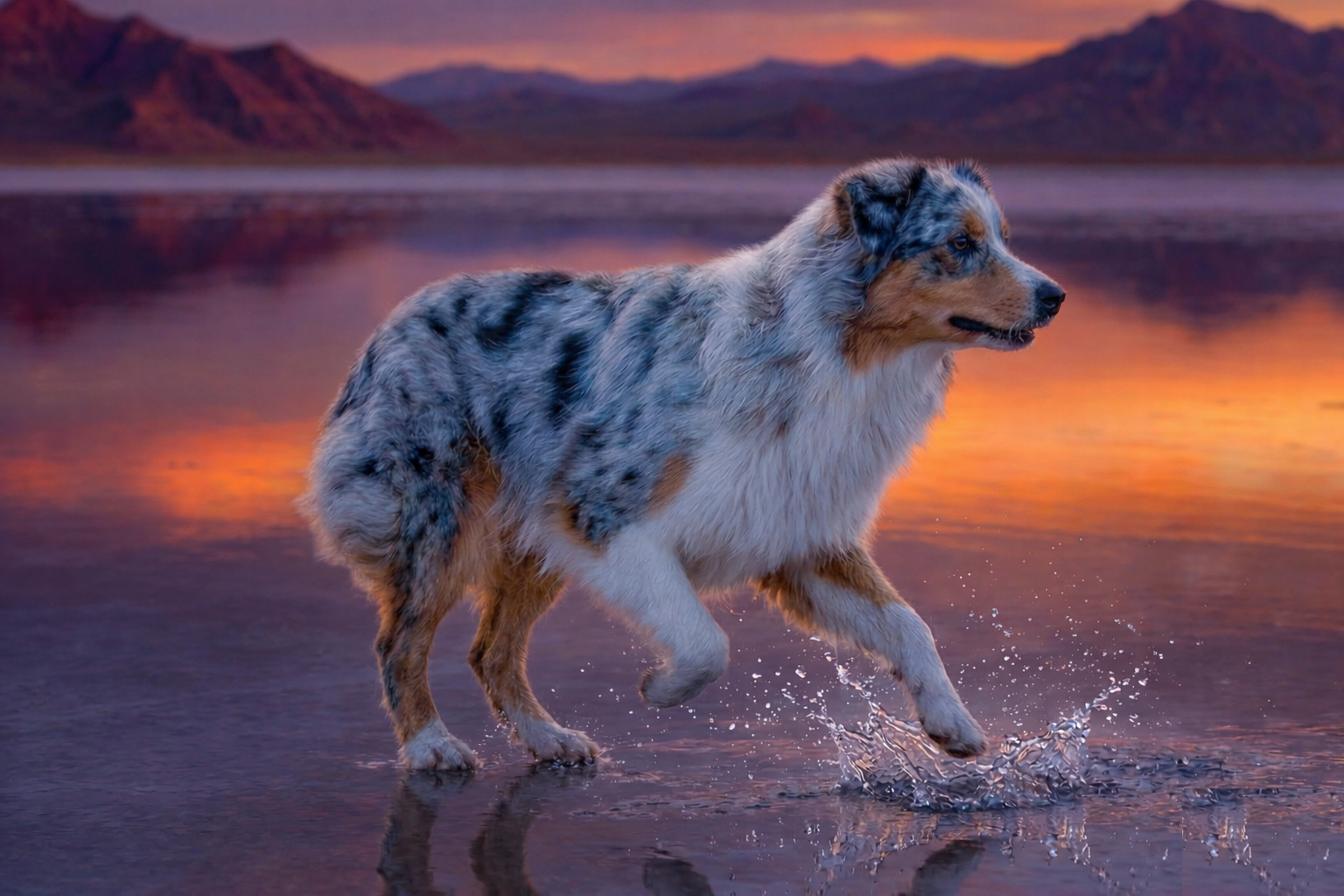
If This Breed Goes Missing
With an Australian Shepherd, assume intelligence and movement both matter immediately. This breed may travel farther and faster than many companion owners expect, especially if it leaves while stimulated, chasing, herding, or scanning.
- Search likely directional routes first: roads, trails, fence lines, field edges, neighborhood loops, and any path the dog regularly travels on walks or runs.
- Check places with movement interest such as livestock areas, parks, running paths, bike corridors, school fields, and open recreation spaces.
- Use calm recall cues tied to routine, not only panic shouting. Many Aussies respond better to familiar structure than to emotional intensity alone.
- Expand the search radius faster than you would for a toy breed, but keep it strategic. Follow terrain logic and likely travel corridors.
- Alert nearby farms, horse properties, dog-sport friends, trail users, and neighbors quickly. An Aussie may engage with people or animals before settling down.
The biggest recovery mistake with an Aussie is underestimating purposeful travel. Owners sometimes assume the dog is “too smart” to go far. In reality, that same intelligence can support continued movement when the dog is reading the environment as a job, route, or pattern to follow.
Health & Practical Care
Australian Shepherds are generally active, capable dogs with above-average longevity in recent UK lifespan data, but they do have several important health considerations. Reported concerns include eye problems, hereditary cataracts, MDR1 drug sensitivity, and, in some lines, issues associated with double merle pairings.
The MDR1 mutation is especially important because it can create dangerous sensitivity to certain drugs that are usually safe at standard doses in other dogs. Responsible owners should know their dog’s status when possible and discuss medication safety with their veterinarian.
Double merle health risks deserve careful factual handling. Problems associated with two copies of the merle gene can include hearing and vision impairment. That is a genetics and breeding issue, not a defining characteristic of the breed as a whole, but it is important enough to acknowledge clearly.
For everyday care, structured exercise, mental stimulation, good recall work, and reliable containment matter just as much as coat maintenance. With this breed, behavior management and escape prevention are tightly connected.
Frequently Asked Questions
Do Australian Shepherds usually go far when lost?
They can. Many Aussies travel farther than owners expect, especially if they leave in an activated state and begin following routes, motion, or familiar environmental patterns.
Are Australian Shepherds easy to call back when loose?
Sometimes, especially if recall is well trained and the dog is not over threshold. But high arousal, movement triggers, or working-style focus can temporarily overpower that responsiveness.
What is the biggest recovery mistake with a loose Aussie?
Waiting too long to think directionally. This breed often rewards corridor-based searching along roads, trails, field edges, and familiar movement routes rather than only a simple close-radius sweep.
Be ready before an emergency.
TailTracker helps owners prepare before a pet goes missing, so they can act faster with a clearer plan if the unthinkable happens.
Most lost-pet tools broadcast alerts.
TailTracker coordinates the recovery.