Jack Russell Terrier
Breed Guide
Fast, fearless, and intensely driven, the Jack Russell Terrier is a compact working terrier whose prey drive, speed, persistence, and independent problem-solving can strongly shape what happens after escape. That makes this breed especially important for rapid, directional recovery planning.
Quick read · Practical pet-owner education with recovery-focused guidance
Overview
The Jack Russell Terrier is a small British terrier developed for real hunting work rather than ornament, and that functional history still dominates the breed’s behavior today. The breed was originally developed to go to ground after badgers, with later work extending to fox and other quarry. Their job was to locate, pressure, and hold quarry underground with stamina, courage, noise, and relentless determination. That background helps explain why the modern Jack Russell can appear almost oversized in personality compared with its body.
Official descriptions consistently emphasize a compact, balanced, athletic terrier that remains sturdy, rugged, and tenacious. The breed may have a smooth, rough, or broken coat, but whatever the coat type, the operational character is the same: intense engagement, quick movement, high prey drive, and a willingness to solve problems independently.
For TailTracker, the Jack Russell Terrier is one of the clearest examples of a breed whose lost-dog pattern is often driven by action rather than confusion. A loose Jack Russell frequently behaves less like a timid missing pet and more like a dog with a mission. That distinction matters enormously when deciding how quickly to widen the search, where to concentrate, and how to avoid turning the event into a prolonged chase.
Personality & Temperament
Jack Russell Terriers are intelligent, energetic, fearless, and famously persistent. They are often lively, playful, affectionate with their own people, and highly entertaining in daily life, but they are not casual low-demand companions. This is a breed that was designed to work independently under pressure, and that independence often shows up as decisiveness, stubbornness, and a tendency to commit fully once stimulated.
Many Jack Russells are extremely quick to notice movement, react to sound, and investigate changes in the environment. They often enjoy chasing, digging, carrying, searching, and solving obstacles. Even well-loved household dogs may remain intensely terrier-like in the presence of squirrels, rabbits, rodents, birds, rustling brush, fence gaps, or sudden motion.
Their confidence can be misleading. Because they are small, some owners expect them to behave like toy breeds, but the Jack Russell is behaviorally closer to a compact working athlete. In recovery terms, this means that once the dog becomes activated, owner attachment alone may not be enough to immediately override pursuit, curiosity, or environmental momentum.
Living With This Breed
Living successfully with a Jack Russell Terrier usually requires structure, not just affection. These dogs often need regular physical exercise, mental engagement, secure containment, and purposeful outlets for their energy. Without enough stimulation, they can become noisy, destructive, escape-prone, and extremely creative in all the wrong ways.
Many thrive in active homes that offer training, games, terrier-safe enrichment, agility, scent work, or other forms of structured challenge. They are often capable little dogs with a sense of competence, and they tend to do better when daily life gives them a job, a pattern, or a reason to focus.
Practical management matters. A Jack Russell may squeeze through a small opening, dig under weak fencing, launch after motion without warning, or convert an ordinary yard into a self-directed hunt. Owners who underestimate the breed’s drive often discover that the dog is smarter, faster, and more determined than their containment plan.
History
The Jack Russell Terrier traces back to small white working terriers associated with Reverend John “Jack” Russell in nineteenth-century England. In the breed’s early working history, these terriers were valued for going to ground after badgers, with later terrier work also extending to fox and other quarry. Russell wanted a terrier with stamina, courage, and enough drive to work underground while still fitting the practical demands of the hunt. One foundational dog in breed history was a small white and tan terrier named Trump, often described as closely matching Russell’s ideal.
Over time, the old working fox terrier type split in multiple directions, eventually contributing to the modern Jack Russell Terrier, the Parson Russell Terrier, and other related terrier forms. Breed-club politics and kennel-club recognition created decades of disagreement over standardization, especially between those who wanted to preserve the Jack Russell primarily as a working terrier and those pushing for narrower conformation recognition.
That history still matters because the Jack Russell’s core identity is tied to practical work. Even today, many national clubs and working enthusiasts define the breed less by show-ring appearance and more by retained function, drive, and terrier character.
Famous Jack Russells Through History
Jack Russell Terriers have built an unusually broad public legacy through exploration, hero stories, television, film, and modern working service.
Bothie became famous as the first dog to travel to both the North and South Poles during the Transglobe Expedition in the early 1980s. His story highlighted the breed’s toughness, adaptability, and willingness to keep up in extreme conditions.
George, a Jack Russell from New Zealand, was posthumously awarded the PDSA Gold Medal after protecting children from attacking dogs. He remains one of the breed’s best-known real-life bravery stories.
Moose and later his son Enzo played Eddie on the television series Frasier, giving the breed one of its most iconic screen identities. Their deadpan presence helped make the Jack Russell one of the most recognizable terriers in American television culture.
Other notable Jack Russells include Wishbone from the children’s television series of the same name, Uggie from The Artist, Chalky from Rick Stein’s television work, and Patron, the explosive-detection dog in Ukraine whose work brought the breed into modern international attention.
TailTracker Recovery Insight
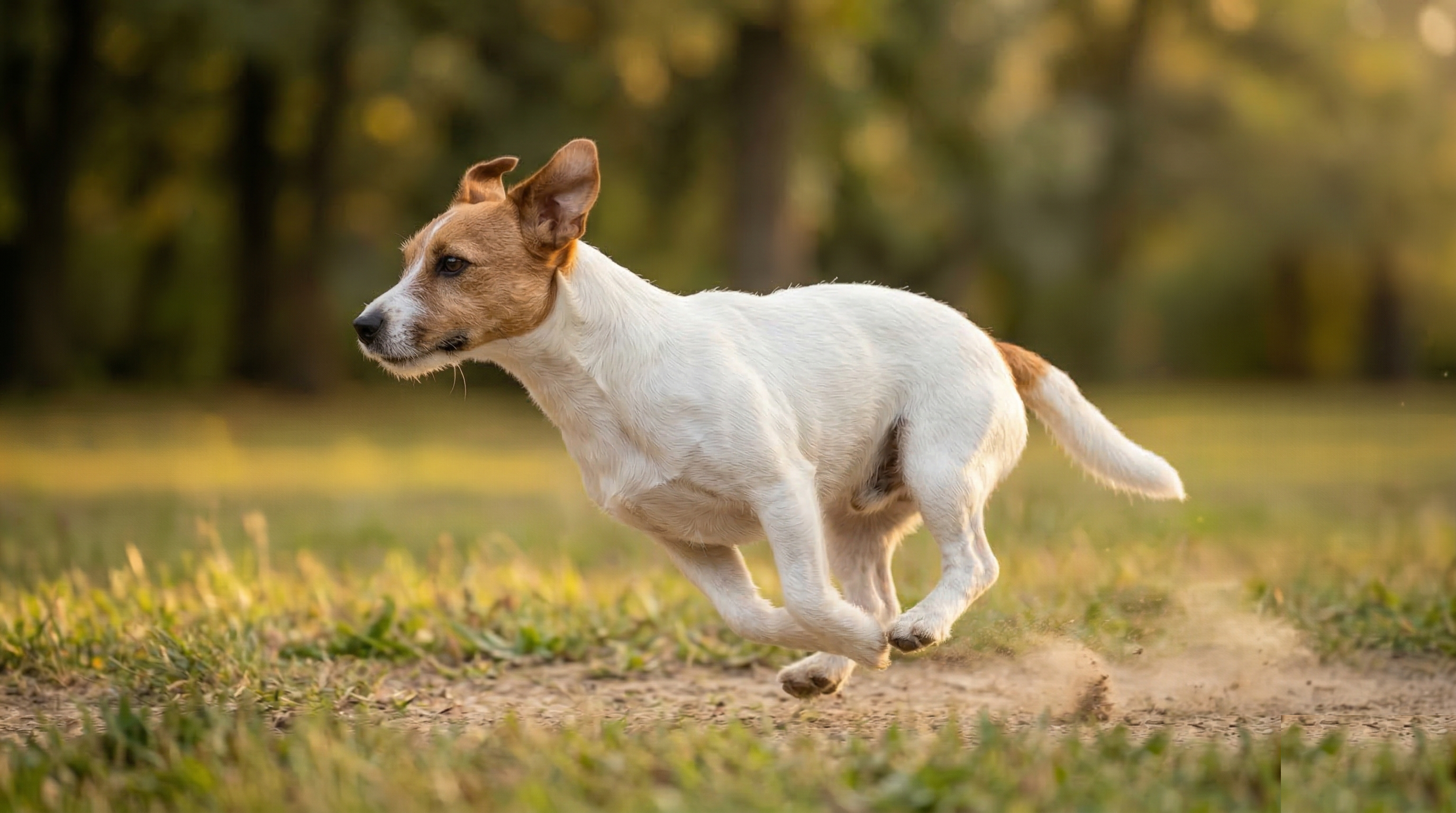
The Jack Russell Terrier is one of the clearest examples of a breed whose lost-dog behavior is frequently driven by prey pursuit, speed, and persistence rather than by passive wandering. When a Jack Russell gets loose, it may not pause to assess, hide immediately, or wait for owner intervention. Instead, it often continues forward with purpose, especially if triggered by motion, scent, quarry, or a moving target. Road danger is a major concern with this breed because a Jack Russell in active pursuit can become so visually locked onto the chase that traffic awareness effectively disappears.
TailTracker models this breed as high in chase tendency, high in directional momentum, and high in environmental commitment once activated. That means the dog may continue along field edges, trails, fence lines, brush corridors, drainage routes, and other movement-friendly channels long after owners expect it to have stopped.
The small body does not reduce the operational problem. In fact, it can make the dog harder to see, easier to lose visually in cover, and more capable of slipping through spaces that would stop a larger dog. Many helpers make the mistake of thinking “small dog” and searching too close for too long, when the more accurate frame is “fast terrier on task.”
If This Breed Goes Missing
A loose Jack Russell Terrier should usually be treated as an urgent chase-driven scenario, especially if the escape happened during outdoor activity, in a stimulating environment, or near wildlife, livestock, trails, or fence lines. The dog may cover ground quickly and may ignore familiar voice cues while focused on pursuit.
- Identify direction of travel immediately rather than assuming the dog stayed in a small radius.
- Search movement corridors first: trails, brush lines, fence edges, field margins, drainage paths, and property boundaries.
- Check places rich in prey activity such as barns, sheds, stone walls, rabbit cover, wood lines, parks, and open fields.
- Avoid creating a loud chase dynamic. Running directly at the dog may convert a recoverable moment into a longer pursuit.
- Treat roads as urgent danger zones. If the dog is chasing toward or across traffic, shift immediately to traffic-aware interception and sightline management.
- Use playful or familiar engagement when possible, but do not assume verbal recall will work once prey drive is activated.
The biggest operational mistake is assuming the dog is merely “wandering.” For a Jack Russell Terrier, the more likely early reality is pursuit. That means search plans should widen faster, think more directionally, and respect how long terrier drive can carry momentum.
A second common mistake is having strangers pressure, corner, or chase the dog. Some Jack Russells will dodge capture, escalate, or even show defensive aggression when overstimulated by unfamiliar people. Rescue dogs can be especially vulnerable to fear once they realize they are in unfamiliar territory, which is why owner involvement is often one of the most important recovery assets.
Jack Russells also should not be trusted to underground or invisible fencing as a primary containment strategy. For this breed, physical secure fencing is the safer default.
Health & Practical Care
Jack Russell Terriers are often long-lived and active into old age, with recent UK lifespan studies placing them above average among dogs overall, though results vary across datasets.
The breed does, however, have several recognized health concerns. Documented issues include patellar luxation, primary lens luxation, inherited eye disorders, Legg–Calvé–Perthes disease, some neurological conditions including inherited ataxia-associated syndromes, and certain rare skin or immune-related conditions.
In practical ownership terms, the larger issue is often not fragility but intensity. A Jack Russell Terrier is frequently physically capable enough to injure itself through speed, jumping, digging, squeezing through obstacles, or working itself into risky situations. Safe exercise, secure fencing, structured activity, and attention to orthopedic and eye health all matter.
Frequently Asked Questions
Are Jack Russell Terriers likely to wander far?
They can travel farther and faster than many owners expect, especially when triggered by prey drive, motion, or scent. Their movement is often directional rather than random.
Are Jack Russell Terriers easy to approach when lost?
Not always. Some are very social with familiar people, but a highly stimulated Jack Russell may dodge approach, keep moving, or stay committed to whatever it is pursuing.
What is the biggest recovery mistake with a loose Jack Russell Terrier?
Assuming the dog stayed nearby and treating the situation like a local hiding problem. Many Jack Russells need a fast directional search because the escape begins as a chase event.
Protect your pet before an emergency starts.
TailTracker helps owners prepare smarter, respond faster, and coordinate recovery with behavior-aware guidance when every minute matters.
Most lost-pet tools broadcast alerts. TailTracker coordinates the recovery.