Treeing Walker Coonhound
Breed Guide
Fast, athletic, and famously vocal, the Treeing Walker Coonhound is one of America's clearest scent-hound recovery profiles. When this breed gets loose, it usually is not drifting aimlessly. It is following a trail, moving with purpose, and may keep traveling until the scent ends or the quarry trees.
5 min read · Practical pet-owner education with recovery-focused guidance
Overview
The Treeing Walker Coonhound is a distinctly American hound bred for one thing above all else: finding game fast, driving it hard, and staying on the scene once the quarry goes up a tree. It is one of the most popular coonhound breeds in the United States and a fixture in nite hunts, pleasure hunting, and modern coonhound culture.
The breed descends from English Foxhounds brought to the American colonies, then refined for more speed, sharper scent commitment, and a stronger instinct to locate and hold treed game. Every modern Treeing Walker is commonly said to trace back in part to a dog called Tennessee Lead, a hound whose influence helped shape the breed's speed, style, and treeing intensity.
TailTracker views the Treeing Walker Coonhound as one of the clearest examples of a scent-locked traveler. Unlike a companion breed that flees and hides or a guardian that circles back to territory, this breed often keeps moving in a meaningful direction. If it escapes on a fresh scent, it may travel far beyond the point where an owner expects a "pet dog" to stop.
Breed History
The Treeing Walker Coonhound was developed in the United States from early English Foxhound stock, with major roots in Virginia, Kentucky, and Tennessee. The "Walker" portion of the name comes from Thomas Walker of Virginia, whose hounds helped define the strain in colonial America.
The breed's story is closely tied to a hound known as Tennessee Lead. According to breed tradition, this dog was obtained in the 1800s and bred into the Walker line, adding extraordinary drive, nose, and treeing instinct. Over time, these hounds separated themselves from the English Foxhound by specializing in raccoon and other tree game rather than pure mounted fox pursuit.
For many years they were treated as part of the English Coonhound family. Their specialized style and consistent type eventually earned separate recognition, and the AKC formally recognized the Treeing Walker Coonhound in 2012. Today, the breed is widely regarded as one of the dominant hounds in American competitive coonhound events.
Physical Characteristics
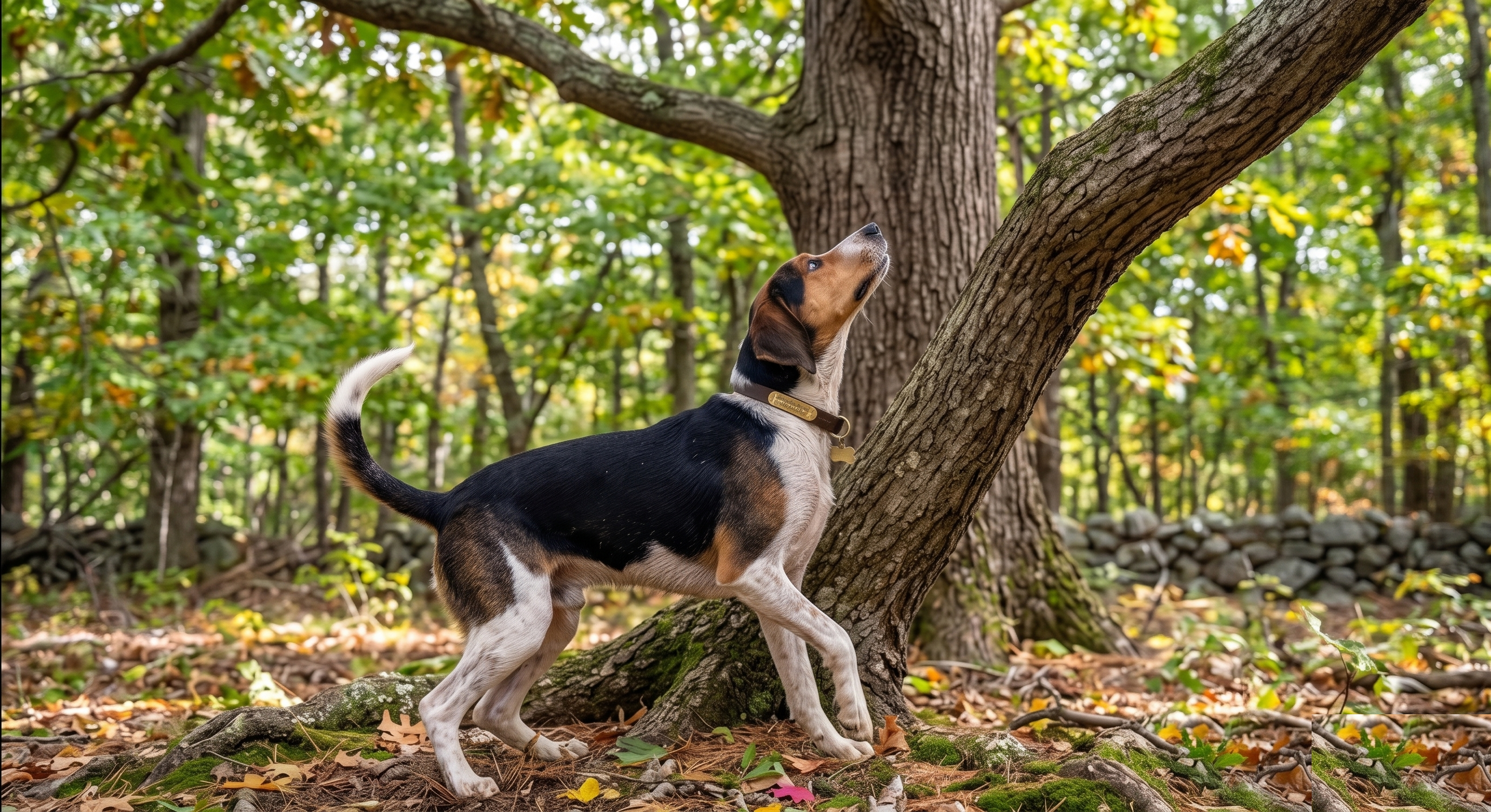
The Treeing Walker Coonhound is a medium-to-large hound built for speed, reach, and stamina rather than heavy power. The body is lean, balanced, and athletic, with long legs, a deep chest, and the clean proportions needed to cover rough ground hour after hour.
Most dogs stand roughly 22 to 27 inches at the shoulder and weigh about 45 to 80 pounds. The coat is short, smooth, and practical, most often seen in the classic tricolor pattern of white, black, and tan. The expression is alert and intelligent, while the long ears and hound voice immediately identify the breed as a serious trailing dog.
Unlike a heavier coonhound built to plow through terrain, the Treeing Walker is often described as clean and efficient in movement. That physical design matters in recovery: this is a dog that can cover meaningful distance quickly and still have enough drive left to keep working once it gets there.
Temperament
Treeing Walkers are energetic, intelligent, and strongly purpose-driven. At home, many are surprisingly relaxed once exercised, often stretching out for long naps and showing a sweet, affectionate side with their families. In the field, though, the personality changes instantly: when scent takes over, the dog becomes intensely task-focused.
This breed is known for its ringing voice — a long trailing bawl and a more rhythmic chop when game is treed. Experienced handlers can often tell whether the dog is moving, checking, or holding a tree just by listening. That vocal distinction is one of the most useful recovery clues owners can exploit when a Treeing Walker is missing.
TailTracker models this breed as friendly when disengaged, highly independent when on scent, and less responsive to recall than many owners assume. The hound is not ignoring the owner out of stubbornness. It is following the exact job generations of breeding told it to do.
Living With This Breed
Treeing Walker Coonhounds do best with owners who understand hounds. This is not a low-drive family dog that can thrive on a casual walk around the block. It needs exercise, scent enrichment, secure containment, and owners who accept that a strong nose will always outrank convenience.
Because they are social hounds, many Treeing Walkers are affectionate and good-natured in the home. But they can also be vocal, distractible, and intensely motivated by wildlife movement, scent trails, and open terrain. A bored or under-managed hound is an escape risk, and once loose it often behaves exactly like a hunting dog rather than a pet.
- Needs real physical exercise and scent-based mental outlets, not just casual yard time.
- Can be very affectionate with family but highly independent once a scent trail activates.
- Requires strong containment — fences, gates, and door management matter.
- Often vocal by nature; baying and "talking" are part of the breed package.
- Wildlife-rich environments can trigger sudden directional movement and poor recall.
- Best suited to owners who appreciate hound instincts rather than trying to suppress them.
Grooming and Health
Grooming is straightforward. The short coat is easy to maintain, usually requiring only regular brushing and routine ear care. As with many long-eared hounds, ear health deserves attention because reduced air circulation can increase the chance of infections if ears are neglected.
Overall, the Treeing Walker Coonhound is considered a hardy sporting breed, but owners should still watch for the familiar issues seen in active medium-to-large dogs: joint strain, cuts or paw injuries from hard field use, and the wear that comes from frequent rough-terrain activity.
From a recovery standpoint, the more important health point is not fragility but endurance. A healthy Treeing Walker often has the physical ability to remain in motion much longer than owners expect. That is one reason early large-radius alerts matter so much for this breed.
Fun Facts
- An American original: While its roots go back to English Foxhounds, the Treeing Walker was developed in the United States for American terrain, American game, and American hunting style.
- Tennessee Lead's legacy: Breed history repeatedly points to Tennessee Lead as a foundational influence on the modern Treeing Walker's speed and treeing style.
- Voice with a purpose: Handlers often distinguish a trailing bawl from a tree chop at long distance, making the breed's voice a real field tool, not just a charming trait.
- Competitive favorite: Treeing Walkers are among the most successful coonhounds in competitive nite hunts across the United States.
- Built for efficiency: Compared with heavier hounds, the Treeing Walker often looks cleaner and leggier — a design that helps explain how fast it can cover country.
- Couch hound at home: Many owners are surprised that a dog so intense outdoors can be so content to sprawl across the house once exercised.
Famous Examples
- Tennessee Lead — The legendary foundation hound whose influence helped define the modern Treeing Walker line.
- Competitive nite-hunt champions — More than almost any single pop-culture dog, the Treeing Walker's fame lives in hunting and competition circles, where top dogs earn reputations for voice, track speed, and accuracy at the tree.
- Modern American coonhound culture — The breed itself is one of the best-known names in U.S. coonhound communities, often treated as the benchmark for a fast, accurate tree dog.
TailTracker Recovery Insight
The Treeing Walker Coonhound fits a distinctive recovery profile: long-range movement, directional travel, scent commitment, and tree-endpoint behavior. This is not a breed that usually panics in circles. It tends to move in a line that makes sense to the dog, especially if wildlife scent is involved.
The behavioral sequence TailTracker models for this breed is: trigger or escape → scent acquisition → long directional travel → trail commitment → stop only when the scent dies or game trees. If the dog reaches a treeing moment, it may remain in one spot for much longer than owners expect, especially if excitement and instinct keep it locked in.
This creates a recovery profile that is both difficult and unusually logical. The dog may be far away, but it often did not get there randomly. Terrain corridors, downwind travel, wildlife routes, creek beds, edges of woods, and road shoulders matter more than a simple expanding circle around home.
If This Breed Goes Missing
Start bigger and think more directionally than you would for most family dogs. A missing Treeing Walker often is not tucked under a porch nearby. It may already be well beyond the immediate neighborhood, especially if it escaped with wildlife scent in play.
- Alert fast and wide. Use a larger initial search radius than you would for a toy breed or companion dog.
- Look for corridors, not circles. Focus on trails, creeks, wooded edges, road shoulders, and likely game movement routes.
- Listen at night and early morning. A hound voice can travel a long distance and may reveal whether the dog is moving or holding at one point.
- Check tree-heavy zones. If the dog got onto quarry, it may have stopped at the base of a tree and stayed there.
- Use strong-smelling bait. Sardines, bacon, or similarly pungent food may interrupt focus better than voice alone.
- Avoid assuming recall will work. On scent, many Treeing Walkers are functionally "deaf" to owner commands until the trail breaks.
- Work sightings quickly. A credible directional sighting is often more valuable than a broad, unfocused neighborhood sweep.
Once sighted, stay calm and avoid pushing the dog into another long movement loop. If the dog is not in active scent drive, soft voice, food, and low-pressure body language may help. If it is still locked in, position and containment usually matter more than direct pursuit.
Frequently Asked Questions
How far can a Treeing Walker Coonhound travel when lost?
Often farther than owners expect. This breed was developed for speed, stamina, and scent commitment. If it leaves on a strong trail, it may travel several miles before slowing or stopping.
Why is the Treeing Walker so hard to call back once loose?
Because the breed was selected for exactly that kind of task focus. When the nose activates, the dog may prioritize trail information over owner voice, familiar sounds, and even immediate surroundings.
What does "treeing" mean in practical terms?
It means the dog has followed quarry until the animal went up a tree, then stayed at the base of that tree barking or chopping to hold the location. In a recovery context, that can leave a lost dog fixed in one spot long after it has traveled out of sight.
Is the Treeing Walker Coonhound a good match for first-time owners?
Sometimes, but only if they truly understand hound behavior. Friendly personality does not cancel out scent drive, vocal tendencies, or roaming risk. This breed is much easier to love than to casually manage.
What is the biggest recovery mistake with this breed?
Starting too small. Owners often search like they lost a companion dog that is likely nearby. A Treeing Walker should be treated early as a scent-driven directional mover, not a short-range homebody.
Related Breed Guides
Comparing the Treeing Walker with other hounds and high-drive field dogs can sharpen expectations around voice, scent commitment, and search radius.
Build a breed-informed recovery plan before your dog ever goes missing.
TailTracker helps pet families prepare smarter with breed-aware recovery guidance, coordinated alerts, and a faster path from panic to action.
Most lost-pet tools broadcast alerts.
TailTracker coordinates the recovery.