Norfolk Terrier
Breed Guide
Small, sturdy, and full of terrier confidence, the Norfolk Terrier combines social warmth with genuine working grit. Originally valued as a barn and vermin dog, the breed is compact enough to slip into astonishingly small spaces yet sociable enough to seek out nearby people, dogs, and activity when loose. That combination creates a very specific missing-dog profile: curious, close-range, ground-level, and easy to underestimate.
5 min read · Practical pet-owner education with recovery-focused guidance
Overview
The Norfolk Terrier is the smallest of the working terriers, but it carries itself with the confidence of a much bigger dog. Compact, active, and sturdily made, it was developed to work around barns and stables, clearing vermin and moving with enough grit and agility to follow quarry into tight places.
Unlike some terriers that feel distinctly solo-minded, the Norfolk has a more social personality. The breed historically worked in groups and generally gets along better with other dogs than many people expect from a terrier. That combination of terrier tenacity and pack friendliness makes the Norfolk especially interesting from a recovery perspective.
TailTracker views the Norfolk Terrier as a breed whose lost-dog behavior is shaped by four key forces: strong curiosity, ground-level movement, a tendency to investigate holes and structures, and a surprisingly social response to nearby people, dogs, and household activity. A missing Norfolk is often not far away — but may be very easy to miss.
Breed History
The Norfolk Terrier shares its roots with the Norwich Terrier and was not formally separated as its own breed until the twentieth century, when the drop-eared type was distinguished from the prick-eared Norwich. Before that split, these little terriers had already built a strong reputation in East Anglia as compact working dogs and companion animals.
They passed through several names during their development, including Cantab Terrier, Trumpington Terrier, and Jones Terrier, reflecting their popularity among Cambridge students and their spread through British horse and sporting circles. Their job was practical and unglamorous: rid stables, barns, and surrounding areas of vermin, and occasionally bolt small animals from cover.
That history still lives in the breed. The Norfolk may be charming and social, but beneath the expression is a real earthdog with a nose for motion, openings, and trouble.
Physical Characteristics
Norfolk Terriers are small, low, and solidly made, with enough bone and rib to stay functional rather than toy-like. The coat is hard, straight, and wiry, with a softer insulating undercoat beneath. The overall look should feel weatherproof, scrappy, and ready for practical work.
Their drop ears are the simplest visual cue separating them from the Norwich Terrier, and their outline should suggest free movement and real agility. Even at a very small size, the Norfolk should never look fragile.
The breed’s small frame is especially important in recovery work. A Norfolk Terrier can disappear into places that would not even register as viable hiding spots for a medium or large dog. Gaps under sheds, porch lattice openings, drainage edges, crawlspace entries, pipes, dense brush, and low gaps in fencing all matter more than many owners expect.

Temperament
Norfolk Terriers are fearless, cheerful, observant, and generally more sociable than many people expect from the terrier group. They still have a real terrier streak — quick to investigate, highly interested in scent and movement, and sometimes determined to finish what they started — but they are often warmer and more group-oriented than their reputation suggests.
They tend to like people, fit well into active homes, and often respond to household pace. If the home is calm, many Norfolks settle. If something interesting is happening, they want to be near it. This “must be included” energy is part of the breed’s charm and part of its recovery logic too.
They are also good little sentinels. While not typically noisy for no reason, many will bark appropriately when something unusual happens. That tendency can be useful in recovery if the dog is nearby but hidden.
Living With This Breed
Living with a Norfolk Terrier means living with a dog that wants participation, stimulation, and access to the action. These dogs were not bred to be ornamental. They were bred to move through real environments, notice small things, and stay engaged with the world around them.
Many do very well in homes with people, children, and other dogs, especially when raised thoughtfully. They usually prefer contact to isolation and can get bored when left alone too long without enrichment. Like other terriers, they may dig or investigate when under-stimulated, but in the Norfolk this behavior often feels more busy than defiant.
- Generally more social with people and other dogs than many terriers.
- Needs stimulation and inclusion; boredom can create mischief.
- Strong prey interest remains active outdoors.
- Small size does not reduce working drive.
- Good family companion when given structure and engagement.
- Not a dog to underestimate near holes, brush, or small escape routes.
Grooming and Health
The Norfolk Terrier’s double coat needs regular combing and periodic hand stripping to preserve its proper texture and color. Clipping tends to soften the coat and flatten the breed’s natural working finish. For companions, routine coat care is manageable, but it should still respect the breed’s hard-coated terrier character.
Health-wise, owners and breeders often watch for issues such as luxating patellas, mitral valve disease, bite problems, and orthopedic concerns including dysplasia in some lines. The field-relevant takeaway is simpler: the Norfolk is physically small, generally hardy, and able to wedge into spaces that may trap or conceal it.
In recovery planning, that means a missing Norfolk may be close, mobile, and physically safe one moment, then quietly stuck the next. Search style matters.
Fun Facts
- Once one breed: The Norfolk and Norwich Terriers were historically the same breed until the ear-type split was formally recognized.
- Cambridge popularity: Early Norfolk-type terriers were fashionable companions among Cambridge students.
- The “little demon” reputation: Their size is tiny, but their drive is pure terrier.
- Pack-friendly terrier: The Norfolk is notably social for the terrier group because it historically worked around other dogs.
- Weatherproof coat: The hard outer coat helps dirt release surprisingly well once dry.
Famous Examples
- Winky in Best in Show: The fictional show-dog terrier energy often associated with the Norfolk’s busy, endearing personality.
- Cambridge room companions: The breed’s early popularity among university students helped cement its identity as both practical and personable.
- Classic barn terriers: The Norfolk remains one of the clearest modern echoes of the old stable and vermin-yard terrier tradition.
TailTracker Recovery Insight
The Norfolk Terrier fits a recovery pattern that is deceptively small-scale: short-range wandering, high curiosity, strong attraction to nearby activity, and elevated hide-or-stuck risk at ground level. This is not typically a breed that launches into a long straight-line run for miles. It is more often a nearby wanderer that joins whatever seems interesting, then disappears into a place people forget to inspect.
TailTracker models the Norfolk lost-dog sequence as trigger → nearby curiosity movement → social or scent-based detour → low hiding / structure investigation / possible entrapment. That sequence means the dog may move only a modest distance from the escape point while still becoming surprisingly difficult to locate.
One of the most important Norfolk Terrier recovery realities is the “ground-level blind spot.” Searchers look outward and upward, but the dog is often low, tucked, behind, under, inside, or partially stuck. Cars do not solve this search well. Feet, flashlights, kneeling, listening, and hands-on inspection do.
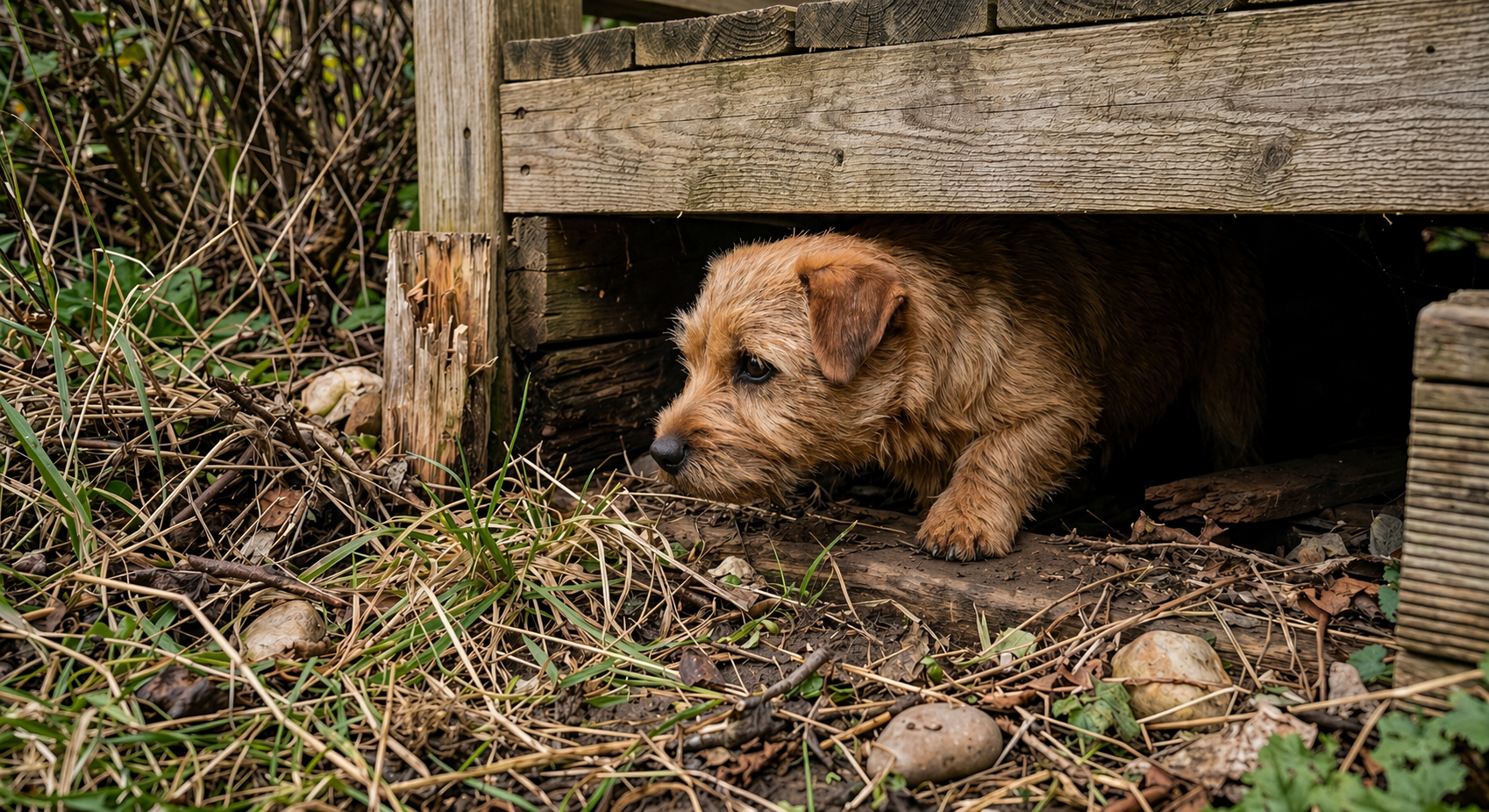
The breed’s social tendency also matters. A Norfolk may wander into a neighbor’s yard, greet someone outside, join another dog, or linger where people are gathered. That makes neighbor canvassing unusually important. At the same time, the terrier instinct to follow scent into holes, gaps, and cover raises a real “stuck” risk that should never be dismissed.
Another advantage with this breed is communication. Unlike some quieter terriers, a Norfolk may bark if it hears familiar people nearby. That means silent pauses during the search can be as important as calling.
If This Breed Goes Missing
Start tight, low, and social. A Norfolk Terrier is often nearby, but the right search mindset is not “drive farther.” It is “inspect better.”
- Work the immediate area first. This breed is often closer than owners think.
- Search at ground level. Under porches, inside sheds, around steps, low fences, brush piles, drainage openings, crawlspaces, and pipe entries matter.
- Check for stuck scenarios. Norfolk Terriers can follow curiosity into spaces they cannot easily back out of.
- Canvass neighbors quickly. Ask whether anyone saw a small terrier in their yard, garage, patio, or around other dogs.
- Use quiet listening pauses. Call once, then stop and listen for barking, scratching, or movement.
- Use playful recovery energy if sighted. For many Norfolks, inviting motion and social excitement works better than direct chase.
- Think “join the action.” A Norfolk may not be fleeing; it may simply be participating somewhere else.
Once sighted, avoid overwhelming the dog. Crouch, soften posture, use happy but not frantic energy, and let curiosity and social engagement work in your favor. For this breed, fun and inclusion are often stronger magnets than urgency.
Frequently Asked Questions
How far can a Norfolk Terrier travel when lost?
Often not very far compared with larger or more independent roaming breeds. Many Norfolk Terriers stay within a relatively tight local radius but become hidden, distracted, or stuck.
Will a Norfolk Terrier come when called?
Sometimes, especially if the energy feels light and inviting. But if the dog is on a scent or deeply engaged in investigating something, it may ignore its name completely for a period of time.
Why is a hands-on search so important for this breed?
Because the Norfolk is small enough to disappear into or under spaces that people routinely overlook from standing height or from a car.
Are Norfolk Terriers social with other dogs?
Generally yes, especially compared with many terriers. Their working background included functioning around other dogs, and that can show up in a more social field profile.
What is the biggest recovery mistake with a Norfolk Terrier?
Expanding too wide too early without thoroughly searching the immediate area at ground level. Many missing Norfolks are close, hidden, or physically stuck.
Related Breed Guides
Comparing the Norfolk Terrier with other small terriers and more people-bonded breeds can sharpen search expectations.
Build a breed-informed recovery plan before your dog ever goes missing.
TailTracker helps pet families prepare smarter with breed-aware recovery guidance, coordinated alerts, and a faster path from panic to action.
Most lost-pet tools broadcast alerts.
TailTracker coordinates the recovery.