Scottish Terrier
Breed Guide
Compact, dignified, and intensely self-possessed, the Scottish Terrier is one of the most distinctive little hunters in the dog world. The Scottie may be small, but its behavioral profile is not. This is a hardy, independent, scent-aware terrier bred to go to ground after badger and fox — a combination that matters enormously when one goes missing. Lost Scotties often move with purpose, hide low, and resist easy stranger capture.
5 min read · Practical pet-owner education with recovery-focused guidance
Overview
The Scottish Terrier is a compact, determined breed originally developed for underground hunting. Despite their small size, Scotties are known for their confidence, persistence, and strong sense of independence.
Unlike many companion breeds, they are natural problem-solvers that rely on instinct as much as training. This self-directed nature becomes especially important in lost dog scenarios.
TailTracker views the Scottish Terrier as a breed whose lost-dog behavior is shaped by four key drivers: strong terrier prey interest, pronounced environmental confidence, low stranger trust, and exceptional ability to disappear into small sheltered spaces. That combination creates a recovery profile that is very different from that of a velcro companion breed of similar size.
Breed History
The Scottish Terrier is one of the old Highland terriers of Scotland and was once grouped with several related rough-coated terriers under broader regional labels. For many years the breed was commonly called the Aberdeen Terrier, reflecting both its popularity in that area and the role of early exhibitors from Aberdeen in helping define the type.
Scotties were bred for utility, not ornament. Their traditional work included dispatching vermin on farms and pursuing foxes and badgers in rough country. The breed's low center of gravity, strong body, prick ears, hard coat, and powerful determination all fit that job. The famous nickname "The Diehard" is tied to the breed's reputation for bravery and grit — a personality signature that still shows up today in the form of boldness, independence, and refusal to quit once engaged in a task.
Formal breed development accelerated in the late 19th century as dog shows, breed clubs, and written standards helped separate the Scottie from other terrier types. The breed gained substantial popularity in Britain and the United States in the early 20th century, later becoming a cultural icon through politics, advertising, and popular media.
Physical Characteristics
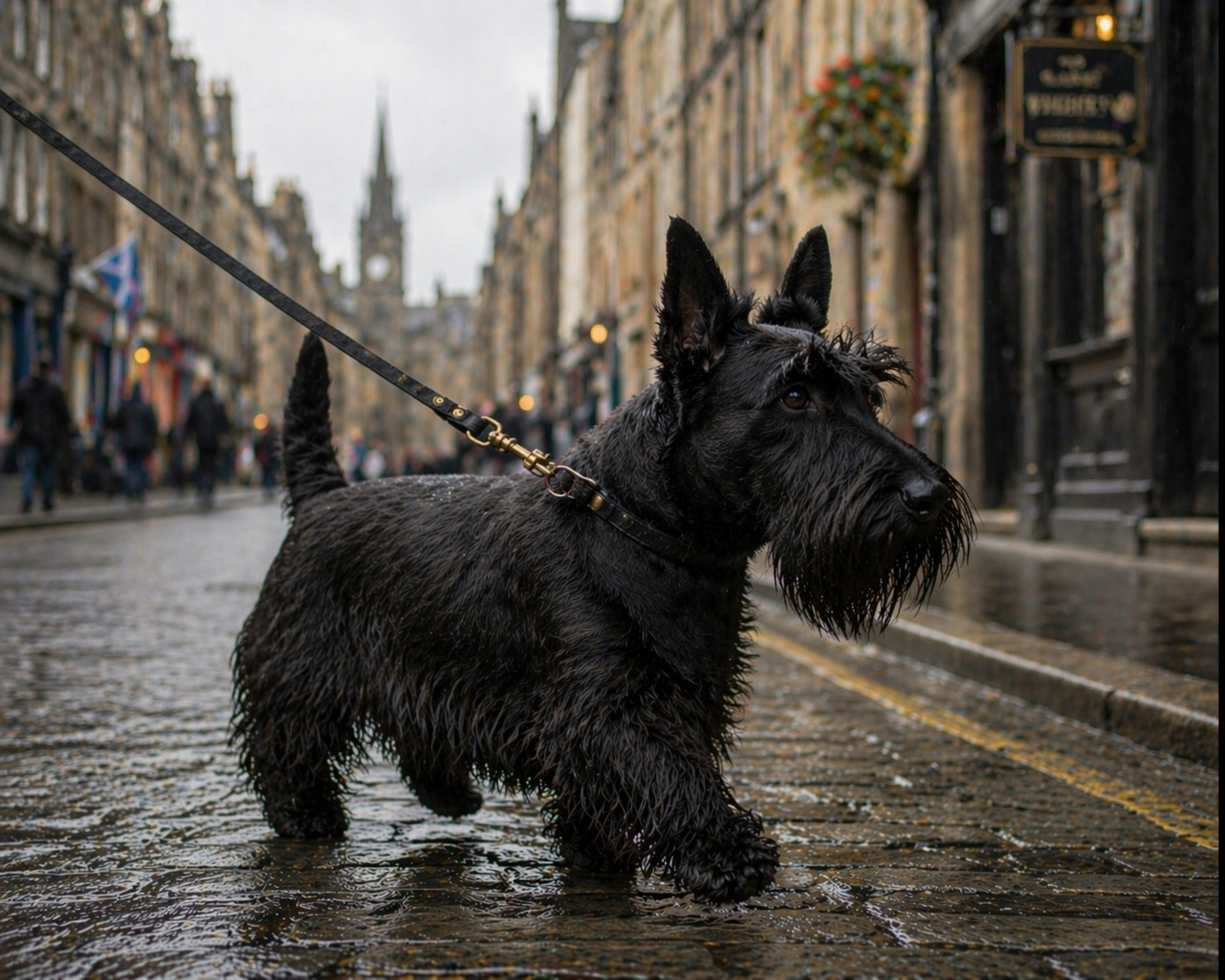
The Scottish Terrier is a small but heavily built terrier, typically standing about 10 inches at the shoulder and weighing roughly 18 to 22 pounds. What matters most is not just size, but structure. A Scottie is meant to feel substantial in the hand — compact, low, muscular, and capable rather than delicate.
The hallmark coat is a double coat: a hard, wiry outer layer over a dense softer undercoat. That coat provided weather resistance in difficult terrain and still defines the breed's outline today. The long furnishings on the face, legs, and lower body create the famous beard, eyebrows, and skirt that give the Scottie its dignified, almost sculpted silhouette. Common colors are black, brindle, and wheaten.
For recovery planning, the body design matters as much as appearance. Scotties are low enough to slip under porches, decks, shrubs, and crawl-space openings that many owners would not initially suspect. Their dark coats, compact shape, and tendency to stay still when uncertain can make them astonishingly difficult to spot in shadow.
Temperament
Scotties are confident, observant, and often reserved. They form strong bonds with their owners but tend to be selective in how they show affection.
They are not typically attention-seeking and may take time to warm up to new people. This thoughtful, self-contained personality is a defining trait of the breed.
TailTracker models the Scottish Terrier as bold in familiar territory, selective in social engagement, and highly capable of self-directed movement under stress. A missing Scottie is often not broadcasting distress. It may appear composed, intent, and quite uninterested in help from unfamiliar people.
Living With This Breed
Scottish Terriers do best with owners who appreciate personality, consistency, and boundaries. They are not usually chaotic dogs, but they can become willful if training is vague or inconsistent. Calm structure, early socialization, and reliable leash and door routines matter, especially because the breed's curiosity about scent trails and small moving animals can override convenience very quickly.
Scotties often bond strongly with their household while remaining somewhat formal with outsiders. Many are excellent home sentinels because they are alert and not typically noisy without reason. They also tend to enjoy having a job, even if that job is simply patrolling the yard, monitoring the front walk, or supervising the home from a chosen lookout point.
- Independent temperament means training works best when it is firm, fair, and consistent.
- Strong prey drive increases risk around squirrels, rabbits, rats, and other small animals.
- Low stature and digging instinct make fences, deck gaps, and crawl-space access points especially important.
- Usually affectionate with family, but often selective rather than exuberant with strangers.
- Needs daily walks, mental stimulation, and opportunities to investigate the environment safely.
- Best matched with owners who appreciate a dog with opinions, not just obedience.
Grooming and Health
Coat care is more demanding than the Scottie's tidy outline suggests. The hard outer coat and furnishings require regular brushing and routine grooming to keep the dog comfortable and to preserve the proper texture and silhouette. Left unmanaged, the skirt and leg furnishings can mat or collect debris.
From a health perspective, owners should be aware of several breed-associated concerns. Scottish Terriers are known to have elevated risk for certain conditions including von Willebrand disease, craniomandibular osteopathy in young dogs, patellar issues, and the movement disorder known as Scottie cramp. The breed is also notable for a higher-than-average predisposition to some cancers, especially bladder transitional cell carcinoma.
For recovery planning, the practical health implication is not fragility but realism. A healthy Scottie can stay mobile and self-directed longer than many owners assume, especially if scent interest is engaged. At the same time, the breed's compact build and stubborn coping style can mask discomfort. A dog that is hiding quietly may still be stressed, overheated, sore, or stuck.
Fun Facts
- "The Diehard" nickname: The Scottie's legendary courage is so embedded in breed history that "Diehard" became a lasting identity marker.
- Formerly called the Aberdeen Terrier: The breed was long associated with the Aberdeen area before the modern name became standard.
- Monopoly icon: The Scottie became one of the most recognizable dog silhouettes in popular culture through its role as a Monopoly token.
- Distinctive face with a purpose: The beard and brows are not just ornamental; they echo the protective furnishings valued in a working earthdog.
- Big-dog attitude in a small frame: Owners often describe Scotties as feeling far larger than they are, especially when patrolling or confronting something unfamiliar.
- Westminster success: The breed has been a standout in the show ring, with a long record of major wins and deep public recognition.
Famous Examples
- Fala — Franklin D. Roosevelt's famously devoted Scottie, memorialized alongside FDR in Washington, D.C.
- Barney and Miss Beazley — The Scottish Terriers of President George W. Bush, who helped bring the breed back into White House public life.
- Jock — The Scottish Terrier character from Disney's Lady and the Tramp, one of the breed's most recognizable fictional appearances.
- The Monopoly Scottie — A cultural symbol in its own right, representing the breed's strong silhouette and enduring popularity.
TailTracker Recovery Insight
The Scottish Terrier fits a very specific recovery profile: purposeful local movement, strong concealment behavior, and low stranger receptivity. When a Scottish Terrier goes missing, its natural instincts take over. Rather than seeking help, the dog is more likely to focus on finding a safe, enclosed place to settle.
The most common error with this breed is underestimating how completely a Scottie can vanish close to home. Because they are small, dark, low, and often silent, they can be physically near while remaining visually hidden. Add terrier prey interest and a willingness to investigate tight cover, and a Scottie can move from visible to nearly undetectable in moments.
TailTracker's working sequence for this breed is: initial exit or trigger event, short mission-oriented movement, environmental investigation along edges or cover, then either continued scent-following or low sheltered concealment. That means the search should begin with detailed physical gridding, not broad assumptions that the dog has already traveled far.

If This Breed Goes Missing
- Start close and search low. Check under decks, porches, stairs, bushes, sheds, crawl spaces, vehicles, woodpiles, and foundation gaps before assuming a long-distance escape.
- Work edges and scent corridors. Scotties often travel along fences, hedges, brush lines, stone walls, and rodent-active paths rather than cutting boldly through open space.
- Do not rely on strangers calling the dog in. Many Scotties will ignore, avoid, or sidestep unfamiliar people even if they are nearby and physically able to approach.
- Use calm, non-pressuring tactics. Sitting quietly, using familiar food, scent items, or passive setup methods often works better than active pursuit.
- Scan for prey distractions. Squirrel traffic, rabbit runs, compost edges, barns, garden perimeters, and areas with rodent scent can all pull a loose Scottie off course.
- Set capture tools early if needed. When a Scottie is repeatedly sighted but not easily recoverable, feeding stations, cameras, and humane trap strategy may outperform repeated chase attempts.
Frequently Asked Questions
Do Scottish Terriers usually run far when they get loose?
Not always, but they can cover more purposeful ground than owners expect from a small dog. Many Scotties do not panic-run aimlessly. They move with intention, often along scent lines or cover, then hide low or continue investigating rather than seeking help.
Why are Scottish Terriers hard to spot when missing?
Their body design works against the searcher. Scotties are low to the ground, compact, often dark-coated, and very capable of holding still in brush, shadow, or under structures. A dog can be physically close and still easy to miss.
Are Scotties affectionate or aloof?
Usually both, depending on who is asking. Many Scottish Terriers are deeply loyal and loving with their own people, but more reserved and selective with strangers. That reserve is a meaningful factor in real-world recovery behavior.
Why is the breed called "The Diehard"?
The nickname reflects the Scottish Terrier's long-standing reputation for courage, determination, and refusal to back down. It captures the breed's working heritage and still fits the modern Scottie's very strong-willed temperament.
What is the biggest recovery mistake with a Scottish Terrier?
Treating the dog like a generic small companion breed. Scotties often require a more tactical recovery approach: tighter physical gridding, more attention to concealment spots, and greater caution about pressure, pursuit, and stranger-based capture attempts.
Related Breed Guides
Comparing recovery behavior across other hunting and terrier-influenced breeds can help sharpen search expectations.
Build a breed-informed recovery plan before your dog ever goes missing.
TailTracker helps pet families prepare smarter with breed-aware recovery guidance, coordinated alerts, and a faster path from panic to action.
Most lost-pet tools broadcast alerts.
TailTracker coordinates the recovery.