Newfoundland
Breed Guide
Sweet, powerful, and famously devoted, the Newfoundland is a giant working breed shaped by cold water, hard hauling, and close partnership with people. That calm strength matters in daily life and in recovery planning when a Newf gets loose.
6 min read · Practical pet-owner education with recovery-focused guidance
Overview
The Newfoundland is a giant, heavily coated working dog developed to help fishermen and coastal communities in and around Newfoundland. The breed is known for immense strength, natural swimming ability, and a famously sweet disposition. Although imposing in size, the classic Newf is not meant to be harsh or intimidating in temperament. A well-bred Newfoundland should feel steady, kind, and quietly capable.
This is a true utility breed. Newfoundlands were shaped for hauling, endurance, and lifesaving work in and around cold water. That background still shows up in modern dogs through their build, coat, webbed feet, patient nature, and instinct to move with purpose. Even as companions, many Newfs carry a calm sense of responsibility that sets them apart from more restless giant breeds.
For TailTracker, the Newfoundland is especially important because its lost-dog behavior is often less frantic than people expect. Many Newfs are strongly bonded to home and family, but their size, quiet determination, and attraction to water or familiar routes can shape where they go and how recovery should be handled.
Physical Characteristics
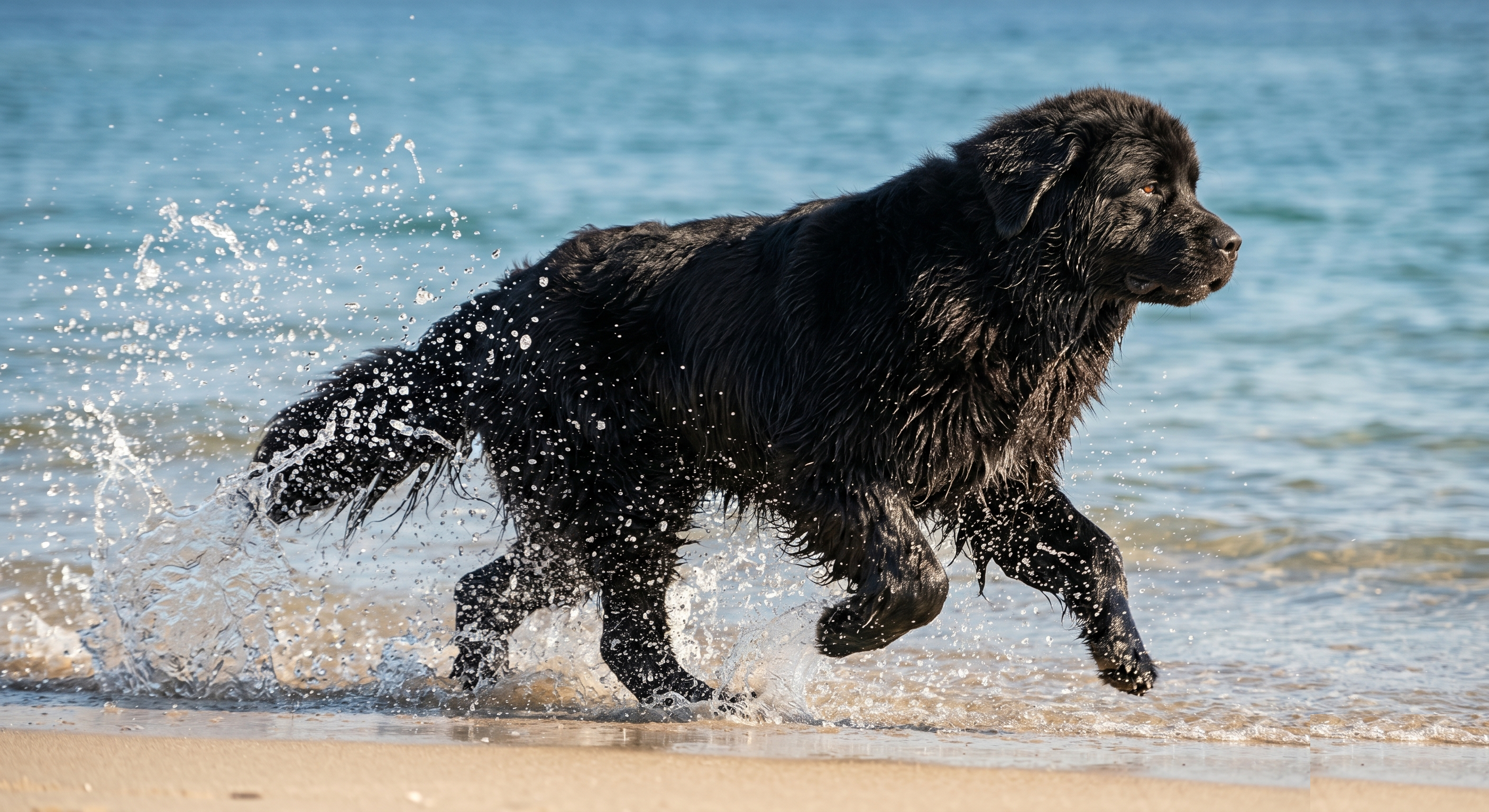
A Newfoundland should look massive, balanced, deep-bodied, heavily boned, and muscular. The head is broad and substantial, the expression soft and intelligent, and the overall impression one of dignity rather than speed. The breed standard calls for average adult heights of about 28 inches for males and 26 inches for females, with approximate weights of 130 to 150 pounds for males and 100 to 120 pounds for females.
The coat is one of the breed’s defining features: a flat, water-resistant double coat with a coarse outer layer and a soft dense undercoat. Accepted AKC colors are black, brown, gray, and white-and-black. White-and-black Newfoundlands are often called Landseers in everyday conversation, though the European Continental Type Landseer is treated as a separate breed in some systems.
Newfoundlands also have webbed feet, strong rear drive, and substantial lung capacity, all of which make sense for a breed developed for swimming, hauling, and steady work in rough conditions. They are not built for quick, darting movement. They are built for controlled power.
Personality & Temperament
Sweetness is the hallmark of the Newfoundland. Well-bred dogs are typically gentle, affectionate, patient, and deeply devoted to their people. They are often calm in the house, tolerant with children, and less sharp or reactive than many working breeds. That is one reason the breed earned its long-standing reputation as a beloved family companion.
Beneath that softness, however, is real substance. Newfoundlands are not fragile or passive dogs. Many are quietly independent, observant, and physically confident. They usually do not need constant activity to feel fulfilled, but they do best with closeness to family, stable routines, and respectful handling. Their nature is often cooperative rather than flashy. They are more likely to lean into people than bounce off the walls.
Under stress, many Newfs stay more deliberate than frantic. Some will keep moving toward familiar ground, family scent, or water edges. Others will settle nearby if they feel safe. Because the breed is generally social and soft, owners may assume a loose Newfoundland will run right up to helpers. Sometimes that is true. But fear can still override friendliness, especially in a giant dog suddenly overwhelmed by traffic, noise, or pursuit.
Living With This Breed
Living with a Newfoundland means living with size, coat, moisture, and heart. These dogs tend to want close household involvement, and they usually do best when they can be near their people rather than treated like decorative backyard giants. They need room to lie down comfortably, thoughtful joint protection while growing, and steady training around leash manners and household boundaries simply because their strength is so substantial.
Exercise needs are usually moderate rather than extreme. Most adult Newfs enjoy steady walks, swimming, carting or draft-style activities, and purposeful outings more than endless high-speed repetition. Many love water and will seek it out when given the opportunity. In warm weather, owners have to think carefully about heat management because a heavily coated giant breed can overheat faster than it looks.
Because of drool, shedding, mud, and sheer body mass, the Newfoundland is not an effortless dog to keep. But for the right household, the breed’s emotional steadiness and loyalty make the tradeoff worthwhile. Many Newf owners describe them as gentle household anchors.
History
The Newfoundland developed on the island of Newfoundland as a practical working dog for coastal life. Historical accounts describe large dogs used by fishermen to pull in nets, haul carts, move loads, and assist in frigid maritime conditions. The smaller St. John’s water dog, which later helped shape modern retrievers, is closely connected to this story as well.
Over time, the Newfoundland became famous not only as a fisherman’s helper but also as a lifesaving dog. Stories of Newfs rescuing people from water are woven deeply into breed history. That reputation is not just folklore: the breed’s structure and instincts were genuinely suited to cold-water work, hauling, and purposeful rescue.
The breed also gained cultural visibility through Lord Byron’s dog Boatswain, the Lewis and Clark expedition dog Seaman, and the black-and-white Newfoundlands painted by Sir Edwin Landseer. Today, the working heritage remains central to the breed’s identity even when most dogs live as companions.
Grooming & Health
Grooming a Newfoundland is serious maintenance. The dense double coat needs routine brushing to manage shedding, prevent mats, and keep skin and undercoat healthy. Owners should also expect seasonal blowouts, wet-coat cleanup, and some drool. Regular ear care matters too, especially for dogs who swim often.
As a giant breed, Newfoundlands deserve thoughtful orthopedic and cardiac awareness. Breed-related health concerns discussed in breed-club and veterinary sources include hips, elbows, cardiac disease, cystinuria, and bloat risk. Peer-reviewed studies have also found noteworthy predisposition in the breed for hip dysplasia, elbow dysplasia, cruciate problems, and dilated cardiomyopathy. That does not mean every Newfoundland will face these conditions, but it does mean responsible breeders and owners should take screening seriously.
Weight control, careful growth management, and avoiding unnecessary joint stress during puppyhood are especially important. Because these dogs mature into such substantial adults, even ordinary habits in feeding, flooring, conditioning, and exercise can matter over time.
TailTracker Recovery Insight
The Newfoundland is a giant working breed with a strong home-and-handler bond, moderate independent problem-solving ability, and unusually high water affinity. In recovery terms, that combination often produces a dog that does not flee with the same sharp, panicked pattern seen in high-strung or highly suspicious breeds. But it can still travel surprisingly well because it has the size, stamina, and confidence to keep going once loose.
TailTracker models the Newfoundland as high in home orientation, high in family attachment, moderate in stranger tolerance, and high in terrain confidence where water, beaches, ponds, marsh edges, or familiar walking corridors are involved. Some Newfs will try to return home. Others will drift toward the last familiar route, a shoreline, a dock area, or any place that feels open, cool, and navigable.
Because the breed is typically social and soft, recovery chances can be good when search pressure stays calm. The big mistake is assuming size makes a Newfoundland easy to manage. A frightened 120-pound dog that decides to keep moving can be difficult to stop, especially near roads or water.
If This Breed Goes Missing
Start by thinking like a purposeful giant, not a random drifter. A loose Newfoundland may stay closer than expected if home, routine paths, or family scent are nearby. But if the dog reaches open movement corridors or water, it may continue steadily rather than circling back quickly.
- Search immediately around home, familiar walking loops, driveways, shade lines, fields, and the quiet edges of roads or trails rather than assuming a long-distance sprint.
- Check ponds, rivers, beaches, marsh edges, boat ramps, docks, drainage paths, and any place where water access feels easy and inviting.
- Use trusted handlers, calm voices, and low-pressure approach. A Newf that is frightened may avoid commotion even if normally friendly.
- Avoid chasing or surrounding the dog, especially near traffic or water. Pressure can turn a manageable recovery into a slow moving but hard-to-stop flight.
- Because of the breed’s size, plan recovery equipment and transport in advance. A giant wet dog may not be safely lifted or contained the way a medium dog can.
In many cases, Newfoundlands are highly recoverable when helpers stay organized and think geographically: home routes, cool resting spots, and water-linked corridors first.
Fun Facts
Newfoundland dogs are among the few breeds whose public image as water rescuers genuinely matches their historical function. Their webbed feet, coat, and power were not decorative. They were practical tools for real work.
The black-and-white Newfoundland pattern became so closely associated with the painter Sir Edwin Landseer that many people still use “Landseer” as a nickname for those markings.
Although often called “gentle giants,” Newfoundlands are not sleepy ornaments. Properly conditioned dogs can be impressively athletic in water, draft work, and purposeful training.
Famous Examples
Seaman, the Newfoundland who accompanied Lewis and Clark, remains one of the most famous dogs in American exploration history. He traveled thousands of miles with the expedition and is commemorated in multiple monuments.
Boatswain, Lord Byron’s beloved Newfoundland, became part of literary history through Byron’s famous memorial tribute at Newstead Abbey.
Luath, J. M. Barrie’s Newfoundland, is often linked to the inspiration for Nana in Peter Pan. The breed’s public image as kind, watchful, and deeply loyal owes a lot to dogs like these.
Frequently Asked Questions
Are Newfoundlands likely to wander far?
Usually not in a frantic, scattered way, but they can cover meaningful distance if they settle into a steady route, especially toward water, open corridors, or familiar paths.
Are Newfoundlands easy to approach when lost?
Often more approachable than many guarding or herding breeds, but fear still changes behavior. A startled giant dog may avoid pressure and keep moving.
What is the biggest recovery mistake with a loose Newfoundland?
Underestimating the dog’s strength and assuming friendliness guarantees an easy capture. Calm containment matters more than optimistic grabbing attempts.
Build a recovery plan before you need one.
TailTracker helps pet owners prepare smarter with breed-informed recovery guidance, organized alert workflows, and practical tools designed to support faster reunions.
Built to help reunite lost pets with the people who love them.