Golden Retriever
Breed Guide
Warm, athletic, and famously easy to love, the Golden Retriever is the classic family sporting dog — but underneath that soft expression is a purposeful Scottish gundog built to retrieve over rough ground and cold water. When loose, Goldens often remain more socially connected than many breeds, yet their momentum, curiosity, food motivation, and love of people can carry them farther than owners expect.
5 min read · Practical pet-owner education with recovery-focused guidance
Overview
The Golden Retriever is a Scottish sporting breed developed in the nineteenth century to retrieve shot game over land and water with steadiness, intelligence, and a gentle mouth. It is one of the most widely recognized family dogs in the world, but that popularity sometimes obscures the breed's original design: the Golden is not just pleasant. It is a durable, athletic working retriever built to collaborate closely with people.
Breed standards consistently emphasize a balanced, active, powerful dog with a kindly expression and a willing, self-confident temperament. Goldens were designed to work with handlers rather than away from them, and that cooperative blueprint still shows up in everyday life. Many are highly trainable, eager to participate, and emotionally tuned to household routines.
TailTracker views the Golden Retriever as a breed whose lost-dog profile is shaped by four interacting factors: strong human orientation, high social and food motivation, moderate athletic range, and a real tendency to drift toward activity rather than retreat from it. The practical result is that a missing Golden is often more approachable than many breeds — but also more likely to be picked up, followed, or inadvertently kept moving by friendly human interaction.
Breed History
The Golden Retriever did not emerge by accident. The breed was carefully developed in the Scottish Highlands by Dudley Marjoribanks — later Lord Tweedmouth — who wanted an efficient retriever suited to wet climate, rough terrain, and the demands of fashionable shooting estates. The foundational breeding took shape in 1868 when a yellow retriever named Nous was bred to a Tweed Water Spaniel named Belle. From that pairing came the yellow line that would become the Golden Retriever.
Tweedmouth's breeding records show later influence from other retrievers and setter lines, helping refine both the coat and the temperament. The result was a dog with enough drive to work all day, enough softness to retrieve delicate birds without damage, and enough steadiness to remain biddable in the field. Early Goldens were called the "Flat-coated Retriever, Golden" before eventually becoming recognized as a separate breed.
The breed spread rapidly in the twentieth century. The Kennel Club in the United Kingdom recognized the Golden as a separate breed in 1913, and the AKC followed in 1925. Since then, the Golden Retriever has become one of the most successful dual-purpose breeds in the world — equally at home in field trials, guide work, therapy settings, family life, and popular culture.
Physical Characteristics
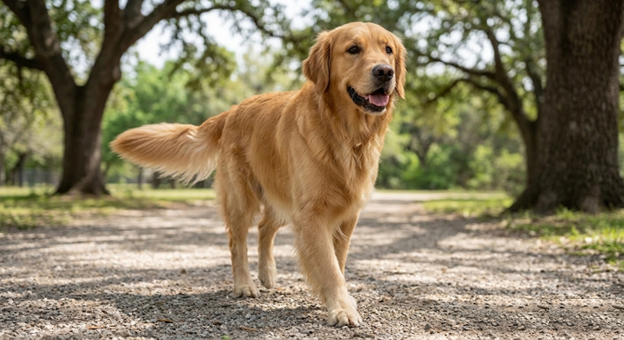
The Golden Retriever is a medium-large sporting dog with a strong, balanced outline and fluid movement. Adult males typically stand 23 to 24 inches at the shoulder; females 21.5 to 22.5 inches. Healthy adults generally weigh between about 55 and 75 pounds, with males larger than females. The breed should look athletic and capable rather than coarse or heavy.
The hallmark of the breed is the dense, water-repellent double coat with feathering along the legs, chest, underside, and tail. Coat shades range from light cream through warm gold to richer deeper gold. Working or field-bred Goldens often appear leaner, darker, and more athletic than heavier-coated show-line dogs, but both should retain the same underlying retriever structure and cooperative temperament.
Goldens are also famous for the so-called "soft mouth" — the breed's ability to carry game gently without crushing it. That trait reflects extraordinary control rather than softness in the weak sense. It is one of the clearest windows into how carefully the breed was engineered for collaborative work.
Temperament
Golden Retrievers are friendly, eager, optimistic dogs with a very strong bias toward human companionship. Most are naturally social with family, typically good with children, and more willing to greet than guard. This is one of the reasons the breed is so frequently chosen for guide work, therapy settings, service roles, and public-facing canine jobs.
But friendliness should not be mistaken for passivity. Goldens are intelligent, playful, emotionally open, and often highly stimulated by movement, smells, food, water, other dogs, and people. Many retain a puppy-like enthusiasm for years. When routine, exercise, and training are in place, this tends to make the breed joyful and easy to live with. When stimulation outruns structure, it can make a loose Golden harder to stop than owners expect.
TailTracker models the Golden as socially confident, highly human-oriented, and generally recoverable — but still capable of overshooting a recall or turning recovery into a game if the scene becomes loud, chase-based, or overexcited. A Golden often wants contact. The trick is making sure helpers do not unintentionally keep the dog moving.
Living With This Breed
Golden Retrievers generally do best in active homes that offer daily exercise, meaningful companionship, and routines that engage both body and brain. They enjoy walks, retrieving games, water, training sessions, travel, and inclusion in family life. Many are happiest when they feel involved in the household rather than merely accommodated by it.
Because the breed is so easy to like, owners sometimes underestimate how much structure still matters. Goldens often mature slowly, remain playful well into adulthood, and can become exuberant, mouthy, or distractible without clear boundaries. Early reward-based training, leash manners, recall work, and solid household habits pay off enormously.
- Needs regular exercise and active engagement — not just yard access.
- Thrives with retrieving games, training, water play, scent work, and family participation.
- Very social; many do poorly with long isolation or low-interaction households.
- Can be highly food-motivated, which helps training but increases weight-gain risk.
- Often slow to mature emotionally, with an extended playful phase.
- May drift toward people, dogs, parks, and routine outing routes when loose.
Grooming and Health
Coat care is moderate but ongoing. The Golden Retriever's dense double coat benefits from routine brushing, especially around the feathering, and seasonal shedding can be substantial. The breed's real long-term management concern, however, is health. Reputable Golden breeding programs place strong emphasis on hip, elbow, eye, and heart screening, and breed clubs continue to highlight significant inherited-health risk.
Cancer is the most widely discussed breed-level health concern in Golden Retrievers, particularly when compared with many other popular breeds. Goldens are also predisposed to conditions such as hip and elbow dysplasia, certain eye disorders, hypothyroidism, and skin issues. For day-to-day care, the breed's appetite and sociability can also make weight management a real priority, especially in less active homes.
From a recovery standpoint, the most field-relevant implications are stamina, coat, and temperament. Goldens can keep moving longer than many companion breeds, especially in cool weather and open spaces. Their love of water also matters operationally: ponds, creeks, beaches, marsh edges, and neighborhood drainage areas deserve early attention during a search.
Fun Facts
- Created with records, not myth: Lord Tweedmouth's breeding books survived, which is rare enough in breed history that we can trace the Golden Retriever's early development with unusual precision.
- The raw egg challenge is real: The breed's famous "soft mouth" is so refined that many Goldens can carry a fragile object gently without crushing it — exactly the quality needed to retrieve birds intact.
- A serious athlete in a friendly disguise: The Golden's public image is cuddly, but the breed was designed to work full shooting days over rough Highland terrain and cold water.
- Three familiar style impressions: Owners often talk about English cream, American, and field-bred or Canadian-style Goldens. These are not separate breeds, but they do reflect visible differences in build, coat, and athletic emphasis.
- Water is often part of the story: Many Goldens are strongly drawn to ponds, marsh edges, beaches, streams, and muddy shoreline routes — a practical search consideration, not just a cute trait.
- One of Hollywood's favorite breeds: The Golden Retriever's trainability, expressive face, and approachable temperament made it a natural fit for film and television families for decades.
- The shadow instinct: Goldens are famous for following their people from room to room and preferring physical proximity, which is why many families describe them as emotional "velcro" dogs in a sporting-dog body.
- Field lines still matter: Leaner, darker, more intensely driven Goldens from working lines can present a meaningfully more athletic search profile than heavier, calmer show-line dogs.
Famous Examples
- Buddy (Air Bud) — The athletic Golden who became one of the best-known canine movie stars of the modern era, cementing the breed's reputation for trainability and charm.
- Shadow (Homeward Bound) — The wise older Golden Retriever whose loyalty and endurance made him one of the breed's most memorable fictional ambassadors.
- Comet (Full House) — A television Golden that helped fix the image of the breed as the ideal affectionate family dog in American popular culture.
- Liberty — President Gerald Ford's Golden Retriever, a notable White House representative of the breed.
- Orca — A Golden Retriever recognized with the PDSA Gold Medal for bravery, highlighting the breed's service and working capacity beyond companionship.
TailTracker Recovery Insight
The Golden Retriever fits a distinctive recovery profile: high social orientation, moderate travel potential, strong food motivation, and relatively high stranger tolerance. This is different from a deeply evasive primitive breed, a territory-driven guardian, or a scent-locked hound. A Golden that gets out is often not trying to disappear. It is following motion, joining activity, investigating smells, seeking people, or continuing a familiar outdoor pattern.
The behavioral sequence TailTracker models for this breed is: trigger or opportunity → enthusiastic movement → social drift or route-following → pause near people, food, water, or comfort. Some Goldens will run to the nearest park, school field, walking loop, beach access point, or neighborhood social hub. Others will end up on a stranger's porch, inside an open garage, or being "rescued" by a well-meaning passerby who assumes the dog belongs to nobody nearby.
This produces a recovery pattern with high upside if handled correctly. Many Goldens can be recovered relatively quickly through calm owner presence, food, familiar toys, and soft social invitation. But when multiple people begin calling, running, cornering, or treating the situation casually because "he loves everyone," the dog may continue drifting outward and turn an easy containment into a much larger search.
If This Breed Goes Missing
Think socially, not just geographically. A missing Golden Retriever may still be close — but just as often the dog has moved along a familiar recreational route or drifted toward people, open space, dogs, food, or water. Prioritize parks, school grounds, beaches, neighborhood loops, trail entrances, and any public space the dog associates with activity or pleasure.
- Check social hubs early. Parks, school grounds, dog-walking routes, beaches, athletic fields, and neighborhood gathering spots often outperform random road searches.
- Use food and familiarity. Rotisserie chicken, hot dogs, favorite toys, and a bonded handler's calm presence can work exceptionally well with this breed.
- Avoid turning recovery into a chase. Even a friendly Golden may keep running if people rush in, clap, shout, or try to corner the dog.
- Check water sources. Creeks, ponds, marsh edges, retention basins, and beach access points matter more here than with many breeds.
- Call nearby homes and businesses. A Golden is one of the breeds most likely to be temporarily taken in by someone trying to help.
- Search likely comfort spots. If truly frightened, a Golden may den under a porch, in tall grass, inside a shed, or beside a structure and wait quietly.
- Use a happy, light approach. Calm invitation usually beats pressure; many Goldens respond better to warmth than urgency.
Once sighted, prioritize soft containment over assertive capture. Approach from the side rather than head-on if needed, crouch or sit, keep voices warm, and let the dog choose engagement. If fear or repeated motion has already set in, switch to passive setup with food, familiar scent, and a reduced human footprint.
Frequently Asked Questions
How far can a Golden Retriever travel when lost?
Farther than many owners assume. Goldens are athletic sporting dogs, not just couch companions. Many still remain highly recoverable, but in open space or along familiar outing routes they can cover real ground before settling.
Why are Golden Retrievers often described as easy to recover?
Because many are strongly people-oriented, food-motivated, and relatively tolerant of strangers. That said, "easy" disappears quickly if helpers create a chase or if the dog keeps getting rewarded for movement by new social attention.
Is every Golden Retriever equally social when loose?
No. Individual temperament, stress level, age, training, and line all matter. A field-bred, highly driven Golden can behave differently from a calmer show-line household dog, and a frightened Golden may avoid approach even if it is normally very friendly.
What is the biggest recovery mistake with a Golden Retriever?
Assuming friendliness guarantees instant capture. Goldens are often more approachable than other breeds, but overconfident helpers can accidentally keep the dog moving by calling, running, clapping, or turning the event into an exciting game.
Why should water be checked early for this breed?
Because many Goldens are naturally drawn to ponds, creeks, beaches, marsh edges, and shoreline routes. Their retriever history and love of water make those areas operationally important during search.
Related Breed Guides
Comparing recovery behavior across other sporting, family-oriented, or highly social breeds can help refine search expectations.
Build a breed-informed recovery plan before your dog ever goes missing.
TailTracker helps pet families prepare smarter with breed-aware recovery guidance, coordinated alerts, and a faster path from panic to action.
Most lost-pet tools broadcast alerts.
TailTracker coordinates the recovery.