Cairn Terrier
Breed Guide
Scrappy, curious, and always ready to investigate, the Cairn Terrier is a classic Scottish earthdog. Its prey drive, confidence, and love of movement through tight terrain can strongly shape what happens after escape.
5 min read · Practical pet-owner education with recovery-focused guidance
Overview
The Cairn Terrier is one of Scotland’s classic working terriers: small, hardy, alert, and built to go where bigger dogs cannot. It was developed as an earthdog that could move through rough farm country, flush vermin from rock piles, and keep working with determination despite weather, brush, or uneven ground.
Modern Cairns still carry that practical wiring. They may be small, but they are rarely passive. Many are cheerful, social, and affectionate with their people, yet they also remain highly curious, eager to explore, and willing to act on movement or prey cues with very little hesitation.
That combination is exactly why the breed matters in TailTracker. A loose Cairn Terrier may not range like a large sporting dog, but it can move quickly through cover, investigate narrow paths, and disappear into everyday terrain features that larger dogs cannot use as efficiently.
Physical Characteristics
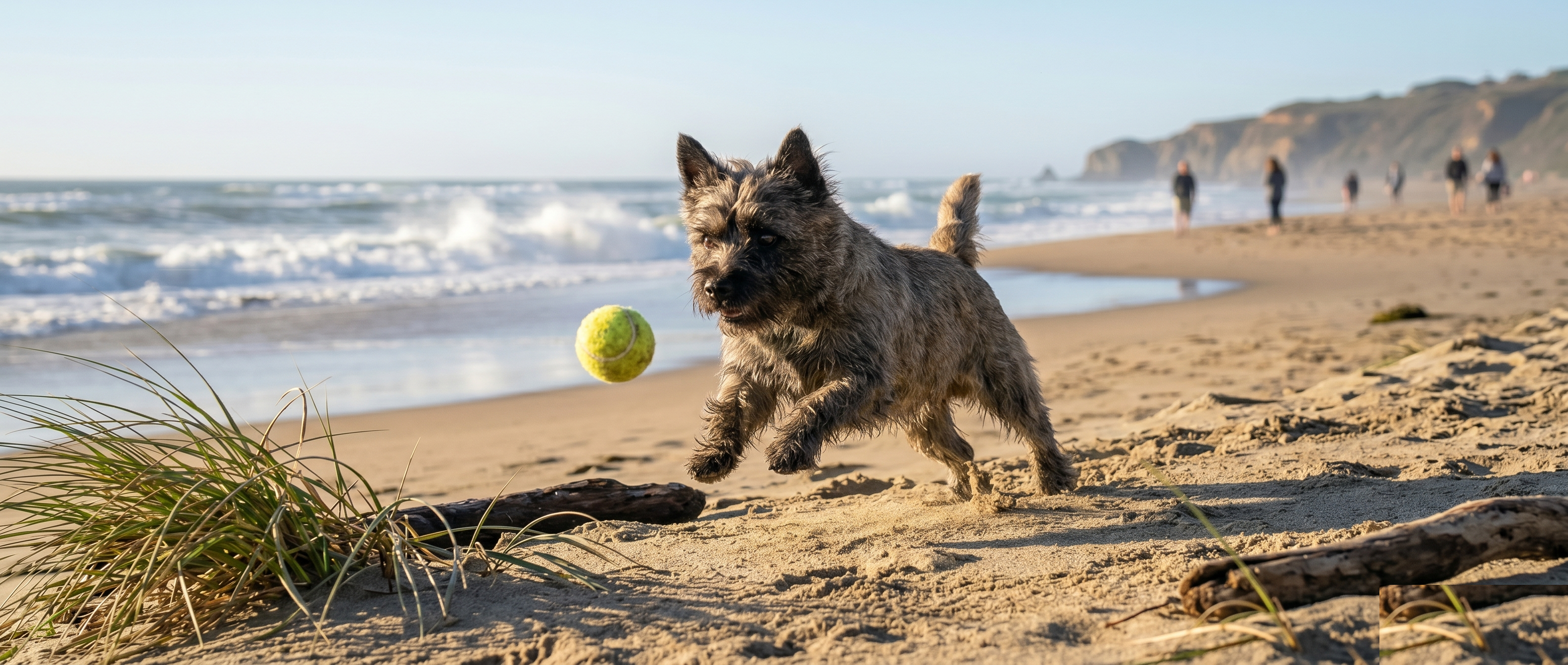
The Cairn Terrier is compact, sturdy, and functional rather than ornamental. The breed standard look is rough-and-ready: a shaggy, weather-resistant outer coat over a softer undercoat, a broad head, upright ears, and a body that feels balanced and agile rather than delicate.
Cairns commonly stand about 11 to 12 inches at the shoulder and usually weigh about 13 to 17 pounds. Their coat colors can include cream, wheaten, red, gray, black, and brindle shades, and brindled dogs may shift in color over time as they mature.
Recovery-wise, the important traits are practical: a body small enough to exploit tight terrain, enough toughness for rough footing, and enough agility to move confidently through brush, rock edges, shrubs, and low cover.
Personality & Temperament
Cairn Terriers are often bright, confident, cheerful, and busy. They tend to be socially engaged with their humans while still retaining the independent-minded streak common in true terriers. They are not generally clingy lapdogs, even though many enjoy affection and settle happily with family after activity.
Many Cairns are friendly with people and remain playful well into later life. They are often active, alert, and quick to learn, but their intelligence comes with self-direction. A Cairn may understand exactly what you want while still preferring to investigate something more interesting in the environment.
Their prey drive is especially important. Outside, squirrels, rabbits, rustling brush, small openings, and movement near the ground can all trigger immediate pursuit or investigation. That makes the breed endearing in daily life and operationally important in recovery planning.
Living With This Breed
Cairn Terriers often adapt well to many living situations, including apartments, suburban homes, and farms, provided they get enough activity and mental engagement. They are lively rather than lazy, and they usually do best when daily life includes walks, play, training, and opportunities to investigate.
Secure containment is important. A Cairn may be small, but it is not casually safe off leash in prey-rich areas. Their willingness to chase, dig, squeeze through cover, or investigate narrow openings means management matters more than many first-time owners expect.
These dogs also tend to dislike being bored. A Cairn with too little to do may become barky, mischievous, or more interested in creating its own entertainment. The breed usually responds best to consistency, positive training, and households that appreciate a little terrier opinion.
History
The Cairn Terrier comes from the Scottish Highlands and the Isle of Skye, where early terriers were used to root out vermin from rock piles and rough farmland. The breed name comes from cairns, the man-made rock piles where these terriers often worked.
Historically, the breed was once associated with the name “short-haired Skye Terrier,” but that name was rejected during formal recognition, and “Cairn Terrier” became the accepted name instead. The breed later received separate recognition in the United Kingdom and established itself as a distinct Scottish terrier type.
This history matters because the Cairn was not designed to be decorative. It was bred to be useful: agile, self-reliant, weather-resistant, and fully willing to engage with rough terrain and quick-moving quarry.
Grooming & Health
The Cairn’s coat is one of its defining features: a hard outer coat over a softer undercoat. To keep the proper texture and rough natural appearance, regular brushing and periodic professional coat maintenance are helpful, especially for owners who want to preserve classic terrier presentation.
Cairns are generally considered a long-lived breed. Recent breed health literature places typical lifespan in the mid-teens, with a 2024 UK study estimating life expectancy at about 14 years.
Reported health concerns in the breed include eye disorders, luxating patella, Legg-Calvé-Perthes disease, hypothyroidism, and some other inherited conditions. The breed is also noted as predisposed to atopic dermatitis, so routine veterinary care and responsible breeding practices matter.
TailTracker Recovery Insight
The Cairn Terrier is one of the clearest examples of a small dog that may remain neighborhood-scale while still being tactically difficult to recover. TailTracker models this breed as highly curious, moderately independent, quick to investigate movement, and comfortable using tight terrain features that owners often overlook.
A loose Cairn may not travel in a huge straight-line range, but it may move in fast, clever transitions: hedge to porch, porch to rock wall, wall to shrub line, shrub line to gap under a fence. Because the dog is compact, alert, and prey-responsive, the search challenge is often less about miles traveled and more about how effectively the dog can use cover and small-dog corridors.
This makes the Cairn very different from a broad-ranging field dog and also different from a passive companion breed that simply freezes in place. Recovery often depends on understanding terrier logic: investigate, pursue, tuck into cover, then repeat.
If This Breed Goes Missing
A loose Cairn Terrier often calls for an immediate, close-range, terrain-aware search. This is a breed that can stay local while still becoming surprisingly hard to secure.
- Search fence lines, shrub beds, rock walls, decks, sheds, crawlspaces, wood piles, and low cover immediately.
- Check prey-rich areas early, especially where squirrels, rabbits, chipmunks, or brush movement are common.
- Avoid direct chase. A pressured Cairn may dash through an opening or turn recovery into repeated short-distance evasion.
- Use calm, familiar voices and strategic positioning rather than crowding the dog.
- Think in tight movement chains rather than large-distance assumptions. The dog may be very close but hard to intercept.
The biggest mistake is assuming that because the dog is small, the search can stay casual. Cairns are often nearby, but they are nearby in a very terrier way.
Fun Facts
The Cairn Terrier takes its name from cairns, the rock piles in Scotland where these dogs once worked vermin out of hiding.
The breed was developed to go where larger dogs could not, which helps explain the Cairn’s trademark confidence in tight spaces, rocky ground, and rough cover.
Brindled Cairns can change noticeably in color as they age, sometimes becoming darker, silvered, or more muted over time.
Cairns are small, but they are not delicate. Their rough weather-resistant coat and sturdy build reflect a true working-terrier background rather than a purely ornamental one.
Many Cairn Terriers keep a youthful, game-for-anything attitude well into adulthood, which is a big part of the breed’s long-standing reputation for spark, humor, and mischief.
Famous Examples
Toto from The Wizard of Oz remains the Cairn Terrier’s best-known popular-culture ambassador and helped fix the breed in the public imagination for generations.
Danny (Snuffy) became a prominent Hollywood Cairn Terrier, appearing in productions such as Pal Joey, Anatomy of a Murder, and I Love Lucy.
Splinters of Twobees is remembered as one of the most important early Cairn Terrier stud dogs, earning eight Challenge Certificates and helping shape the breed in its formative years.
Redletter McRuffie was an influential Cairn Terrier imported to Canada by breeder Betty Hyslop and is associated with the breed’s development in North American lines.
Frequently Asked Questions
Are Cairn Terriers likely to wander far?
Usually not in the way large sporting breeds do, but they can move quickly and cleverly through tight terrain if prey or curiosity keeps rewarding movement.
Are Cairn Terriers easy to catch when loose?
Not always. They are often more local than people expect, but also more evasive and terrain-savvy than many companion breeds.
What is the biggest recovery mistake with a loose Cairn Terrier?
Underestimating how effectively a small, confident terrier can use cover, gaps, and edge terrain while still staying close by.
Be ready before an emergency.
TailTracker helps owners prepare before a pet goes missing, so they can act faster with a clearer plan if the unthinkable happens.
Most lost-pet tools broadcast alerts.
TailTracker coordinates the recovery.