Dachshund
Breed Guide
Bold, determined, and far more independent than their small size suggests, the Dachshund is a classic scent-and-earth dog whose tracking instinct, digging drive, and stubborn persistence can strongly shape what happens after escape. That makes this breed especially important for recovery planning.
5 min read · Practical pet-owner education with recovery-focused guidance
Overview
The Dachshund is a short-legged, long-bodied hunting breed developed in Germany to scent, chase, and flush badgers and other burrow-dwelling animals. Miniatures were also used on smaller quarry, especially rabbits. That original job matters because the Dachshund was not built merely to look distinctive. It was built to pursue scent, enter tight ground, and keep going.
What makes the breed especially distinctive is the combination of size and determination. Dachshunds often look companion-sized, but behaviorally many still show the confidence, persistence, and independence of serious working dogs. They can be affectionate and funny at home, yet remarkably stubborn once instinct takes over.
This is one of the clearest examples of a breed where small size can mislead owners. A Dachshund may look easy to contain, but in the wrong moment it can move with surprising purpose, vanish into cover, track scent far beyond expectation, or wedge itself into places bigger breeds would ignore.
Personality & Temperament
Dachshunds are often described as clever, lively, bold, brave, and vivacious. Many are strongly bonded to their people, but that does not automatically make them compliant. The breed is widely known for stubbornness, persistence, and a willingness to ignore human preferences once something interesting captures its attention.
A well-adjusted Dachshund can be affectionate, playful, and full of personality. At the same time, many are suspicious of strangers, vocal about environmental changes, and quick to challenge dogs or situations that appear larger than they are. That mismatch between body size and self-perception is part of what makes the breed so memorable.
Under stress, Dachshunds do not always default toward broad social reassurance. Some cling closely to familiar people, but others become surprisingly self-directed. If scent, prey movement, or escape momentum takes over, recall may drop sharply.
Living With This Breed
Living well with a Dachshund means respecting both the dog's personality and its physical structure. Most do best with daily walks, sniffing time, controlled exploration, training repetition, and thoughtful household management. They are often happiest when they are included, mentally engaged, and allowed to use their noses.
Dachshunds commonly enjoy tracking scent, burrowing under blankets, barking at arrivals, patrolling windows, and inspecting edges, holes, brush, and under-structure spaces. Many are entertaining and deeply affectionate, but the breed often benefits from calm rules and steady repetition more than from casual assumptions that it will simply follow along.
Because the breed's long back and short rib cage create real structural vulnerability, everyday life also needs practical care. Weight control, muscle tone, and avoiding reckless jumping or rough handling are especially important.
History
The Dachshund is a German breed whose name literally means “badger dog.” Historically, it was developed to go to ground after badgers and other burrowing animals, and to use scent, persistence, and digging ability in hard conditions. Over time, miniature forms were used for smaller quarry such as rabbits.
The breed later diversified into smooth, long-haired, and wire-haired varieties, but the working blueprint remained: an earth dog with courage, nose, determination, and the willingness to press into tight spaces.
That history matters for recovery planning. A Dachshund is not simply a low companion dog. It comes from a lineage that values pursuit, persistence, and ground-level problem solving.
TailTracker Recovery Insight
The Dachshund is one of the most underestimated lost-dog profiles in the field. Owners often assume a small dog will stay near home or be easy to scoop up. But a scent-driven, stubborn Dachshund may follow a trail, disappear into brush, duck under structures, or keep moving along edges and cover lines with surprising determination.
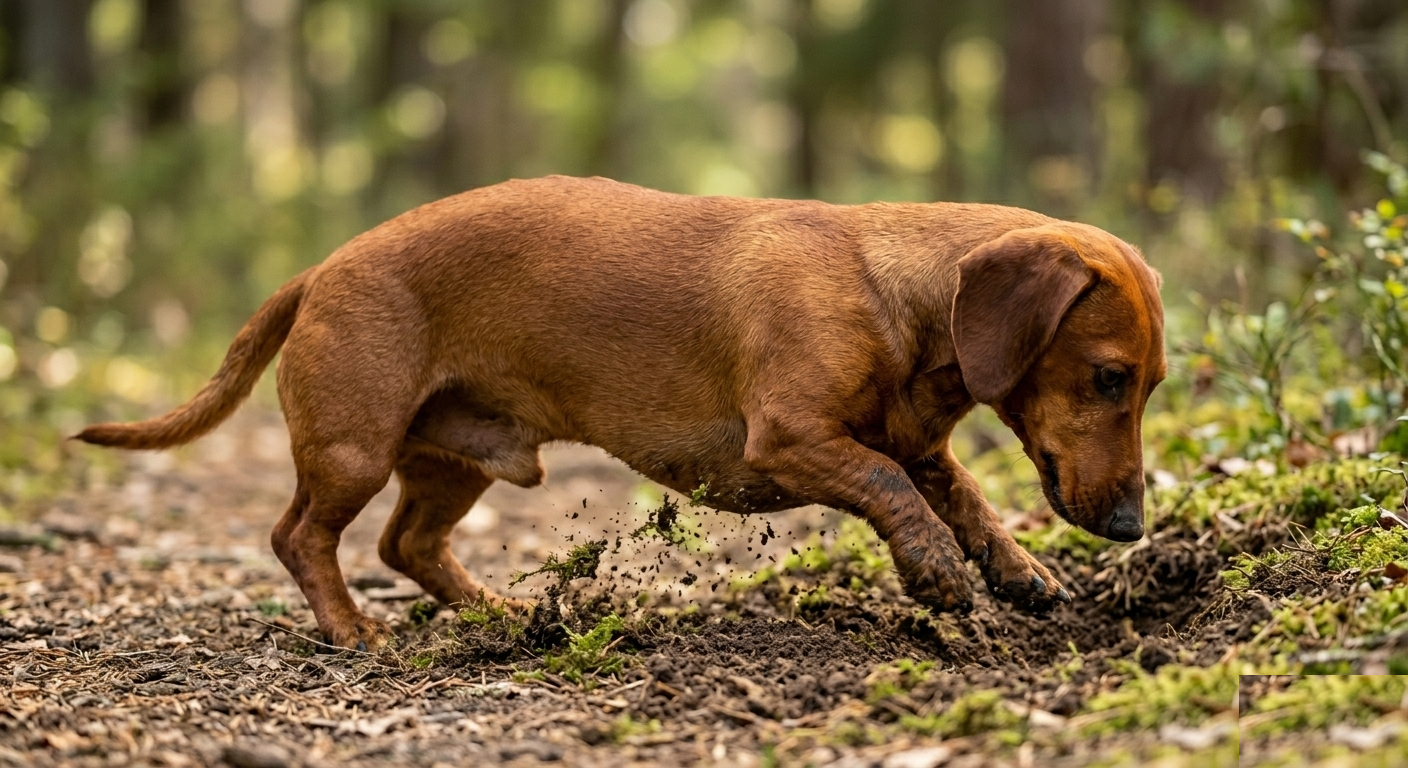
This breed is especially important because its likely movement is often horizontal, hidden, and low-profile rather than obviously wide-ranging. A Dachshund may not cross miles of open terrain like a large hound, yet it can still become extremely difficult to locate if it moves into thick cover, drainage edges, foundation gaps, woodpiles, sheds, porches, crawlspaces, retaining-wall voids, or rabbit-rich brush zones.
TailTracker models this breed as high in persistence, high in ground-level cover use, moderate in stranger tolerance, and strongly vulnerable to chase errors. The breed may also be more likely than owners expect to bark defensively or evade capture when pressure rises.
If This Breed Goes Missing
A loose Dachshund may stay closer than a larger hunting dog in terms of raw radius, but it can become much harder to recover if it gets under, behind, or into things. Do not assume visibility equals accessibility. Many Dachshunds hide well, track low, and commit stubbornly to an interesting direction once momentum starts.
- Search first under decks, porches, sheds, stairs, crawlspace edges, woodpiles, brush lines, retaining walls, and fence gaps.
- Work slowly along scent-interest zones such as rabbit cover, garden edges, hedgerows, drainage lines, and familiar walking paths.
- Avoid direct chase. A small dog that feels cornered may slip under something or keep tracking away from pressure.
- Use familiar voices, food, calm crouching posture, and low-pressure containment instead of fast approaches from above.
- Check burrow-like spaces, low openings, and neighborhood edges repeatedly. A Dachshund may hold in cover rather than traveling far into the open.
The biggest operational mistake with this breed is underestimating how working-dog stubbornness combines with small-body stealth. A Dachshund can disappear in very little space.
Health & Practical Care
The Dachshund is particularly associated with intervertebral disc disease, often abbreviated IVDD. Because of the breed's very long spine and short structure, excess weight, repeated jumping, rough handling, and poorly managed activity can place additional strain on the back.
That matters for both daily care and recovery. If a Dachshund goes missing, owners should not only think about where the dog may have gone, but also about what kinds of movement or terrain might put the dog at physical risk. A frightened Dachshund that repeatedly jumps off obstacles, forces into narrow places, or remains stuck in awkward cover may be especially vulnerable.
Practical ownership priorities include keeping body condition lean, supporting daily muscle tone, handling the dog carefully, and using ramps or other management tools where appropriate. A safe Dachshund lifestyle is not just about comfort; it is about preserving function.
Frequently Asked Questions
Are Dachshunds likely to wander far?
They may not always travel huge open distances, but they can follow scent farther than owners expect and are especially good at disappearing into low cover and tight spaces.
Are Dachshunds easy to approach when lost?
Not always. Some will come to familiar people readily, but others become stubborn, barky, evasive, or suspicious under stress, especially if chased or crowded.
What is the biggest recovery mistake with a loose Dachshund?
Assuming that because the dog is small, recovery will be easy. Low-profile movement, stubbornness, scent commitment, and hiding behavior can make them deceptively difficult to secure.
Be ready before an emergency.
TailTracker helps owners prepare before a pet goes missing, so they can act faster with a clearer plan if the unthinkable happens.
Most lost-pet tools broadcast alerts.
TailTracker coordinates the recovery.