Poodle
Breed Guide
Highly intelligent, athletic, and uniquely available in four official size varieties, the Poodle is among the most recognizable and capable breeds in the world. It is also the one breed in the TailTracker database whose lost-dog profile shifts most dramatically by size. A Toy Poodle and a Standard Poodle are the same breed on paper — and genuinely different recovery scenarios in practice.
5 min read · Practical pet-owner education with recovery-focused guidance
Overview
The Poodle — known in German as the Pudel and in French as the Caniche — is one of the world's most popular and most recognizable breeds. It is also genuinely unusual in how it is organized. Most major kennel clubs recognize three or four size varieties of a single breed: the Standard Poodle, the Miniature Poodle, the Toy Poodle, and (recognized by the FCI and most Continental European registries) the Medium Poodle.
Underneath the size differences, all four varieties share a common temperament profile: high intelligence, strong trainability, social orientation, and a genuinely athletic build designed originally for retrieving waterfowl. Behind the elaborate show-ring grooming sits a working gundog — the Standard Poodle is a hunting breed with prey drive, a love of water, and real physical range.
TailTracker views the Poodle as the one breed in the database where size variant is the primary recovery variable. A Toy Poodle loose in an urban neighborhood is at meaningful risk from cars, larger dogs, and birds of prey. A Standard Poodle loose near open water, fields, or waterfowl habitat is an athletic retriever doing exactly what the breed was built to do. The search strategy for these two scenarios should not be the same.
The Four Size Varieties
Size is the defining organizing principle of the Poodle breed. The FCI breed standard recognizes four varieties by height at the shoulder:
- Standard Poodle: 18–24 in (45–62 cm) at the shoulder, 44–71 lb. Originally bred as a water-retrieving gundog, and still the variety most commonly used in modern hunt-test and retriever work.
- Medium Poodle: 14–18 in (35–45 cm), 20–29 lb. Recognized by the FCI and most Continental European kennel clubs, but not universally recognized in the UK or US.
- Miniature Poodle: 11–14 in (28–35 cm), 26–31 lb. Developed largely through circus breeding in 19th-century France, where smaller, easier-to-transport Poodles were used as performing dogs.
- Toy Poodle: 9.4–11 in (24–28 cm), 4.4–6.6 lb. Developed in the early 20th century as a purpose-bred companion dog — a toy-sized replica of the working Standard Poodle.
The US Kennel Club does not recognize the Medium Poodle, classifying dogs in that size range as either Standard or Miniature. There is no such thing as a "Teacup Poodle" in any responsible registry — early attempts to breed a smaller variety produced serious genetic abnormalities and were discontinued.
Breed History
Most cynologists believe the Poodle originated in Germany during the Middle Ages, developed as a dedicated water retriever for wildfowl hunters. The German breed name Pudel comes from the Low German word puddeln — meaning "to splash" — and works by German artists depicting recognizably Poodle-type dogs date from at least the 17th century.
The Fédération Cynologique Internationale, however, officially recognizes France as the breed's country of origin, citing the French name Caniche and a proposed descent from the French Barbet. A minority of cynologists have proposed Russian, Piedmontese, or Northwest African origins instead. Whatever the exact origin, both major European breed names — Pudel and Caniche — reference water and waterfowl work, confirming the core working role.
From the 18th and 19th centuries onward, French circuses played a major role in developing the smaller varieties, selectively breeding Poodles down to a more portable size for performance work. The Miniature Poodle variety emerged from this tradition, known as "tightrope walkers, comedians, and even card-trick performers" in travelling circuses of the period. The Toy Poodle was developed later, in the early 20th century, as a dedicated companion dog — a toy-sized replica of the working breed rather than a new performing variety.
The Poodle was recognized by the Kennel Club of the United Kingdom in 1874 and by the American Kennel Club in 1886. In the United States, the breed remained relatively uncommon until 1935, when Nunsoe Duc de la Terrace won Best in Show at Westminster. From there, Poodle popularity exploded — the breed was the AKC's most-registered breed every year from 1960 to 1982 and remains among the most popular breeds worldwide today. As of 2012, the Poodle was the third-most registered breed by the FCI globally, behind only the Labrador Retriever and German Shepherd.
Physical Characteristics
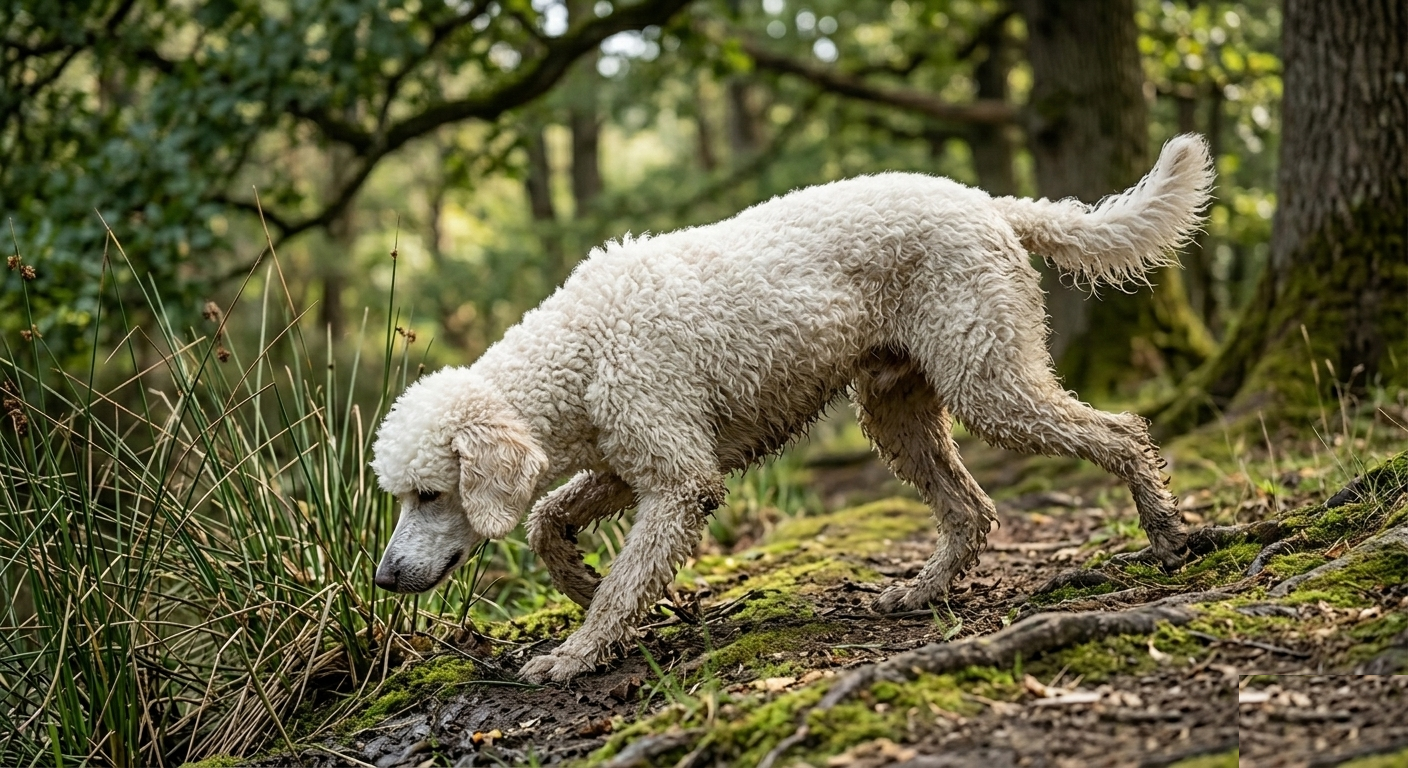
Across all varieties, the Poodle is a square-proportioned, athletic, well-balanced dog. The most distinctive feature is the coat: thick, curly, and single-layered, with a growth cycle and follicle structure unusual among dog breeds. Poodles are often cited as a hypoallergenic breed because their coat traps dander rather than shedding it into the environment, although allergy researchers have generally not found clear evidence of reduced allergens across breeds.
The breed's famously elaborate show clips — Continental, English Saddle, Sporting — are not purely aesthetic. The Continental clip in particular has a documented working origin: a Poodle swimming in cold water to retrieve game benefited from a shaved hindquarters (for mobility and reduced drag) while retaining longer hair over the chest, joints, and vital organs for insulation. The pompoms on the ankles, tail tip, and hips are the decorative survivors of what were originally functional protective tufts.
Coat colors are extensive: the FCI formally recognizes black, white, brown, grey, fawn, brindle, black&fawn, brown&fawn, bicolor, and tricolor. The AKC recognizes both solid and multi-colored Poodles, though only solid-colored dogs may compete in conformation. Apricot, red, silver, café au lait, and cream are all commonly seen in pet Poodles.
Temperament
Poodles are consistently described as highly intelligent, highly trainable, energetic, and sociable. Stanley Coren's landmark 1994 ranking of canine working and obedience intelligence placed the Poodle second out of 130 breeds — behind only the Border Collie — reflecting the breed's exceptional ability to learn from and work with humans. Shyness or sharpness is explicitly considered a serious fault in the breed standard.
The practical implication is that Poodles respond unusually well to training but also learn unintended behaviors with the same efficiency. A clever Poodle that has figured out how to open a back gate, jump a fence, or operate a specific door latch will continue to use that knowledge. This matters for recovery planning because repeat-escape behavior is genuinely more common in this breed than in lower-IQ working breeds.
TailTracker models the Poodle as a highly trainable, highly aware, size-variable breed. When loose, a well-socialized Poodle of any variety is often responsive to familiar recall cues, familiar humans, and food incentives. The complicating factors are size-specific: a Toy Poodle's risk profile is dominated by vulnerability to predators and traffic; a Standard Poodle's risk profile is dominated by distance, water, and prey drive.
Living With This Breed
Poodles thrive in active, engaged households that can provide meaningful physical exercise and, critically, mental stimulation. An under-stimulated Poodle is often a Poodle that invents its own problem-solving projects — counter-surfing, escape routes, elaborate attention-getting behaviors. For Standard Poodles especially, moderate-to-high daily exercise is essential.
Grooming is a significant ongoing commitment across all varieties. Professional clipping every four to eight weeks is typical for pet Poodles, and the coat requires regular brushing between appointments to prevent mats. The famous low-shedding quality cuts both ways: hair that would otherwise shed tends to stay in the coat, which both reduces environmental allergens and dramatically increases matting risk without consistent care.
- Exceptional trainability; responds well to consistent, reward-based training.
- Needs meaningful mental stimulation in addition to physical exercise.
- Can learn escape behaviors — gates, latches, fence heights — and retain them.
- Significant grooming commitment: professional clipping every 4–8 weeks plus regular brushing.
- Generally sociable but can be reserved with strangers if not well socialized.
- Lifespan varies sharply by size — Toy Poodles often live 14–18 years; Standards typically 10–14.
Grooming and Health
Coat care is the defining daily reality of Poodle ownership, and the continuous curly growth means that neglect produces matting quickly. Most Poodles are professionally groomed every four to eight weeks, with regular at-home brushing between appointments. Ears also require consistent attention because the curly coat that grows inside the ear canal can trap moisture and contribute to infections.
The breed has several well-documented hereditary health considerations, many of which became more prevalent after the mid-20th-century popularity boom drove rapid breeding from a narrow pool of show lines. A 2015 study found that two average Standard Poodles are about as closely related as full siblings from an unrelated village-dog population — a striking indicator of genetic bottlenecking. Sebaceous adenitis (a skin condition) and Addison's disease (an endocrine disorder) are among the best-known breed-specific risks. Progressive rod-cone degeneration, hypothyroidism, and Cushing's syndrome are also more common in Poodles than in the general canine population.
Life expectancy varies substantially by size. A 2024 UK longevity study found an average of 14 years across Poodles — meaningfully above the purebred average of 12.7 — with smaller varieties typically outliving larger ones. A Japanese study of Toy Poodles specifically found a median of 12.7 years, and a 2005 Swedish insurance-records study found that only 25% of Miniature and Toy Poodles had died by age 10, compared to 35% of dogs overall.
For recovery planning, the most field-relevant health variables are vision (progressive rod-cone degeneration can meaningfully impair low-light navigation in older Poodles) and endurance (older Standard Poodles with undiagnosed Addison's disease may fatigue or collapse unexpectedly under stress).
Fun Facts
- A water dog by name: The German name Pudel derives from puddeln, meaning "to splash" — a direct reference to the breed's original role as a waterfowl retriever. The English word "puddle" shares the same root.
- Four official sizes: No other major breed is recognized across four distinct size varieties — Toy, Miniature, Medium, and Standard — with the Medium recognized by the FCI but not by all national kennel clubs.
- The haircut has a job: The famous Continental clip, with its shaved hindquarters and pompoms at the joints, originated as working equipment. A Poodle swimming to retrieve cold-water waterfowl was more efficient without heavy rear coat, but needed insulation over vital organs and joints.
- Intelligence ranked #2: In Stanley Coren's 1994 evaluation of canine working and obedience intelligence, the Poodle ranked second out of 130 breeds — behind only the Border Collie.
- Most-registered AKC breed for 23 straight years: The Poodle held the top AKC registration spot every year from 1960 through 1982, and remains among the most registered breeds in the world today.
- A circus star turned companion: The Miniature Poodle was largely developed in 19th-century French circuses, where smaller dogs were easier to handle and transport. Performing Poodles of the era were trained to walk tightropes, perform comedy routines, and execute card tricks.
- Westminster royalty: Poodles have won Best in Show at Westminster ten times since 1935 — the second-most of any breed, trailing only the Wire Fox Terrier.
- Prince Rupert's Poodle: During the English Civil War, Prince Rupert of the Rhine rode into battle accompanied by a famous hunting Poodle. The breed has been used in military and working contexts for centuries.
TailTracker Recovery Insight
The Poodle is the one breed in the TailTracker database where recovery strategy should be sorted by size variant before any other consideration. A Toy Poodle (4–7 lb) and a Standard Poodle (44–71 lb) share a breed name and a temperament profile but almost nothing of practical recovery logic.
Toy and Miniature Poodles fit a small-dog recovery profile: vulnerable to predators (coyotes, larger loose dogs, and in some areas birds of prey), vulnerable to traffic, often unable to clear tall fences or cross open ground safely, and frequently sheltering in tight concealed spaces — under decks, behind HVAC units, inside garden shrubbery. The search radius is usually small but the time pressure is often high because the small-dog risk window closes fast.
Medium and Standard Poodles fit a working-retriever recovery profile: physically capable of real distance, athletic enough to clear fencing that would contain a smaller dog, and often drawn toward water features, open fields, and waterfowl habitat. Standard Poodles with hunting or hunt-test backgrounds may actively work terrain that connects to waterways, which should shape the search map.
Across all sizes, the breed's exceptional trainability creates two consistent factors. First, a well-socialized Poodle is often more responsive to familiar recall cues than a less-trainable breed of the same size. Second, Poodles learn escape behaviors that persist — a dog that has figured out how to open a specific gate or clear a specific fence will likely use that knowledge again. Repeat-missing events are genuinely more common in this breed than in many others.
If This Breed Goes Missing
Sort your search strategy by size variant from the first minute. The questions that matter vary depending on which type of Poodle has gone missing.
- For Toy and Miniature Poodles: Search close, search fast, and search low. Check under porches, decks, cars, shrubs, garden structures, and inside garages and sheds within a tight radius. Predator and traffic risk dominate the first-hour picture.
- For Medium and Standard Poodles: Expand the radius and include water. Rivers, ponds, lakes, marshland, and waterfowl habitat should be priority search zones. Standard Poodles from hunting lines may actively head toward water rather than away from it.
- Use recall confidently if training was solid. Poodles are among the most trainable breeds, and a well-trained Poodle typically has genuine recall reliability that other breeds lack. Voice, whistle, and familiar-person approaches often work.
- Check the escape route. Because Poodles often figure out specific gates, latches, fences, or doors, trace exactly how the dog got out. That route is often repeated, and the direction of the initial departure usually indicates the dog's travel vector.
- Alert groomers and vets. Poodles are among the most distinctive-looking dogs in the world — a stray Poodle found by a neighbor is very likely to be recognized as a Poodle and to be taken to a groomer, shelter, or veterinary office rather than left to wander.
- For competition or show Poodles: Groomed show Poodles in Continental or English Saddle clip are among the most visually identifiable dogs anywhere. Use that in flyers, alerts, and social posts — "distinctive show clip" dramatically narrows identification ambiguity.
Once sighted, calm, familiar-voice recall usually outperforms aggressive pursuit. For Toy and Miniature Poodles in particular, avoid loud chasing — small Poodles bolted into the street by pursuing searchers are a known recovery failure mode.
Frequently Asked Questions
How are Toy, Miniature, Medium, and Standard Poodles different?
They are the same breed at different sizes, ranging from roughly 9 inches tall and 4–7 pounds (Toy) to 18–24 inches tall and 44–71 pounds (Standard). Temperament is broadly consistent across varieties, but physical capability, risk exposure when loose, and typical lifespan all differ meaningfully.
Are Poodles actually hypoallergenic?
Poodles are often marketed as hypoallergenic because their curly coat traps dander and shed hair. However, allergy researchers have generally not found clear evidence that Poodles produce fewer allergens than other breeds. Individual variation appears to be far more important than breed.
Why do show Poodles have such elaborate haircuts?
The traditional show clips originated as working haircuts for waterfowl retrieving. A Poodle swimming in cold water moves more efficiently with a shaved hindquarters, but benefits from longer hair over the chest, joints, and vital organs to retain heat. The modern show clips are the stylized descendants of those functional patterns.
Is the Poodle really from Germany or France?
Most cynologists and dog historians identify Germany as the country of origin, based on the Germanic name (Pudel), early German artwork depicting the breed, and historical written records. However, the Fédération Cynologique Internationale officially recognizes France as the breed's country of origin, citing a proposed descent from the French Barbet.
What is the biggest recovery mistake with a Poodle?
Applying a single recovery strategy regardless of size. A plan built for a Toy Poodle (tight radius, predator and traffic risk, low-to-ground shelter spaces) fails when applied to a Standard Poodle (wider radius, water features, athletic fence-clearing). Identify the size variant first, then build the search plan around it.
Related Breed Guides
Comparing recovery behavior across related water-dog, small-companion, or doodle breeds can help refine search expectations.
Build a breed-informed recovery plan before your dog ever goes missing.
TailTracker helps pet families prepare smarter with breed-aware recovery guidance, coordinated alerts, and a faster path from panic to action.
Most lost-pet tools broadcast alerts.
TailTracker coordinates the recovery.