Dutch Shepherd
Breed Guide
Athletic, independent, and built for real work, the Dutch Shepherd is one of the rarest and most operationally demanding breeds in the TailTracker database. Unlike more human-dependent shepherds, a loose Dutch Shepherd often behaves less like a panicked pet and more like a self-directed mover — using terrain intelligently, maintaining distance, and avoiding social pressure while determining where safety lies.
7 min read · Premium breed intelligence with recovery-focused field guidance
Overview
The Dutch Shepherd, or Hollandse Herdershond, is a versatile Dutch farm and working dog developed to herd livestock, guard property, pull carts, patrol field edges, and handle a wide range of practical jobs with minimal supervision. That history matters. This is not a breed designed to wait for direction—it was built to interpret and act.
Today the breed is best known in working-dog circles for police work, sport, protection training, and KNPV-driven lines. Internationally, the Dutch Shepherd remains much rarer than the German Shepherd Dog or Belgian Malinois, but among experienced handlers it is respected for its balance of athleticism, intelligence, environmental sensitivity, and composure under pressure.
TailTracker treats the Dutch Shepherd as one of the most distinctive recovery profiles in the entire dog database. A missing Dutch Shepherd often does not seek immediate human reconnection, and it does not always advertise itself once spotted. Instead, many loose Dutchies assess, move, choose cover, and establish advantageous routes or temporary holding zones. That makes them harder to recover than their outward “shepherd” label suggests.
Breed History
The Dutch Shepherd developed as a landrace shepherd dog in the rural Netherlands, where farmers needed a single practical dog capable of many tasks. These dogs moved sheep along roads and field boundaries, kept livestock out of crops, guarded farms, pulled milk carts, and served as all-purpose rural partners. Unlike highly specialized breeds refined for one narrow function, the Dutch Shepherd was shaped by utility.
A formal breed standard appeared in 1898, and in 1914 the breed’s permissible color was narrowed to brindle to distinguish it from closely related continental shepherd types. That brindle coat remains one of the breed’s signatures. The breed nearly disappeared as traditional shepherding declined and suffered further heavy losses during World War II, when food shortages and war disruption devastated breeding stock.
The breed’s survival was driven not by fad popularity but by working value. Dutch Shepherds proved highly capable in police and utility work, and their reputation grew in demanding programs like KNPV. That heritage helps explain the modern Dutch Shepherd in a lost-dog scenario: this is a breed with deep roots in self-directed work, environmental judgment, and terrain use.
Physical Characteristics
The Dutch Shepherd is a medium-sized, square, athletic dog built for stamina, balance, and useful movement. Adults typically stand between about 21.5 and 24.5 inches and usually weigh between 50 and 70 pounds. The body is lean, muscular, and efficient rather than bulky. Everything about the structure suggests endurance and control, not ornament.
The breed appears in three coat varieties — short-haired, long-haired, and rough-haired — but all share the same hallmark brindle color family. Golden brindle and silver brindle are both recognized, often with a dark mask. This is not just a cosmetic note. In field conditions, brindle significantly reduces visual detection, especially in brush, edge habitat, dry grass, and mixed woodland light.
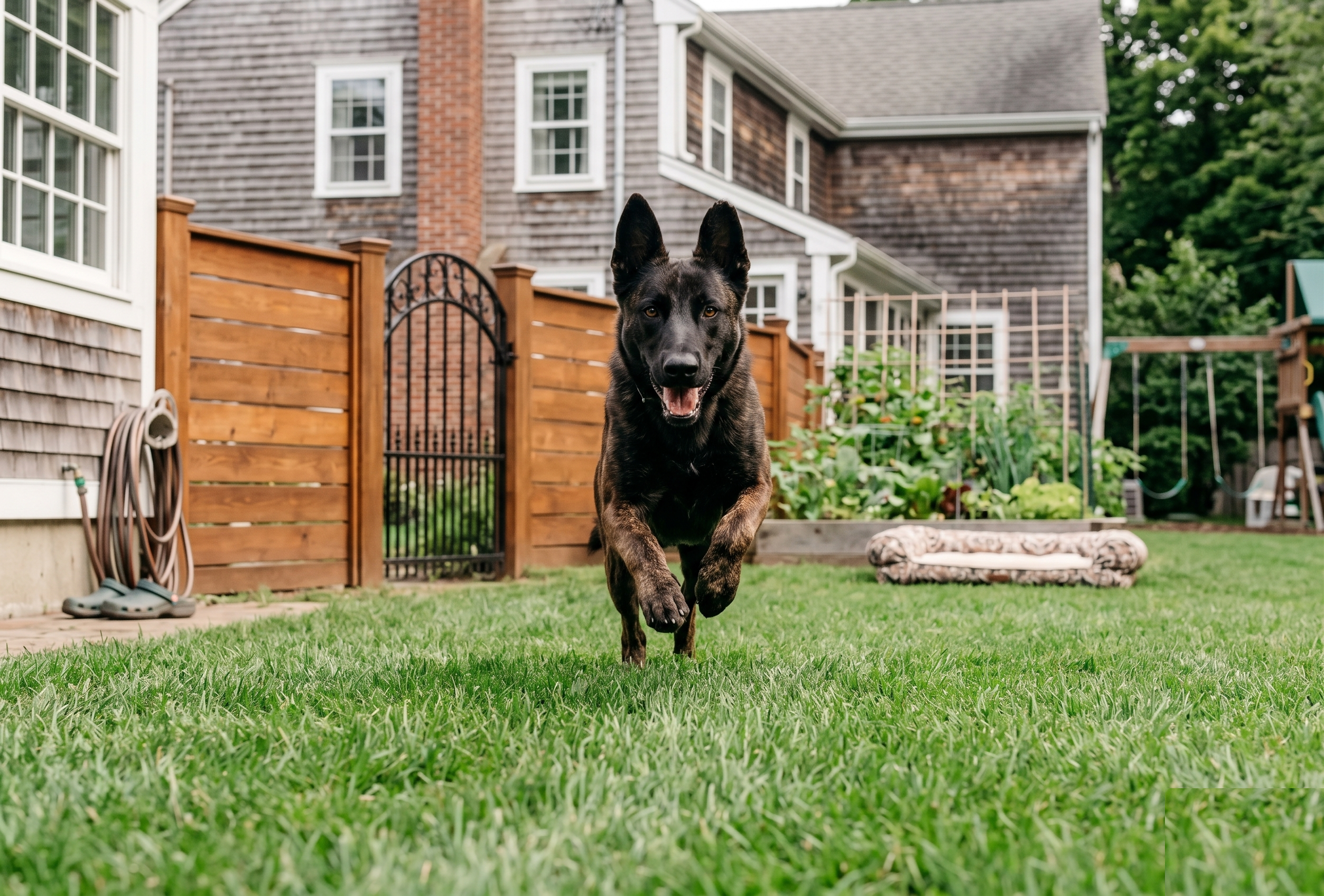
Compared with the German Shepherd Dog, the Dutch Shepherd often looks slightly tighter, more utilitarian, and less exaggerated. Compared with the Belgian Malinois, it is often described as somewhat more balanced and slightly less frenetic, though working lines vary. From a recovery standpoint, the coat pattern is one of the breed’s biggest tactical variables. A stationary Dutch Shepherd can be astonishingly difficult to see even at short range.
Temperament
Dutch Shepherds are intelligent, observant, loyal, and highly capable. They are also independent in a way many pet owners underestimate. While German Shepherds are often strongly person-centered and emotionally anchored to a primary handler, Dutch Shepherds were shaped by a more self-managing working model. They still bond closely with their people, but their decision-making often prioritizes environment over immediate handler reference.
That difference matters enormously in the field. A German Shepherd often asks, in effect, “Where is my person?” A Dutch Shepherd is more likely to ask, “What is the best route, position, or safe perimeter from here?” That does not make the Dutch Shepherd less loyal. It means the breed often resolves stress by repositioning rather than seeking interaction.
With strangers, Dutch Shepherds are frequently reserved and watchful. A sound dog should not be unstable, but many are naturally difficult to casually win over. When loose, they may absolutely see searchers and still decide not to reveal themselves. TailTracker models the Dutch Shepherd temperament as a mix of high drive, strong environmental awareness, real stamina, moderate handler attachment, and high stranger caution.
Living With This Breed
The Dutch Shepherd is not a passive household dog. It thrives in environments that offer structure, challenge, movement, and a clear working relationship. In the right home, this breed is intensely capable, trainable, and rewarding. In the wrong home, it can become frustrated, destructive, hyper-vigilant, or self-directed in ways owners did not anticipate.
Dutch Shepherds generally do best with people who understand working breeds and appreciate the difference between “smart” and “easy.” This is a dog that notices patterns, loopholes, exits, routines, and emotional inconsistency. Under-stimulated Dutchies do not merely become naughty. They begin running their own program.
- Needs meaningful daily engagement, not just a fenced yard.
- Thrives with obedience, sport, tracking, scent work, agility, or structured task-based activity.
- Can become compulsive, reactive, or escape-prone when underworked.
- Usually requires experienced handling and confident leadership.
- Often reserved with strangers even when deeply affectionate with their own people.
- May appear emotionally tough while still being highly sensitive to inconsistency or pressure.
Grooming and Health
Grooming needs vary by coat variety. Short-haired Dutch Shepherds are relatively low-maintenance aside from seasonal shedding. Long-haired dogs require more regular brushing, and rough-haired dogs need more specialized coat care. In general, however, this is a practical breed rather than a glamorous one.
Health-wise, Dutch Shepherds are generally considered hardy working dogs, though they are not exempt from orthopedic and inherited concerns. Responsible breeders screen for issues such as hip and elbow problems, and specific lines may also be watched for breed-related conditions. As with many working breeds, the more relevant operational point is functional durability: a healthy Dutch Shepherd can keep moving, keep assessing, and keep using terrain effectively long after many family dogs would have settled down.
In recovery operations, that means the early timeline matters. Owners and searchers who assume the dog is still nearby simply because the dog is bonded often lose valuable hours. A Dutch Shepherd may be calm, capable, and already well beyond the emotionally “reasonable” search radius.
Fun Facts
- The brindle coat was deliberately protected: it was retained in the breed standard in part to visually separate Dutch Shepherds from closely related continental shepherds.
- This breed was once a true farm generalist: herding, guarding, cart work, and day-to-day property management were all part of its job description.
- Dutch Shepherds are rare compared with GSDs and Malinois: their relative scarcity is one reason many pet owners and even volunteers misread their behavior.
- KNPV has helped define the modern working image of the breed: Dutch Shepherds from those lines are respected worldwide for serious utility work.
- Brindle is beautiful — and operationally inconvenient for searchers: the same coat that makes the breed striking in daylight can make it nearly disappear in rough cover.
- This is one of the clearest “ghost breeds” in the TailTracker system: it often prefers concealment, distance, and control over noisy interaction.
Famous Examples
- KNPV-titled Dutch Shepherds — while less celebrity-driven than some breeds, the Dutch Shepherd’s strongest fame comes from elite working lines and serious trial performance rather than household-name mascot culture.
- Police and sport Dutchies worldwide — the breed’s international working reputation comes from repeated success in patrol, bite sport, detection, and protection roles.
- The breed itself as a connoisseur’s working dog — among experienced handlers, Dutch Shepherds are often treated almost like an insider’s alternative to more widely known shepherd breeds.
TailTracker Recovery Insight
A Dutch Shepherd recovery should not be run like a generic missing-pet search. This breed’s working history changes the operational picture. TailTracker models the Dutch Shepherd as a corridor-minded, independent field solver. When loose, many Dutchies do not immediately collapse inward toward comfort. They expand outward, select routes, and favor positions that preserve safety, visibility, and movement options.
Compared with a German Shepherd, the Dutch Shepherd typically shows less emotional looping and more strategic expansion. A German Shepherd often revisits owner-linked spaces, walking routes, cars, or known human scent corridors. A Dutch Shepherd is more likely to commit to linear terrain corridors (trails, ridges, edges, and similar routes).
This is also one of the strongest camouflage profiles in the database. A brindle Dutch Shepherd under stress may go still in cover rather than call attention to itself. Many can watch search activity from surprisingly short range without being seen. Unlike more socially demonstrative breeds, a Dutchie may slip away silently long before a searcher realizes the dog was there.
Capture strategy is the final divider. A German Shepherd may sometimes be interrupted effectively with strong familiar commands. A Dutch Shepherd more often requires passive reacquisition: scent stations, quiet handler presence, low-pressure containment, and allowing the dog to choose return on its own terms.
If This Breed Goes Missing
Start with a wider operational assumption than you would for many other breeds. Do not assume the dog is still close or easily callable. And do not assume that seeing the dog will make capture easy. A Dutch Shepherd recovery is often a low-pressure, wide-radius, terrain-aware mission.
The Dutch Shepherd Search Profile
- Very high range potential: strong forward movement can create major distance in the first night.
- Corridor bias: linear terrain corridors matter early.
- Low stranger approachability: the dog may see helpers and choose not to approach.
- Camouflage advantage: brindle coat and stillness make visual detection harder than expected.
- Environmental positioning: many Dutchies prioritize advantageous terrain rather than immediate social reunion.
First Operational Priorities
- Expand the search radius earlier and farther than you would for a human-dependent companion breed.
- Identify and map likely travel corridors immediately.
- Deploy scent stations using owner-worn items, bedding, and familiar working objects where appropriate.
- Use quiet observation and camera coverage at likely routes, water sources, and edge habitats.
- Avoid pursuit unless safe containment is certain; chasing usually converts a sighting into a relocation event.
German Shepherd vs. Dutch Shepherd Recovery Contrast
| Feature | German Shepherd | Dutch Shepherd |
|---|---|---|
| Recovery focus | Often person-oriented and owner-linked | Often perimeter-oriented and self-protective |
| Search pattern | More looping, doubling back, checking known human locations | More linear, outward, route-committed movement |
| Hiding style | More likely to remain near human structures or known routes | More likely to “ghost” into natural cover and observation points |
| Best recovery tool | Familiar commands and owner-linked reconnection | Passive reacquisition, scent station, quiet containment |
| Main tactical mistake | Searching too broadly too early | Searching too narrowly and using too much pressure |
Expert TailTracker Note
One of the biggest mistakes owners make is assuming all “shepherds” recover the same way. They do not. If you are looking for a German Shepherd, search for connection: owner scent, routine paths, vehicle locations, familiar loops. If you are looking for a Dutch Shepherd, search for corridor and advantage: what trail leaves town, what ridge offers visibility, what edge habitat provides concealment and escape.
Frequently Asked Questions
How is a Dutch Shepherd different from a German Shepherd in recovery terms?
German Shepherds are often more person-centered and more likely to revisit owner-linked locations. Dutch Shepherds are usually more independent, more corridor-biased, and more likely to prioritize safe positioning and terrain logic over immediate social reunion.
Why are lost Dutch Shepherds often harder to capture than to locate?
Because many remain behaviorally engaged when loose. They may see searchers, evaluate them, and quietly relocate instead of approaching. Their brindle coat can also make them much harder to detect than owners expect.
Should you call and chase a missing Dutch Shepherd?
Usually no. High-pressure pursuit often drives the dog farther away. Calm handler presence, scent stations, quiet observation, and passive containment are usually more effective.
How far can a Dutch Shepherd travel when lost?
Farther than many owners expect, especially in the first night. TailTracker treats this as a very wide-radius breed with strong forward momentum and real staying power.
Related Breed Guides
Comparing the Dutch Shepherd with nearby working and herding profiles can sharpen recovery expectations.
Build a breed-informed recovery plan before your dog ever goes missing.
TailTracker helps pet families prepare smarter with breed-aware recovery guidance, coordinated alerts, and a faster path from panic to action.
Most lost-pet tools broadcast alerts.
TailTracker coordinates the recovery.