Belgian Malinois
Breed Guide
Fast, focused, and intensely handler-bonded, the Belgian Malinois is one of the most capable working dogs in the world. That same athleticism and environmental awareness make it one of the most distinctive missing-dog profiles in TailTracker’s breed intelligence system. When loose, a Malinois often stays engaged, travels farther than expected, and can remain difficult to approach even when it sees the people searching for it.
7 min read · Premium breed intelligence with recovery-focused field guidance
Overview
The Belgian Malinois is one of the most capable and high-performance working dogs in the world. Developed as the short-haired variety of the Belgian Shepherd, it shares origins with the Groenendael, Tervueren, and Laekenois, but emerged as the most refined expression of athleticism, responsiveness, and working intensity.
Today, the breed is widely used in military, police, and security roles. That reputation reflects its underlying design: highly observant, fast-learning, deeply bonded to a handler, and constantly engaged with its environment. A Malinois does not simply exist in a space—it evaluates it.
TailTracker treats the Malinois as a defining example of why breed-informed recovery matters. This is not a dog that typically panics and shuts down when loose. It is more likely to stay engaged, move with direction, and remain difficult to approach even when aware of searchers.
Breed History
The Belgian Malinois descends from the traditional shepherd dogs of Belgium, formally standardized in the late nineteenth century. Early breeders identified a consistent working type—medium-sized, alert, and highly trainable—then separated varieties based on coat and regional traits.
The Malinois, named after the city of Mechelen (Malines), became known for its short coat, balanced structure, and exceptional working ability. Over time, its combination of speed, stamina, and responsiveness made it especially valuable in police and military applications.
This history matters in a lost-dog context. The breed was selected for independent decision-making within a working framework—capable of operating without constant direction while remaining mentally engaged with its surroundings.
Physical Characteristics
The Belgian Malinois is a medium-sized, square, athletic dog built for speed and endurance. Adults typically stand 22–26 inches and weigh 45–65 pounds. The structure is lean and muscular, designed for efficient movement rather than bulk.
The head is long and clean with erect ears and an alert expression. The short coat is fawn with black overlay and a distinctive dark mask, creating one of the most recognizable working-dog profiles.
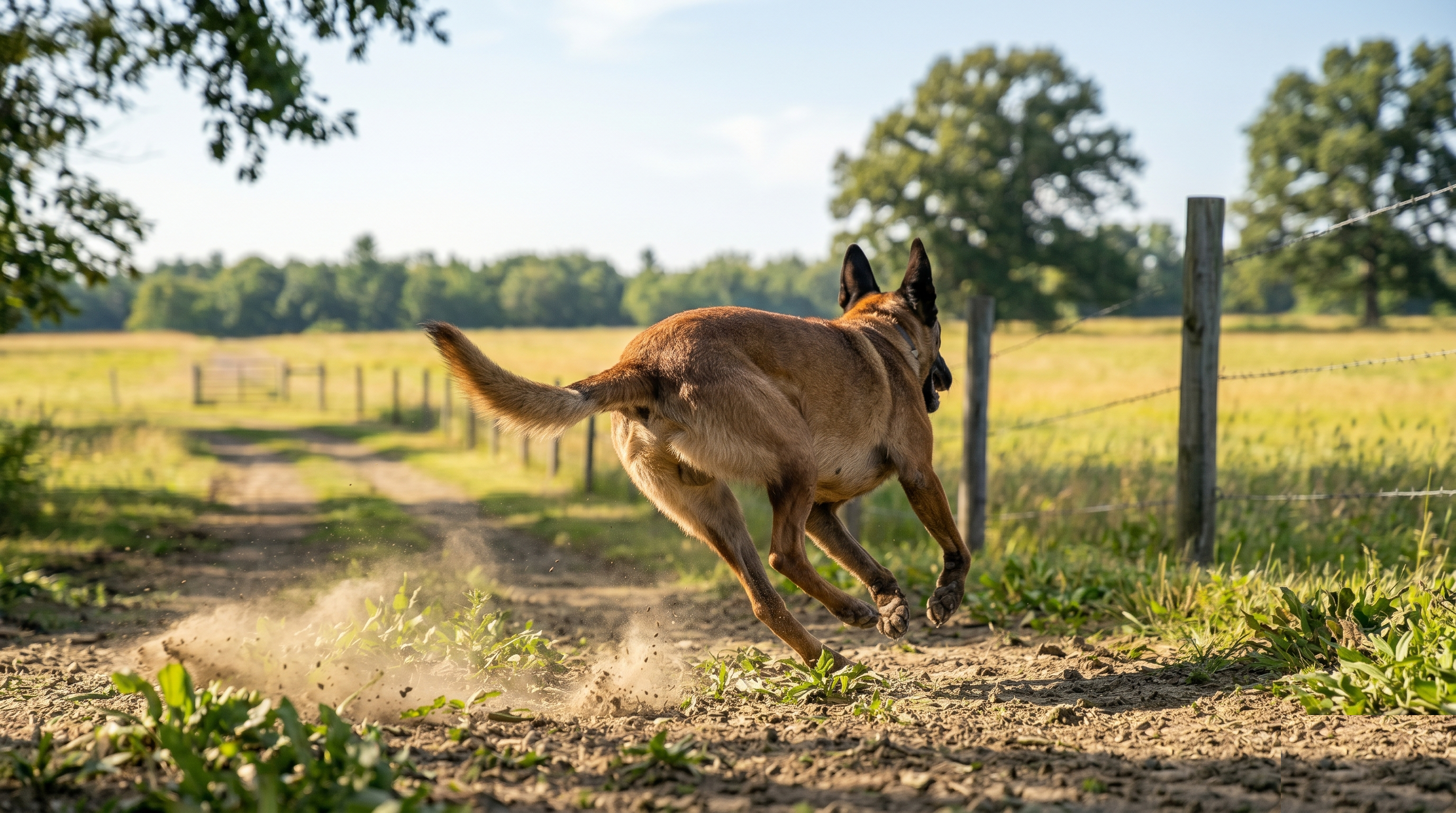
Compared to heavier shepherd breeds, the Malinois is lighter, faster, and more agile. Obstacles that slow other dogs—fences, uneven terrain, elevation changes—are often only minor interruptions. This directly affects how far and how quickly the breed can travel when missing.
Temperament
The Belgian Malinois is highly intelligent, alert, and responsive. It constantly processes movement, patterns, and environmental cues, often anticipating change rather than reacting to it.
The breed typically forms an intense bond with a primary handler. This bond is not just emotional—it is functional, shaping how the dog navigates the world. Many Malinois remain strongly oriented to that relationship even when loose.
With strangers, the breed is often reserved and observant. A missing Malinois may recognize people attempting to help while choosing not to approach them.
TailTracker models the Malinois as a combination of very high drive, strong handler attachment, elevated environmental awareness, and moderate-to-high stranger caution. Together, these traits create a dog that may travel farther than expected and remain difficult to capture.
Living With This Breed
The Belgian Malinois requires structure, engagement, and purpose. It is not a passive companion and does not self-regulate without sufficient mental and physical stimulation.
In the right environment, the breed is loyal, responsive, and highly capable. In the wrong setting, it can become frustrated, destructive, or hyper-vigilant. What appears as easy trainability in a young dog is often a reflection of intense drive rather than simplicity.
- Requires daily structured engagement, not just exercise.
- Thrives with training, sport, scent work, or task-based activity.
- Can develop compulsive or reactive behaviors if under-stimulated.
- Often bonds most strongly with one or two individuals.
- Needs consistent handling and clear communication.
Grooming and Health
The Malinois coat is short, weather-resistant, and relatively low maintenance. Routine brushing is typically sufficient, with moderate seasonal shedding.
The breed is generally athletic and durable, though screening for hip and elbow dysplasia is recommended. Some lines are also evaluated for neurological conditions, reflecting the highly tuned working traits of the breed.
From a recovery standpoint, the key factor is physical capability. A healthy Malinois can cover significant ground quickly and sustain movement longer than many companion breeds, especially in the early stages after going missing.
Fun Facts
- The “Formula One” comparison is not just hype: few breeds combine this level of acceleration, agility, responsiveness, and work intensity in such a compact package.
- They are lighter than German Shepherds for many tactical applications: one reason the breed has been favored in demanding field work is its blend of speed, stamina, and compact power.
- Owners call them “Mali-gators” for a reason: gripping, mouth-oriented play, and rapid nipping behavior are rooted in the breed’s herding and control instincts.
- They are famous for “parkour” style athleticism: walls, barriers, jumps, and awkward surfaces are often part of the breed’s comfort zone.
- The black mask is a defining visual trait: paired with erect ears and a clean fawn body, it creates one of the most recognizable working-dog silhouettes in the world.
- They can be deeply affectionate at home: despite the hard-driving image, many Malinois are physically close and intensely attached to their favorite person.
- A bored Malinois rarely stays quiet for long: this is a breed that creates its own assignments when humans fail to provide them.
Famous Examples
- Cairo — the Belgian Malinois that accompanied SEAL Team 6 during Operation Neptune Spear, helping cement the breed’s modern public image as an elite tactical dog.
- Conan — the U.S. Army Malinois associated with the mission that led to Abu Bakr al-Baghdadi’s death, further raising public awareness of the breed’s military role.
- Diesel — the French police Malinois posthumously awarded the PDSA Dickin Medal after being killed during the 2015 Saint-Denis raid.
- K9 Killer — the Kruger National Park anti-poaching Malinois recognized for helping capture large numbers of poachers.
- Mali and Kuga — military Malinois honored for bravery in Afghanistan, reinforcing the breed’s reputation for nerve and commitment under pressure.
- Lulu from Dog (2022)
- The Malinois team in John Wick: Chapter 3 – Parabellum — one of the breed’s most visible modern film appearances, highlighting its athleticism and precision.
- Max from Max (2015)
TailTracker Recovery Insight
A missing Belgian Malinois behaves differently from most companion dogs. Rather than shutting down near the escape point, it is more likely to remain active, travel with direction, and maintain awareness of its surroundings.
TailTracker models this breed as a mission-oriented mover. Many follow natural corridors such as trails, field edges, utility paths, and property boundaries. Movement is often linear and deliberate rather than random.
Prey drive can significantly extend travel distance. Wildlife or sudden motion may trigger pursuit, adding miles to the search area in a short period of time.
The final factor is observation. Many Malinois remain visually aware of search activity while avoiding direct interaction. They may watch from cover or elevation rather than reveal their position, which makes detection easier than capture.
If This Breed Goes Missing
Approach recovery as a wide-range, high-drive search. Do not assume the dog is nearby or that calling alone will resolve the situation.
The Malinois Search Profile
- High mobility: expect rapid movement beyond the immediate area.
- Prey activation: wildlife can extend distance significantly.
- Low approachability: may observe without engaging.
- Handler focus: familiar cues may be more effective than general calling.
- Athletic capability: barriers are not reliable containment.
First Operational Priorities
- Expand search radius early.
- Map likely corridors and directional travel.
- Prioritize sighting direction, not just location.
- Avoid pursuit unless containment is certain.
- Use familiar scent items and working cues.
Recovery Tactics That Often Work Better
| Trait | Likely Lost-Dog Behavior | Best Tactical Response |
|---|---|---|
| High drive | Continues moving after escape instead of rapidly settling | Widen perimeter early and look for directional travel patterns. |
| Prey activation | Chases wildlife or motion cues far beyond the immediate neighborhood | Use movement-based lures such as squeakers or favorite tug or ball cues when appropriate. |
| Stranger caution | Observes but refuses direct approach | Reduce pressure, avoid eye contact, sit low or sideways, and let the dog make the final move. |
| Working mindset | May respond better to known task language than emotional calling | Use calm, familiar commands like “heel,” “watch,” “sit,” or other heavily reinforced cues. |
| Athletic confidence | Uses elevation or awkward access points to maintain advantage | Check heights, rooftops, retaining walls, industrial edges, stacked materials, and vantage points. |
Expert TailTracker Note
Many Malinois are not “lost” in the traditional sense. They are actively navigating their environment. Recovery is most effective when it reintroduces familiarity and structure rather than applying pressure or pursuit.
Frequently Asked Questions
How far can a Belgian Malinois travel when lost?
Farther than many owners expect, especially in the first hours. A healthy Malinois can cover serious ground quickly, particularly if it locks onto a corridor or prey trigger. TailTracker treats this as a wide-radius breed by default unless specific evidence suggests otherwise.
Will a lost Malinois come when called?
Sometimes, but not reliably in high arousal. A bonded Malinois may recognize the handler immediately and still not approach if it is in pursuit, defensive observation, or survival mode. Calm working cues often outperform emotional pleading.
Why are Malinois often harder to capture than to locate?
Because many remain behaviorally engaged even when lost. They are often suspicious, physically agile, and highly aware of approach pressure. Searchers may know where the dog is before they have any safe chance of actually containing it.
Is the Belgian Malinois a good family pet?
In the right home, yes, but only with realistic expectations. This is not a low-maintenance family companion. It requires substantial structure, training, activity, and human involvement.
What is the biggest recovery mistake with a missing Malinois?
Treating the dog like a generic lost pet: searching too narrowly, expanding too slowly, over-calling, or chasing. This breed needs a more tactical plan from the start.
Related Breed Guides
Comparing the Malinois against nearby herding and protection profiles can sharpen recovery expectations.
Build a breed-informed recovery plan before your dog ever goes missing.
TailTracker helps pet families prepare smarter with breed-aware recovery guidance, coordinated alerts, and a faster path from panic to action.
Most lost-pet tools broadcast alerts.
TailTracker coordinates the recovery.