Doberman
Breed Guide
Sleek, fast, intelligent, and exceptionally tuned in to people, the Doberman is one of the clearest examples of a working breed whose lost-dog behavior is shaped by vigilance, handler bonding, and purposeful movement rather than random wandering. A missing Doberman often creates a recovery problem of routes, interception, and pressure management — not simple visibility.
5 min read · Practical pet-owner education with recovery-focused guidance
Overview
The Doberman, also called the Dobermann or Doberman Pinscher, is a German working breed developed in the nineteenth century as a medium-large protection dog built to work closely with people. AKC describes the breed as among the canine kingdom’s “noblemen,” prized for intelligence, fearlessness, vigilance, and loyalty.
That original design still matters. The Doberman was not built to drift through the world like a hound, nor to detach emotionally from its people like a primitive survival breed. It was built to move with purpose, respond quickly, and stay oriented to human context. When loose, many Dobermans remain behaviorally engaged even while physically out of reach.
TailTracker models the Doberman as a breed whose lost-dog behavior is shaped by strong handler attachment, high environmental awareness, and a tendency to travel in clear lines or edges when pressured. The result is a dog that may be seen repeatedly, sometimes close, yet remain difficult to contain if the recovery scene becomes loud, rushed, or confrontational.
Breed History
The breed was created in Germany by Louis Dobermann, a tax collector who wanted a reliable companion-protector to accompany him in dangerous work. AKC notes that the Doberman is unusual among working breeds because it was intentionally created as a protector of humans rather than livestock or property.
Later breeders refined the early dogs into a more consistent type: sleek, muscular, fast, and mentally sharp. Doberman Pinscher Club of America describes the breed as a composite of multiple influences, blending terrier-like reactivity with the power and intelligence of guarding and herding stock.
Over time, the Doberman became known worldwide in police, military, obedience, sport, and protection settings. Public culture often distorted the breed into a one-note image of menace, but the ideal temperament remains stable, confident, watchful, determined, loyal, and obedient.
Physical Characteristics
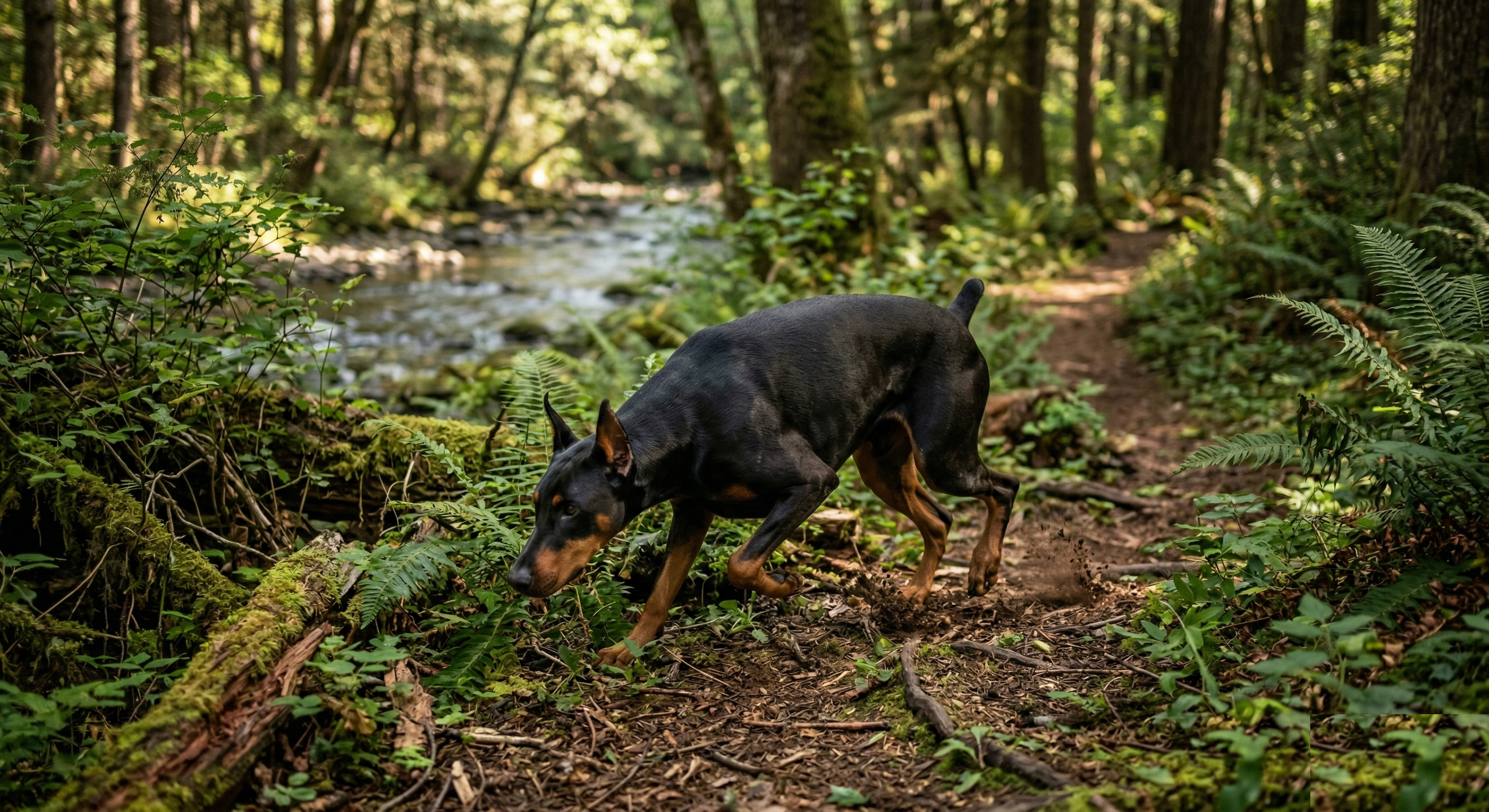
The Doberman is clean-lined and powerfully athletic. The body should read as compact, muscular, and efficient rather than bulky, with enough substance for endurance and enough refinement for speed. Common recognized colors include black and rust, red and rust, blue and rust, and fawn and rust. AKC and DPCA both emphasize elegance, balance, and proud carriage as central to the breed picture.
For recovery work, the biggest physical implication is not camouflage but mobility. This is a dog that can open space quickly. A Doberman in motion often follows roads, field edges, driveways, fence lines, and travel corridors rather than collapsing into tiny hiding spaces. The challenge is often not finding signs of the dog, but containing the dog before it extends the route.
The breed’s short coat is easy to maintain, but it also means less protection in severe weather than heavily coated breeds enjoy. That matters operationally in rain, cold, and overnight exposure, especially if the dog is under stress or has an underlying medical condition.
Temperament
DPCA’s temperament language is concise and useful: energetic, watchful, determined, alert, fearless, loyal, and obedient. AKC adds that Dobermans learn easily, respond quickly, and can be loving, fun companions. Put together, that describes a breed that is both emotionally attached and behaviorally switched on.
This is why lost-dog recovery can become counterintuitive. A Doberman may be strongly bonded to its owner and still not come when called if stress, motion, or perceived threat overwhelms its training. A dog that is flawlessly obedient at home may become evasive outdoors if approached by multiple strangers or pursued too assertively.
TailTracker treats the Doberman as . The dog is often still thinking, still reading, and still making choices. The wrong pressure extends the search; the right calm handler strategy can shorten it quickly.
Living With This Breed
Dobermans do best in homes that offer structure, exercise, mental engagement, and real inclusion. DPCA materials repeatedly emphasize that these are sensitive, observant dogs who read owner confidence and household tone very quickly. They are not a breed that thrives on boredom, isolation, or inconsistent leadership.
Most need daily physical activity plus a job, training objective, or meaningful routine. Without that, their intelligence often redirects into self-appointed work: patrolling, reacting, pushing boundaries, and inventing stimulation.
- Needs consistent physical and mental work rather than casual ownership alone.
- Usually prefers close daily involvement with people, not backyard-only living.
- Can become overstimulated or dysregulated when routines break down.
- Benefits from calm, confident handling rather than harsh correction.
Grooming and Health
Grooming is simple: the coat is short, sleek, and low-maintenance. Health, however, is a major part of responsible Doberman ownership. Breed-wide concern around dilated cardiomyopathy is especially important, along with von Willebrand disease, hypothyroidism, and gastric dilatation-volvulus risk. These issues are well recognized in breed education and materially affect emergency planning.
From a recovery standpoint, cardiac disease is especially relevant. A Doberman that appears powerful and tireless may fatigue or destabilize faster than expected under fear, exertion, or weather stress. Owners sometimes assume the breed’s athletic outline means indefinite endurance. It does not.
The short coat also means less insulation in extended cold or wet exposure. That does not make the dog fragile, but it does mean weather can become a meaningful factor more quickly than with heavily coated herders or northern breeds.
Fun Facts
- One of the few truly purpose-built human protection breeds: AKC highlights the Doberman as unusual because it was deliberately bred to work with and protect people, not animals.
- Named for its creator: The breed takes its name from Louis Dobermann, the German tax collector associated with its development.
- A breed of elegance, not just force: DPCA materials emphasize nobility, balance, and proud carriage as central to correct type.
- Highly trainable but emotionally perceptive: Dobermans often learn quickly, but they also read uncertainty and inconsistency in ways owners underestimate.
- Deeply tied to military and service history: The breed’s intelligence, courage, and responsiveness helped cement its place in police, war-dog, obedience, and protection circles.
- Still a true inside-the-home dog: DPCA repeatedly notes that a Doberman needs to live with its family, not apart from it.
Famous Examples
- Marine war-dog Dobermans of World War II — The breed is deeply associated with military service, especially in Pacific-theater war-dog history.
- Police and protection Dobermans — More than perhaps any other modern companion-working breed, the Doberman became a symbol of disciplined human protection work.
- Film and television Dobermans — Popular culture often cast the breed as the elite guardian archetype, reinforcing its image as sleek, powerful, and highly controlled.
- Top obedience and sport dogs — Beyond the protection image, the breed has long been admired for trainability, precision, and working versatility.
TailTracker Recovery Insight
The Doberman fits a distinct recovery profile: purposeful movement, route logic, and sensitivity to social pressure. This is different from a scent hound that locks onto odor and follows it, a velcro giant that stops near home, or a primitive breed that disappears into survival mode. A Doberman often remains mentally engaged with the environment and actively responds to how people are trying to recover it.
The behavioral sequence TailTracker most often models for this breed is: trigger → fast displacement → edge or corridor travel → vigilance under pressure → repeated sighting without easy containment. In other words, the dog may not be gone far. It may simply be moving intelligently through a manageable area while staying just ahead of the wrong recovery tactics.
This is why route analysis matters so much. Roads, fence lines, driveways, property edges, field margins, and familiar travel patterns often outperform random searching. The Doberman is often visible enough to generate sightings but mobile enough to stay just beyond containment.
If This Breed Goes Missing
Think interception before chase. A loose Doberman can cover ground quickly, but many stay within a logical network of movement rather than vanishing into total randomness. Search success usually improves when owners reduce pressure, map likely corridors, and use familiar human anchors.
- Secure exits and visual corridors early. If the dog is still close, containment beats pursuit.
- Focus on route logic. Roads, driveways, fence runs, field edges, and trail openings often matter more than broad neighborhood sweeps.
- Use calm familiar handlers. One bonded person often outperforms a large excited search group.
- Avoid direct pressure.
- Leverage familiar anchors.
- Monitor repeat sightings. A Doberman seen twice in the same corridor is giving you movement data, not randomness.
Once sighted, prioritize calm body language and containment angles. Do not assume friendliness or obedience will override stress instantly. A Doberman that sees you may still choose movement first if the approach feels wrong.
Frequently Asked Questions
Do Dobermans usually run far when lost?
They can cover real ground quickly, but many do so in route-based patterns rather than through random aimless wandering. The more useful question is often not “how far,” but “along what lines?”
Why won’t my Doberman come when called if it knows me?
Because stress, vigilance, and motion can override training. A Doberman may still recognize and care about its owner while making avoidance decisions in a high-alert state.
What is the biggest recovery mistake with a Doberman?
Turning the event into a chase. Loud pursuit, multiple strangers, and confrontational approach can keep the dog moving and make containment much harder.
What should I check first?
Start with roads, driveways, fence lines, property edges, familiar walking routes, and any place strongly connected to household routine or handler movement.
Is the Doberman a good match for route-based TailTracker analysis?
Yes. This is one of the strongest examples of a breed where movement logic, interception planning, and pressure management often matter more than simple radius expansion.
Related Breed Guides
Comparing the Doberman with other alert, mobile, or handler-sensitive breeds can sharpen search expectations and improve breed-specific planning.
Build a breed-informed recovery plan before your dog ever goes missing.
TailTracker helps pet families prepare smarter with breed-aware recovery guidance, coordinated alerts, and a faster path from panic to action.
Most lost-pet tools broadcast alerts.
TailTracker coordinates the recovery.