Alaskan Malamute
Breed Guide
Powerful, affectionate, independent, and built for Arctic freight work, the Alaskan Malamute is a heavy-duty spitz breed with a very different missing-dog profile from many family companions. When loose, a Malamute may rely on endurance, environmental confidence, prey drive, scent memory, and trail corridors — making calm, breed-aware recovery strategy especially important.
6 min read · Practical pet-owner education with recovery-focused guidance
Overview
The Alaskan Malamute is a large, powerful Arctic spitz breed developed for heavy freight hauling, camp work, and survival in severe northern conditions. Unlike racing sled dogs selected primarily for speed, the Malamute was shaped for strength, patience, stamina, and the ability to move substantial loads over long, difficult ground. The breed's recognizable features — dense double coat, broad head, erect ears, large feet, and plumed tail — are all part of that working design.
Modern Malamutes are often affectionate, playful, and deeply social with their families, but they are not soft, easygoing couch dogs by default. They are physically strong, environmentally confident, and often independent in decision-making. Many are friendly with people yet challenging around small animals, unsecured yards, weak gates, or inconsistent training. Their intelligence is practical rather than obedient: they evaluate, improvise, pull, dig, and solve problems.
TailTracker models the Alaskan Malamute as a high-endurance, high-environmental-confidence, moderate-to-high independence breed. A missing Malamute may not remain near the escape point in the way a highly home-bound companion breed might. Search strategy should account for trail corridors, scent and prey targets, cold-weather survivability, and the breed's ability to keep moving even through rough or snowy terrain.
Breed History
The Alaskan Malamute is among the oldest Arctic sled-dog types and is closely associated with the Mahlemut, or Malemiut, Inupiaq people of northwestern Alaska. These dogs were not decorative village companions. They were survival partners used for hauling freight, moving supplies, assisting with hunting, and living in close cooperation with people in an environment where inefficient animals could not be kept.
During the Klondike Gold Rush, Arctic sled dogs became highly valuable to prospectors and settlers, and many northern dogs were crossed with imported breeds. Organized recognition came later: the American Kennel Club recognized the Alaskan Malamute in 1935, with early preservation efforts often associated with Eva B. Seeley and the Kotzebue strain. World War II nearly devastated the registered population; postwar recovery required reopening the studbook and combining surviving lines, which is why modern Malamutes carry ancestry from several early strains.
The breed also served in polar expedition and military contexts, including freighting, packing, and search and rescue work. In 2010, the Alaskan Malamute was named the official state dog of Alaska — a fitting honor for a breed whose identity is inseparable from northern working history.
Physical Characteristics
The Alaskan Malamute is substantial without being clumsy. The AKC's desired freighting size is about 25 inches and 85 pounds for males and 23 inches and 75 pounds for females, though individual dogs may vary. The body is powerful, compact, and built over strong legs and large, snowshoe-like feet. The chest is deep, the shoulders are strong, and the gait should be steady, balanced, and efficient rather than flashy.
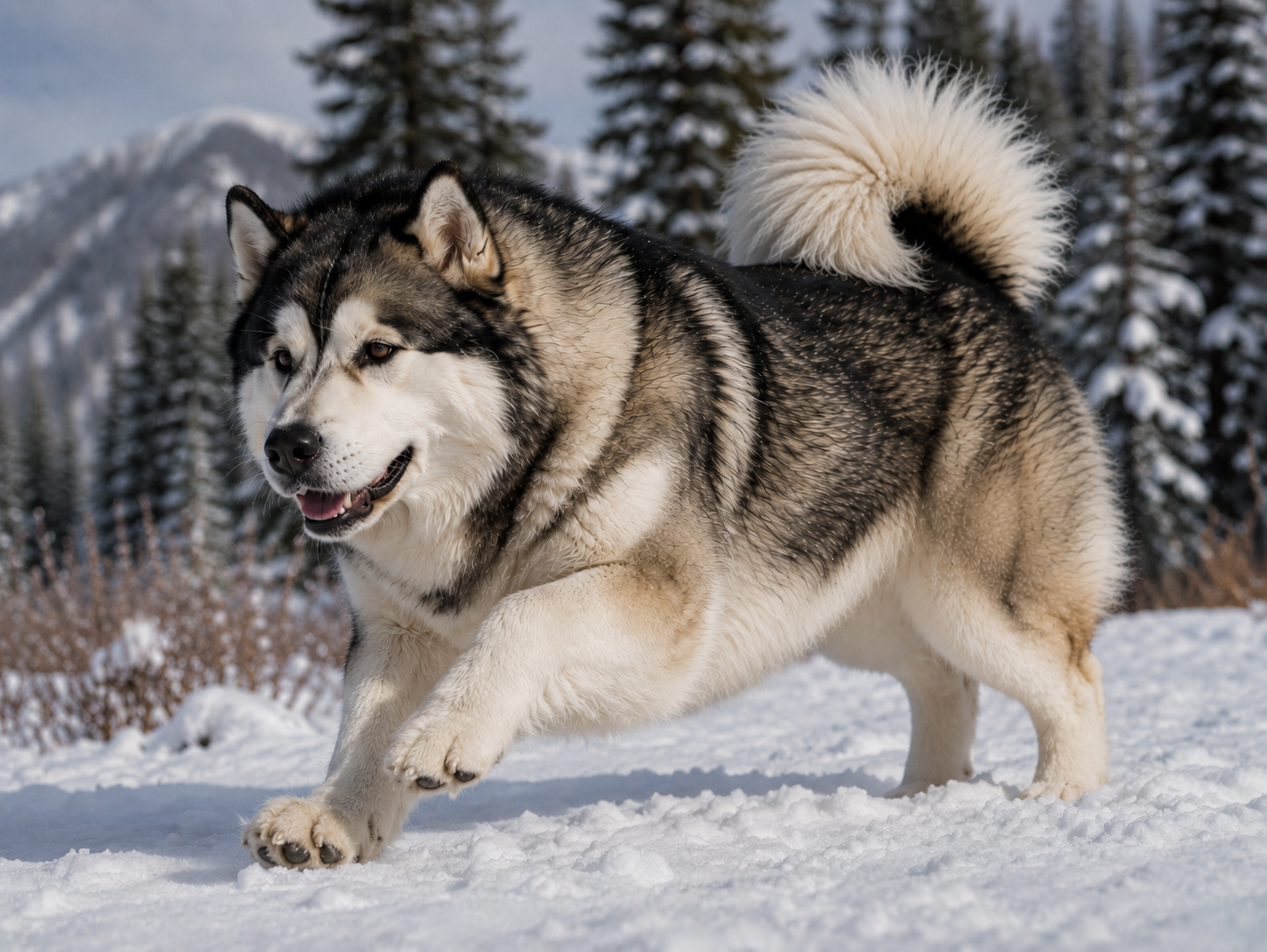
The coat is one of the breed's defining features. A harsh outer coat protects a dense, woolly undercoat that insulates against cold and moisture. Common colors include shades of gray, black, sable, seal, and red with white markings; all-white is also accepted. The face may show caps, masks, goggles, blazes, or other distinctive markings. The eyes should be brown and almond-shaped; blue eyes are not consistent with the purebred Malamute standard and are a major distinction from the Siberian Husky.
The tail is well-furred and usually carried over the back like a waving plume. Combined with erect ears, a broad head, and heavy bone, that silhouette is why Malamutes are often confused with Siberian Huskies. The simplest distinction is function: the Husky is a lighter, faster distance runner; the Malamute is a heavier, stronger freight dog.
Temperament
Alaskan Malamutes are often affectionate, loyal, playful, dignified, and expressive. They may be highly people-friendly and are often poor guard dogs despite their impressive size. Many Malamutes greet people with enthusiasm, vocal "woo-woo" talk, or full-body social energy rather than suspicion. Their social nature, however, should not be confused with automatic obedience.
This breed was developed to think and work in harsh conditions, not to wait for constant step-by-step commands. A Malamute may understand a request and still decide whether the request is worth following. That independence makes early training, leash manners, recall management, and secure containment essential. The breed's strength also means that ordinary household gates, weak fencing, or casual leash handling can fail quickly.
Prey drive is a serious management issue. Many Malamutes have strong interest in small animals, wildlife, poultry, and fast-moving objects. When lost, this can convert into resource-seeking or chase behavior, pulling the dog along trails, wooded edges, wetlands, alleys, or other scent-rich corridors. TailTracker treats the breed as friendly but operationally independent: approachable in some situations, evasive in others, and rarely helped by pursuit.
Living With This Breed
Living well with an Alaskan Malamute requires structure. The breed needs daily exercise, mental work, and clear household rules. Pulling sports, hiking, backpacking, skijoring, obedience foundations, and controlled scent or enrichment games can all help channel the breed's working instincts. Without outlets, Malamutes may invent their own jobs: digging, escaping, counter-surfing, vocalizing, or testing boundaries.
Malamutes can be wonderful family dogs in the right setting, but they are not low-maintenance. They shed heavily, especially during seasonal coat blowouts, and they can struggle in hot, humid conditions. Secure fencing should be treated as a safety requirement, not a convenience. Many Malamutes can dig under fences, push through weak points, or exploit open doors with surprising speed.
- Needs consistent daily exercise and mental engagement; boredom often becomes escape behavior.
- Requires secure containment, strong leash handling, and reliable door/gate routines.
- Often affectionate with people but independent under distraction or stress.
- High prey drive makes wildlife, cats, poultry, and small dogs important risk considerations.
- Dense coat requires climate awareness; hot weather increases urgency during a search.
- Best matched with owners who respect primitive working-dog instincts rather than expecting automatic obedience.
Grooming and Health
Grooming is significant because of the dense double coat. Routine brushing helps control shedding, but twice a year many Malamutes "blow coat," releasing large amounts of undercoat over a short period. Shaving the coat is generally not appropriate because the double coat helps regulate temperature and protects the skin. Owners should pay close attention to mats, paw hair, nails, and skin condition, especially after wet or snowy outdoor activity.
Health concerns reported in the breed include hip and elbow dysplasia, inherited polyneuropathy, eye issues such as cataracts or progressive retinal atrophy, hypothyroidism, and zinc-responsive skin problems. Recent longevity research cited in breed summaries has found an average lifespan around the low double digits, while AKC public materials list a broader 10–14 year range. Responsible breeders typically discuss orthopedic, eye, and breed-specific screening.
For lost-dog recovery, health and coat matter operationally. In cold weather, a healthy Malamute may remain mobile and survive outdoors longer than many breeds, which can widen the search radius. In warm weather, the same dense coat can become a liability. Heat, humidity, and lack of water should move the search toward shade, water sources, cool ground, and sheltered outdoor structures.
Fun Facts
- Alaska's state dog: The Alaskan Malamute was named the official state dog of Alaska in 2010.
- Freight, not racing: Malamutes were built for heavy pulling and endurance, not sprint speed or racing-style sled work.
- Brown eyes only: Blue eyes are a well-known Husky feature but are not correct for purebred Alaskan Malamutes under the breed standard.
- Snowshoe feet: Large, compact feet help spread weight over snow and provide traction in cold terrain.
- Coat blowouts are dramatic: Seasonal shedding can release enough undercoat to seem like a second dog has appeared in the house.
- Expressive talkers: Many Malamutes vocalize with howls, grumbles, and "woo" sounds rather than relying only on barking.
- Friendly but formidable: The breed's appearance can be intimidating, but many Malamutes are socially warm and poor candidates for true guard work.
Famous Examples
- Alaska state symbol — The breed's 2010 designation as Alaska's official state dog reflects its cultural connection to the region.
- Polar expedition dogs — Malamutes and related Arctic freight dogs were used in major polar-era work, including hauling supplies and equipment across severe terrain.
- World War II service dogs — The breed served in wartime roles including freighting, packing, and search and rescue, though the war severely reduced registered numbers.
- University mascots — The University of Washington's live Husky mascot has historically been represented by Alaskan Malamutes, reflecting the breed's northern working-dog look.
- Champion Toro of Kotzebue — A well-known foundational figure associated with the Kotzebue strain and modern breed preservation.
TailTracker Recovery Insight
The Alaskan Malamute fits a wide-radius, endurance-driven, corridor-seeking recovery profile. This is not the same as a tiny companion dog that hides near the porch, or a scent hound that follows one track with nose-down persistence. The Malamute is more likely to combine movement confidence, opportunistic scent interest, prey drive, spatial memory, and resource-seeking behavior.
The behavioral sequence TailTracker models for this breed is: escape or separation → forward movement along a natural corridor → investigation of resource targets → possible denning or resting site. That corridor may be a trail, driveway, road shoulder, powerline cut, beach, rail line, drainage path, snowmobile trail, wooded edge, or animal path. In cold weather the search radius can expand because the breed is built to keep moving. In heat, the radius may narrow around shade, water, cool ground, and shelter.
The key recovery mistake is assuming friendliness equals easy capture. A loose Malamute may like people and still refuse to be caught, especially if the dog has shifted into independent travel mode. Calm containment, feeding stations, owner scent, controlled sightings, and careful corridor mapping are more effective than teams pushing through the landscape and repeatedly moving the dog farther away.
If This Breed Goes Missing
Treat the first hours as a corridor-management problem. A missing Alaskan Malamute may be able to cover real ground, especially in cold weather or in areas with trails, woods, beaches, farms, or open utility corridors. Start at the point last seen, but map the most efficient paths outward instead of searching in a simple circle.
- Do not chase. Pursuit can turn a recoverable sighting into a moving target and extend the search radius.
- Map corridors immediately. Check trails, powerline cuts, railbeds, snowmobile paths, beaches, riverbanks, drainage routes, and wooded edges.
- Secure likely resource targets. Alert neighbors with chickens, livestock, outdoor pet food, dumpsters, compost, hunting areas, and wildlife-heavy properties.
- Use a wider early notification radius. Compared with home-bound companion breeds, Malamutes justify faster outreach to trail users, animal control, road crews, farms, and outdoor recreation groups.
- Place feeding stations strategically. Use high-value food near the point last seen and along confirmed travel corridors; avoid scattering food randomly across too many locations.
- Adjust for weather. In cold weather, expand quickly along corridors. In hot weather, prioritize shade, water, garages, sheds, culverts, and cool ground.
- Contain before attempting capture. Use gates, fenced yards, vehicle blocking, long lines, calm owner approach, or humane capture planning rather than grabbing at the dog.
- Check digging and barrier sites. A Malamute may dig under fences, rest in a shallow depression, or use a sheltered den-like space if tired or weather-stressed.
Once sighted, keep the dog stationary. Have the person who sees the Malamute stop following, report exact direction of travel, and avoid calling loudly unless instructed. A bonded owner should approach slowly with food, a leash, and calm body language. If the dog remains evasive, shift to a passive recovery setup with predictable food, scent articles, camera monitoring, and a planned containment point.
Frequently Asked Questions
How far can an Alaskan Malamute travel when lost?
Farther than many owners expect. Malamutes were developed for endurance and freight work, so a loose dog may travel several miles if it finds an efficient corridor, especially in cool or cold weather. Search strategy should combine close property checks with rapid corridor alerts.
Is an Alaskan Malamute the same as a Siberian Husky?
No. They are both northern spitz-type sled dogs, but the Malamute is heavier and built for freight power, while the Siberian Husky is lighter and built more for speed and distance. Brown eyes are expected in Malamutes; blue eyes are a major visual clue that the dog may be a Husky or mix.
Are Malamutes easy to catch if they are friendly?
Not always. Many Malamutes are friendly with people, but once loose they may become independent, distracted, or unwilling to be restrained. Calm containment and owner-led recovery usually work better than strangers chasing or grabbing.
What is the biggest recovery mistake with a missing Malamute?
Treating the search like a short-radius porch-and-backyard search only. Those checks still matter, but Malamutes can move confidently along trails, roads, woods, beaches, or utility cuts. Early corridor mapping is essential.
Can an Alaskan Malamute survive outside overnight?
A healthy adult Malamute has strong cold-weather tolerance compared with many breeds, but no missing dog is safe simply because of breed type. Traffic, heat, dehydration, injury, thin ice, wildlife, and human interference remain urgent risks.
Related Breed Guides
Comparing recovery behavior across other northern, primitive, and working breeds can help refine search expectations.
Build a breed-informed recovery plan before your dog ever goes missing.
TailTracker helps pet families prepare smarter with breed-aware recovery guidance, coordinated alerts, and a faster path from panic to action.
Most lost-pet tools broadcast alerts.
TailTracker coordinates the recovery.