Mastiff
Breed Guide
Ancient, massive, and famously steady, the Mastiff is one of the great guardian breeds of canine history — and one whose missing-dog behavior is shaped more by weight, sensitivity, and home attachment than by a desire to roam. A missing Mastiff is usually a short-range, shelter-seeking dog: powerful enough to move quickly in the first moments of stress, but far more likely to slow, settle, and hide than to travel for miles.
5 min read · Practical pet-owner education with recovery-focused guidance
Overview
The Mastiff — often called the English Mastiff or Old English Mastiff — is one of the largest and most historically important guardian breeds in the world. Massive, calm, and powerfully built, the breed carries the visual language of ancient protection dogs: a huge head, broad muzzle, deep chest, heavy bone, and a quiet confidence that can make movement seem unnecessary until movement is required.
Modern Mastiffs are not high-speed patrol dogs or tireless search dogs. They are deliberate, observant, family-centered giants. Their traditional role was not to chase endlessly, but to guard, hold territory, intimidate through presence, and remain close to the people and property they considered theirs.
TailTracker views the Mastiff as a breed whose missing-dog profile is shaped by four interacting factors: strong home attachment, moderate but powerful flight capability, low endurance for sustained travel, and a strong tendency to settle into shaded or structural shelter. The practical result is that a missing Mastiff may appear to vanish, even when the dog is still very close to the point of escape.
Breed History
Mastiff-type dogs are among the oldest recognized dog forms, with large, short-coated guardian and war-dog types appearing in European and Asian records thousands of years ago. These dogs were valued for physical power, territorial courage, and the ability to protect people, property, and livestock from serious threats.
The English Mastiff developed into the breed most familiar today. In older English sources, large guard dogs of this type were sometimes described as bandogs — dogs tethered by day and released at night to guard an estate. Through the centuries, Mastiffs were used as property guardians, hunting dogs, war dogs, and, in harsher periods of history, as participants in blood sports that are now rightly abandoned.
One of the most enduring Mastiff stories comes from the Battle of Agincourt in 1415, where a Mastiff is said to have protected the wounded Sir Peers Legh on the battlefield and later contributed to the famous Lyme Hall line. Whether treated as legend, family history, or breed lore, the story captures the breed's core image: immense physical strength paired with personal loyalty.
The Mastiff population suffered severely during the World Wars, especially in Britain, where feeding and maintaining giant dogs became difficult. Dedicated breeders rebuilt the modern Mastiff from the remaining lines, preserving the breed's size, dignity, and calm protective temperament while shaping it into a more manageable family companion.
Physical Characteristics
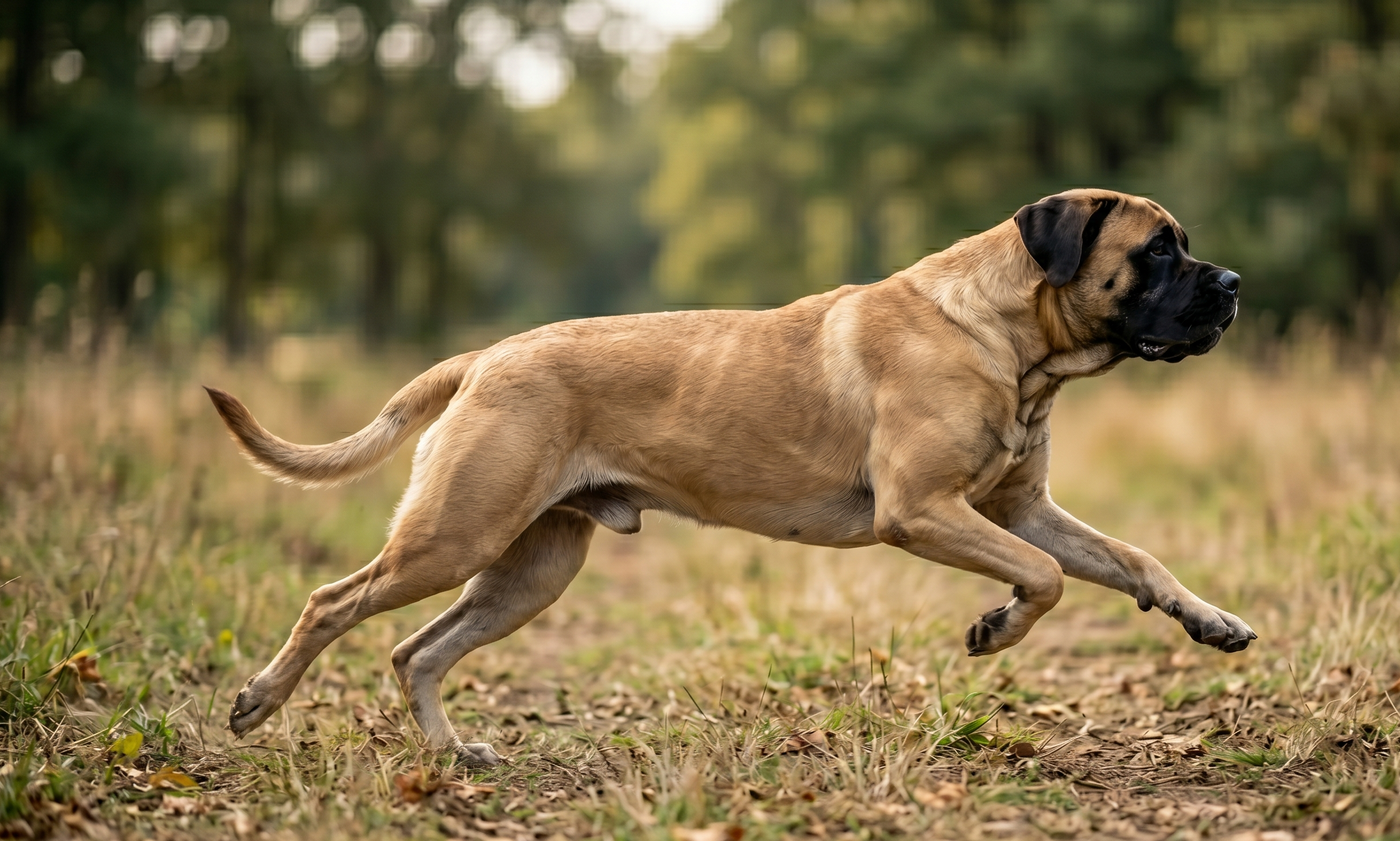
The Mastiff is defined by mass and balance. Adult males commonly stand at least 30 inches at the shoulder, while females commonly stand at least 27.5 inches. Weight varies substantially, but mature adults often fall in the 120 to 230 pound range, with some individuals exceeding that. The overall impression should be rectangular, massive, and powerful without losing soundness.
The head is one of the breed's defining features: broad skull, short muzzle, dark mask, pronounced stop, pendant ears, and a thoughtful, steady expression. The coat is short and close-fitting. Common colors include fawn, apricot, and brindle, all with the characteristic black mask around the muzzle, nose, and eyes.
Unlike the Great Dane, whose silhouette emphasizes height, elegance, and long stride, the Mastiff emphasizes weight, depth, and grounded power. The breed can run with surprising force, but its body is not designed for sustained distance. In recovery terms, that matters: a Mastiff may bolt, but it usually does not range the way a hound, herder, or sighthound might.
Temperament
The Mastiff temperament is best understood as quiet authority. Well-socialized Mastiffs are typically affectionate with family, patient indoors, and reserved rather than frantic around unfamiliar people. They are often deeply bonded to their household, but they show that bond through presence, leaning, watching, and calm proximity rather than constant activity.
Historically, Mastiffs were expected to think before acting. A traditional guardian did not need to bark at every sound or chase every movement. The breed's job was to remain steady, read the situation, and use its enormous physical presence as the first line of protection. That measured response remains part of the modern breed's behavioral signature.
TailTracker models the Mastiff as home-bonded, pressure-sensitive, physically powerful, and behaviorally conservative. This is not usually a dog that wants to explore the horizon. When loose, most Mastiffs are trying to resolve stress: find home, find a familiar person, find shade, find cover, or stop moving.
Living With This Breed
Living with a Mastiff requires planning for size. Doorways, vehicles, stairs, slippery flooring, bedding, veterinary care, food storage, and basic training all become giant-breed considerations. A Mastiff does not need extreme exercise, but it does need steady routines, safe traction, weight control, and gentle leadership.
Training should begin early, while the puppy is still physically manageable. Polite leash walking, calm door behavior, recall, and controlled greetings are not optional with a dog that may eventually outweigh many adults. The best approach is consistent, reward-based, and calm. Harsh handling is especially unwise because the breed can be emotionally sensitive despite its intimidating appearance.
- Extremely large and strong; early manners and leash training are essential.
- Moderate exercise needs; most adults prefer steady walks and rest over intense athletic work.
- Heat sensitivity is important because of mass, short muzzle structure, and limited endurance.
- Often deeply attached to household members and routines.
- May be reserved with strangers without being indiscriminately aggressive.
- Drool management, large bedding, and vehicle access are practical daily realities.
Grooming and Health
The Mastiff's short coat is easy to maintain with weekly brushing, but grooming is not the main challenge of ownership. The larger considerations are drool, skin folds, ears, nails, weight, and orthopedic health. Heavy jowls mean drooling is normal, especially after drinking, eating, exercising, or becoming excited.
As a giant breed, the Mastiff has meaningful health considerations. Common concerns include hip and elbow dysplasia, arthritis, cruciate ligament injuries, entropion, heart disease, bloat, and obesity-related joint stress. Maintaining a lean, well-conditioned body is one of the most important ways to protect long-term comfort and mobility.
For recovery planning, the most field-relevant health issues are heat, fatigue, and mobility. A missing Mastiff in warm weather can become overheated quickly, and a dog with orthopedic discomfort may travel less than expected before lying down. Search strategy should account for this by prioritizing nearby shade, structure, water access, and low-visibility resting spots.
Fun Facts
- Ancient guardian type: Mastiff-type dogs appear in records and artwork dating back thousands of years, making them one of the oldest recognizable dog forms.
- Not just one breed name: The word "mastiff" is also used broadly for a family of large guardian and molosser-type breeds, but the English Mastiff is the breed most commonly meant by "Mastiff" in the United States.
- The black mask matters: The dark muzzle and face are part of the classic Mastiff look and help give the breed its solemn, watchful expression.
- Famous for leaning: Many Mastiffs show affection by leaning their full body weight against a trusted person.
- Record-setting mass: A Mastiff named Zorba became one of the most famous giant dogs in modern breed history because of his extraordinary size.
- Quiet intimidation: The breed's traditional guarding style relies more on presence and steadiness than constant barking or frantic reaction.
Famous Examples
- Zorba — One of the most famous Mastiffs in modern history, remembered for extraordinary size and record-book recognition.
- Hercules, "The Beast" — The English Mastiff from The Sandlot, remembered as a frightening backyard legend who turns out to be a gentle giant.
- Mudge — The beloved Mastiff from Cynthia Rylant's Henry and Mudge children's books, representing the patient family-companion side of the breed.
- Lyme Hall Mastiff lore — The battlefield story connected to Sir Peers Legh remains one of the best-known pieces of Mastiff breed legend.
TailTracker Recovery Insight
The Mastiff fits a distinctive recovery profile: short-distance displacement, rapid energy conservation, and quiet shelter-seeking. This is not a scent-hound pattern, where the dog follows odor corridors for miles. It is not a herding-breed pattern, where movement may loop back through familiar routes. A missing Mastiff is usually reacting to a trigger, then attempting to reduce exposure.
The behavioral sequence TailTracker models for this breed is: trigger → powerful short burst → deceleration → shade or structure → silent hold. The dog may cover ground quickly in the first minutes, but the combination of size, heat load, joint stress, and temperament usually pushes the Mastiff toward stillness sooner than many owners expect.
This creates the Mastiff recovery paradox. A Mastiff is enormous and should be easy to see — but when a frightened Mastiff lies behind a shed, under a deck, in a barn corner, in tall brush, or along a shaded property edge, the dog can be astonishingly hard to spot. Owners should not assume that silence means the dog has moved on. A scared Mastiff may remain quiet even when familiar voices are nearby.
If This Breed Goes Missing
Start close and search physically. A missing Mastiff is often much nearer than the size of the dog makes people imagine. Begin with the immediate neighborhood, shaded structures, property edges, and places where a massive dog could lie down out of view.
- Lock down the close radius first. Prioritize the first half-mile to two-mile zone before assuming long-distance travel.
- Check large shelter spaces carefully. Garages, barns, sheds, porches, decks, brush lines, drainage areas, and shaded fence corners are high-value locations.
- Use calm owner presence. A bonded family member speaking quietly from a seated or stationary position is often more effective than a moving search party.
- Do not chase. A pursued Mastiff may retreat deeper into cover or shift from watchful hiding into renewed flight.
- Watch heat and water access. In warm weather, search shaded and damp areas early. Heat stress can become urgent in giant breeds.
- Ask neighbors to inspect their own property. A Mastiff may be behind a garage, under a deck, or inside an open outbuilding where public searchers cannot see.
- Use ground-level visual checks. Look under, behind, and into spaces rather than only scanning roads from a car.
The early goal is not to widen the search as fast as possible. The early goal is to prevent the dog from being missed close by while energy, heat, and fear push the Mastiff into silent shelter.
FAQs
Are Mastiffs good family dogs?
Many Mastiffs are excellent family companions when well-bred, well-socialized, and trained early. Their size requires responsible handling, but their typical temperament is calm, loyal, and affectionate with family.
Do Mastiffs need a lot of exercise?
Most adult Mastiffs need moderate daily exercise rather than intense athletic work. Steady walks, controlled yard time, and weight management are usually more appropriate than high-impact activity.
How far will a missing Mastiff usually travel?
Many missing Mastiffs remain relatively close to the escape point, especially once the first stress burst ends. Search close shelter spaces thoroughly before expanding outward.
Will a Mastiff come when called if frightened?
Not always. A stressed Mastiff may recognize a familiar voice but remain silent and still. Calm owner presence, food, scent items, and patient observation are often more effective than repeated calling.
Are Mastiffs sensitive despite their size?
Yes. Many Mastiffs are emotionally sensitive and respond best to calm, consistent handling. Loud, frantic, or forceful recovery attempts can increase avoidance behavior.
Related Breeds
Compare the Mastiff with other large guardian and giant companion breeds whose missing-dog behavior may look similar at first glance but differs in important ways.
Build a breed-informed recovery plan before your dog ever goes missing.
TailTracker helps pet families prepare smarter with breed-aware recovery guidance, coordinated alerts, and a faster path from panic to action.
Most lost-pet tools broadcast alerts.
TailTracker coordinates the recovery.