Catahoula Leopard Dog
Breed Guide
Rugged, intelligent, and unmistakably American, the Catahoula Leopard Dog is Louisiana’s native working dog — a powerful stock, bay, and hunting breed shaped by swamps, forests, cattle, and feral hogs. Its striking coat and glass eyes may catch attention first, but the real story is the breed’s independence, terrain confidence, and control-oriented working style.
7 min read · Premium breed intelligence with recovery-focused field guidance
Overview
The Catahoula Leopard Dog is a striking, rugged breed with a history as colorful as its coat. Often described as one of America’s great working dogs, it was developed to control livestock, bay feral hogs, tree game, guard property, and make independent decisions in difficult terrain.
Catahoulas are not casual ornament dogs. They are functional, intelligent, athletic animals with strong instincts and a serious need for purpose. Their leopard-patterned coats, glass eyes, and webbed feet are visually memorable, but their defining trait is working judgment: the ability to assess, move, contain, and persist.
TailTracker classifies the Catahoula as a control-oriented working dog. When missing, a dog of this breed may travel with purpose, follow terrain features, investigate animal movement, or hold position near environmental stimuli rather than simply returning when called.
Breed History
The Catahoula Leopard Dog is widely associated with Louisiana and is recognized as the state’s native dog. Its name is commonly linked to a Choctaw word often translated as “sacred lake,” tying the breed to the Catahoula region and the working culture of the American South.
Its ancestry is best understood as a practical blend rather than a tidy show-ring origin story. Native American dogs, Spanish war and stock dogs, scent hounds, sighthound influence, and later European herding dogs such as the Beauceron are often cited as part of the larger genetic and functional background that shaped the breed.
By the time the Catahoula’s reputation solidified, its value was clear: this was a dog that could manage unruly cattle, confront feral hogs, navigate wetlands and woods, and work without constant instruction. In 1979, the Catahoula Leopard Dog was officially named the State Dog of Louisiana, reflecting its deep regional significance.
Physical Characteristics
The Catahoula is medium-to-large, muscular, and athletic, with a body built for endurance and agility rather than bulk alone. Its structure supports long hours of field work, sudden bursts of speed, and confident travel over muddy, wooded, uneven, or wet ground.
Coat variation is one of the breed’s signatures. Catahoulas may appear in leopard or merle patterns, brindle, patched, or solid colors. Eye color is equally distinctive: blue “glass eyes,” amber eyes, brown eyes, heterochromia, and “cracked” eyes with multiple colors in one iris are all part of the breed’s visual identity.
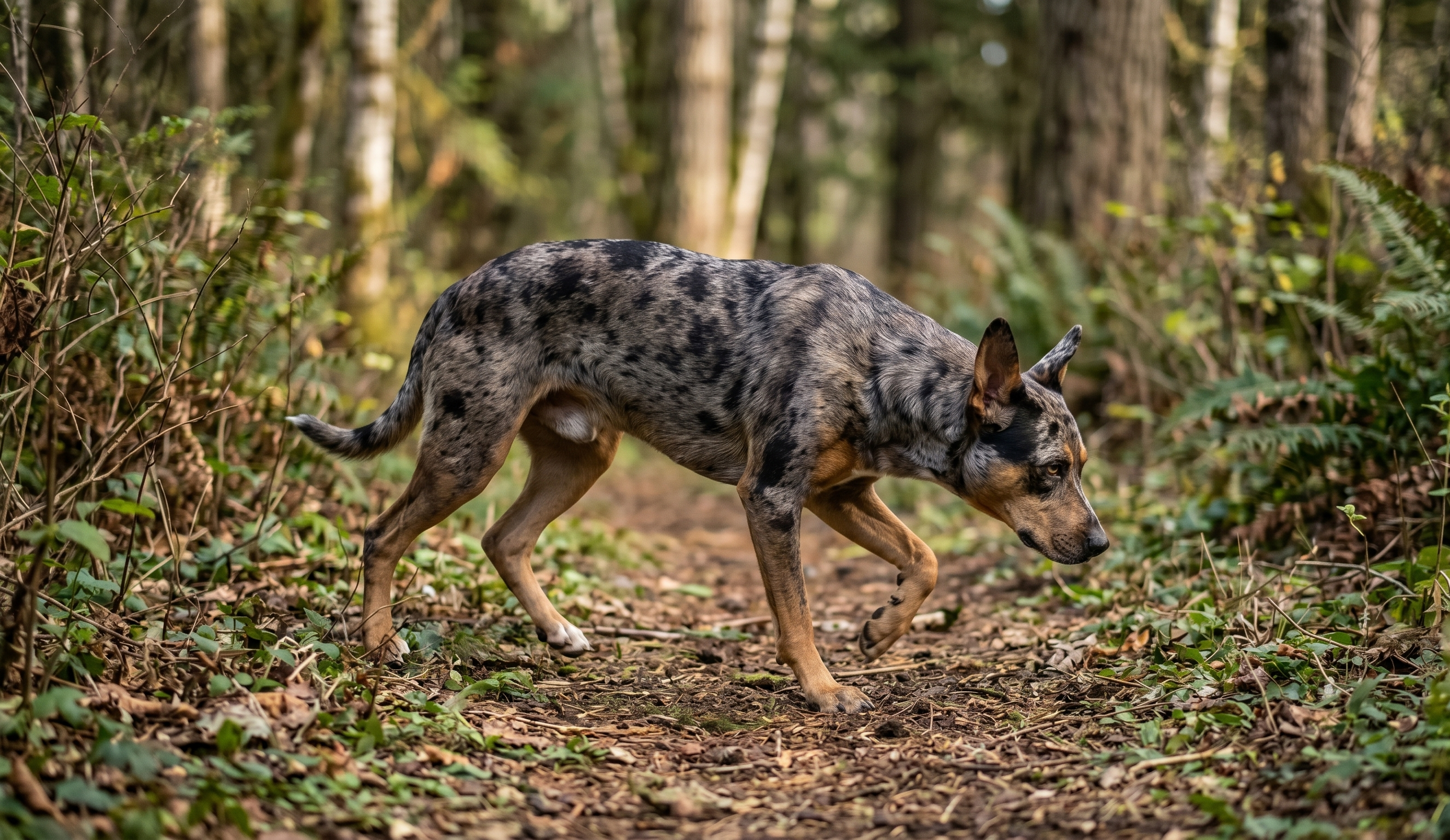
Prominent webbing between the toes gives the breed a practical advantage in marshy or muddy environments. This foot structure supports swimming, traction, and stability, helping explain why Catahoulas are so comfortable in places where many companion breeds would slow down.
Temperament
Catahoulas are intelligent, independent, and deeply loyal to their primary people. They can be affectionate at home, but they often remain watchful, reserved with strangers, and highly aware of their surroundings. This is a breed that notices movement, evaluates pressure, and remembers patterns.
Their independence is not stubbornness for its own sake. It is part of the breed’s working design. A Catahoula expected to bay hogs, manage cattle, or hold game at a tree could not wait passively for instructions. It had to make decisions, use its body, use its voice, and adapt to the situation.
The same traits that make the breed impressive also make it demanding. Without structured activity, clear boundaries, socialization, and meaningful work, the Catahoula can become restless, frustrated, noisy, or difficult to manage.
Living With This Breed
The Catahoula Leopard Dog is best suited to active, experienced owners who understand working-dog behavior. Rural homes, large properties, structured sport, tracking, scent games, farm work, and advanced obedience can all help give the breed a constructive outlet.
In the right home, the Catahoula can be loyal, funny, protective, and impressive. In the wrong home, it can feel like too much dog: too much energy, too much independence, too much suspicion, and too much problem-solving ability without a job.
Early socialization matters. A well-managed Catahoula learns how to read people, dogs, livestock, vehicles, and unfamiliar environments without overreacting. A poorly managed one may become overly territorial, reactive, or difficult to recover if it ever escapes.
Grooming and Health
Most Catahoulas have short, practical coats that are easy to maintain. Regular brushing, nail care, ear checks, and skin inspection are usually enough for routine grooming, especially after time in brush, mud, water, or rough vegetation.
Health considerations include joint stress from high activity, ear issues in some lines, and deafness risk associated with heavy white or double-merle genetics. A hearing-impaired Catahoula needs especially careful management because voice recall, sound-based alerts, and normal calling strategies may be unreliable.
For recovery planning, hearing status is not a small detail. A missing dog that cannot hear well may ignore calls not because it is avoiding the owner, but because sound is not reaching or orienting it in the expected way.
Fun Facts
- Louisiana icon: The Catahoula Leopard Dog is closely tied to Louisiana’s landscape, livestock culture, and regional identity.
- Glass eyes: Pale blue eyes, mixed-color eyes, and cracked eyes are among the breed’s most recognizable traits.
- Webbed feet: The breed’s feet help it move through mud, water, and swampy ground with unusual confidence.
- Canine wall: Catahoulas often work by baying and containing animals rather than simply chasing or nipping them.
- Treeing ability: Some Catahoulas can tree game and hold attention on a target until the handler arrives.
Famous Examples
The Catahoula has a strong place in Louisiana lore and Southern working-dog culture. Stories connect the breed with frontier figures such as Jim Bowie, and Theodore Roosevelt is often associated with Catahoulas in hunting contexts.
The breed has also appeared in search-and-rescue conversations because of its agility, scenting ability, and willingness to work difficult terrain. Its public image remains rooted in practical performance: a dog of the woods, bayous, stockyards, and hunting camps rather than a polished parlor breed.
TailTracker Recovery Insight
The Catahoula’s missing-dog profile is shaped by independence, terrain confidence, prey and stock-control instincts, and a strong tendency to make its own decisions under pressure. This breed may move through difficult ground with ease and may not remain near the point of escape if environmental stimuli draw it onward.
Unlike a companion breed that may seek people quickly, or a scent hound that may commit to one odor trail, the Catahoula may behave like a working problem-solver. It may investigate movement, hold near livestock or wildlife, follow field edges, cut through brush, or pause in cover while observing activity from a distance.
The most important recovery insight is that pressure can expand the problem. Crowds, chasing, repeated calling, and unfamiliar people approaching directly may encourage a missing Catahoula to keep moving or hold farther away. Calm patterning, credible sightings, owner scent, food stations, and quiet containment are better aligned with the breed’s working mind.
When a Dog of This Breed Is Missing
When a Catahoula Leopard Dog is missing, the search should account for purposeful movement through cover, not just neighborhood wandering. This breed often favors natural corridors: wooded trails, field edges, drainage routes, farm roads, fence lines, and low-traffic rural lanes.
Because Catahoulas can be wary of strangers, direct pursuit is rarely helpful. A missing dog of this breed may see or hear people before people see it, then shift away quietly. A familiar owner’s scent, vehicle, calm presence, and controlled feeding location can become more effective than a large visible search group.
If the dog has a known history of working livestock, chasing wildlife, climbing, swimming, or ignoring recall under stimulation, those details should shape the search plan immediately. The search radius may need to expand into terrain corridors early, while close-range cameras and scent anchors monitor likely return loops.
FAQs
Is the Catahoula Leopard Dog a good breed for first-time owners?
Usually not. Some first-time owners succeed with excellent guidance, but the breed’s independence, energy, strength, and working instincts make it better suited to experienced dog owners.
Why is the Catahoula important for TailTracker recovery modeling?
It represents a control-oriented working profile: independent, terrain-capable, highly alert, and comfortable making decisions. That creates a different recovery pattern than companion dogs, scent hounds, or simple escape runners.
Are Catahoulas easy to identify if missing?
Often, yes. Coat pattern, eye color, build, and markings can be distinctive. However, merle and patchwork coats may also blend into brush, shadow, and wooded environments, so clear photos remain important.
Prepare before an emergency.
TailTracker helps owners understand how breed instincts influence missing-dog behavior, from close-range hiding to long-distance movement through terrain.
A prepared profile gives owners a faster starting point if their dog ever goes missing — with better photos, stronger identification, and breed-informed recovery guidance ready to use.