Strategy
Behavior-informed guidance helps determine how the pet may respond under stress, where attention should begin, and how the plan should change when new sightings or conditions emerge.
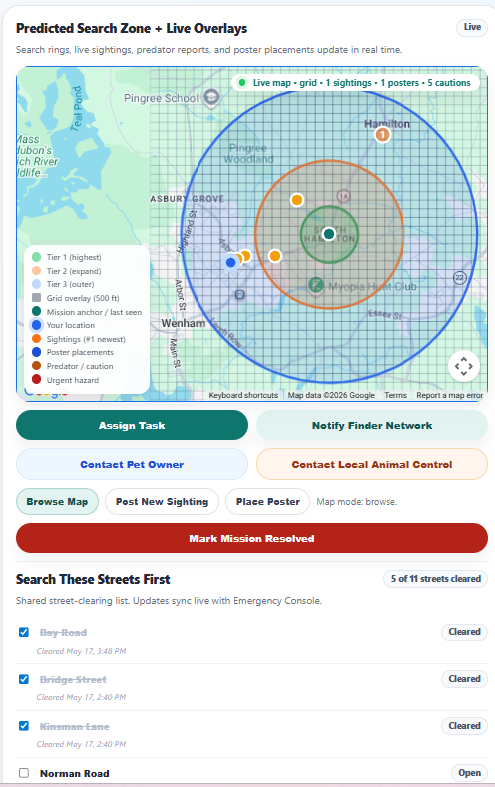
Microchips identify. GPS devices track. Cameras detect. Alerts spread the word. TailTracker coordinates the recovery response by bringing search guidance, sightings, maps, posters, and community action into one structured mission.
A lost pet recovery system organizes the information, people, and actions needed to find a missing pet. It is not a single device, database, or alert.
Microchips, GPS collars, cameras, ID tags, lost-pet databases, shelters, and social networks can all contribute essential information. A coordinated recovery system brings those inputs together and turns them into organized action.
Behavior-informed guidance helps determine how the pet may respond under stress, where attention should begin, and how the plan should change when new sightings or conditions emerge.
Shared information, defined roles, mapped activity, and structured updates help families, Finders, partners, and community members work from the same recovery mission.
TailTracker is designed to complement the tools pet owners and recovery partners already use. The difference is what happens after a signal, alert, or report is received.
| Tool or resource | Primary contribution | What still needs to happen |
|---|---|---|
| Microchip | Connects a scanned identification number to registration information. | The pet must first be located, safely contained, and brought to someone with a compatible scanner. |
| GPS collar | Supplies location signals while the device is attached, powered, and connected. | People must interpret the signal, approach safely, and coordinate the response around changing locations. |
| Camera or door sensor | Detects an escape or captures a possible sighting. | The information must be reviewed, mapped, shared with the right people, and converted into next actions. |
| Lost-pet database | Publishes reports and helps match lost and found animals. | Search activity, sightings, responders, and follow-up decisions may still need operational coordination. |
| Social network | Spreads awareness quickly across a community. | Comments, leads, volunteers, and repeated posts must be organized so useful information is not lost. |
| TailTracker | Coordinates recovery strategy, sightings, maps, posters, responders, and mission updates. | Brings the contributing tools and people together within one structured recovery mission. |
Detect → Track → Identify → Coordinate. TailTracker occupies the coordination layer.
Recovery is a sequence. Each stage should make the next stage more focused, safer, and easier to manage.
Capture the pet, last-seen location, time missing, escape circumstances, and immediate hazards in one operational record.
Use species, breed information, temperament, escape context, environment, and available signals to establish where attention should begin.
Bring family, trusted contacts, trained Finders, shelters, rescues, pet-care providers, and municipal partners into appropriate roles.
Gather time, location, notes, and optional photos so the mission team can distinguish uncertain reports from actionable leads.
Update search areas, poster locations, assignments, monitoring, and containment strategy as new information arrives.
Help the recovery team move from a credible location to a safe approach, containment, identification, and reunification when possible.
TailTracker organizes information from multiple sources without requiring every tool, person, or organization to work the same way.
The technology should make the recovery operation easier to understand—not add another disconnected tool to manage.
Predictive analytics based on breed info, temperament, escape circumstances, and available context help establish an initial recovery strategy. The guidance is a starting point, not a certainty.
Keep last-seen information, search areas, sightings, poster locations, hazards, resources, and operational activity connected to the same mission.
Create high-visibility printable and digital alerts with a public reporting path that does not require publishing a family’s personal contact information.
Turn community goodwill into safer participation with clear roles, do-not-chase guidance, mission access controls, and shared information.
Collect location, time, observations, and optional photos while helping the mission team evaluate duplicate, uncertain, and higher-confidence reports.
Support owners and authorized recovery leaders in interpreting information, coordinating actions, sustaining longer-running cases, and escalating the response when appropriate.
A person who sees a missing pet should be able to submit useful information quickly. They do not need access to the family’s private contact details, internal notes, mission members, or full operational plan.
A scent-driven dog, a frightened newly adopted dog, and an indoor cat displaced outdoors may respond very differently. One generic search radius cannot account for every behavior.
TailTracker uses predictive analytics based on breed info together with temperament, circumstances, environment, and incoming sightings to help establish an initial approach. Real-world observations and human judgment remain essential throughout the mission.
This example illustrates the flow of information and action. It is not a claim about a specific recovery outcome.
Instead of starting with disconnected posts, calls, and screenshots, Maple’s family activates one recovery mission that can organize each next step.
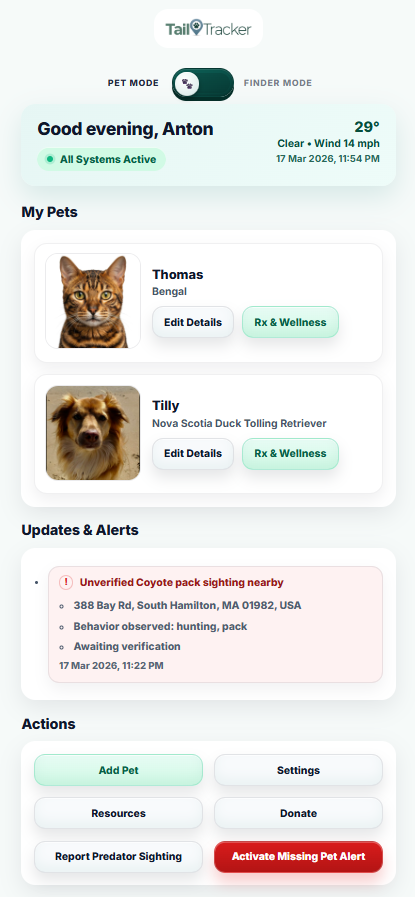
A current pet profile reduces the number of decisions a family must make while stressed and creates better information for posters, search guidance, reporting, and partner coordination.
TailTracker is designed for pet families and the wider network of people and organizations that may contribute before, during, and after a missing-pet event.
Prepare pet information, activate the mission, provide essential context, and remain central to recovery decisions.
Support active missions through safe sighting reports, assigned activities, information sharing, and do-not-chase protocols.
Join the Finder Network →Maintain current animal information through intake, placement, and adoption while supporting identification and recovery coordination.
Explore the partner platform →Contribute local knowledge, intake information, animal-handling expertise, and municipal coordination when appropriate.
Strengthen preparedness through trusted education, current identification information, and local resource guidance.
Dog walkers, sitters, groomers, daycares, and boarding facilities can preserve emergency-ready information for pets temporarily in their care.
Core to our mission is providing TailTracker’s recovery platform, tools, and coordinated recovery missions at no cost to pet families, shelters, rescues, and foster organizations.
Public alerts and sighting paths are structured to avoid unnecessary disclosure of private contact and mission information.
TailTracker can be reached through a compatible web browser without relying on an app-store download during an emergency.
Recovery outcomes depend on the pet, environment, timing, available information, and conditions on the ground.
Add current photos, identifying details, behavior information, and trusted contacts now so the information needed for recovery is already in place.
Register My Pet FreeUse local predator awareness, weather risks, and escape-risk alerts to support safer walks and hikes—and prepare your home before fireworks, storms, or sudden neighborhood noise.
Explore Pet Safety RadarNo. A microchip registry connects a scanned identification number to registration information after a pet is found. A lost pet recovery system helps organize the active search, public reporting, sightings, responders, and next actions that may lead to safe recovery.
No. TailTracker is the coordination layer. It is designed to work alongside GPS devices, smart collars, cameras, microchips, ID tags, databases, and neighborhood alert tools.
Begin by recording the last confirmed location and time, checking the immediate property and likely exit points, notifying appropriate household contacts, and starting a structured recovery mission. Avoid encouraging uncoordinated chasing, especially when a pet is frightened or in flight mode.
Yes. Preparedness makes activation faster, but you can still begin by creating the pet record and adding the information needed for the active recovery mission.
TailTracker uses predictive analytics based on breed info together with species, temperament, escape context, environment, and incoming sightings. This guidance establishes a starting point and should be adjusted as real-world information develops.
Public sighting intake is designed to let community members submit useful observations without needing access to the private mission. Mission participants can then review the report and determine how it should affect the recovery plan.
TailTracker uses public-safe mission information and reporting paths so a family does not need to publish personal contact details on every poster or community post. Private mission information remains separate from the public reporting experience.
The mission can continue into extended recovery, preserving sightings, poster locations, monitoring activity, assignments, and strategy after the initial wave of public attention declines. Longer-running cases may require different search, monitoring, or containment approaches.
TailTracker is designed to support missing-pet recovery across pet types. Recovery guidance should reflect species, individual behavior, environment, and the circumstances of the disappearance.
Yes. TailTracker’s recovery platform, core tools, and coordinated recovery missions are provided at no cost to pet families, shelters, rescues, and foster organizations.
No responsible recovery system can guarantee an outcome. TailTracker is designed to reduce fragmentation, preserve useful information, guide next actions, and help people coordinate a more organized response.
Reviewed by TailTracker on . TailTracker provides recovery coordination and educational guidance; it does not replace veterinary care, animal control, law enforcement, or emergency services.